Plate Nº 73 · recorded November 10, 2026
PhysicsReported finding
Gravity Can Break and Reconnect Like Magnetic Fields, Physicists Calculate
Physicists show Einstein's equations allow gravitational fields to break and reconnect like magnetic fields on the Sun — a theoretical first with astrophysical implications.
By Nathan Brooks4 min read814 words
In brief
- Luca Comisso and Felipe A. Asenjo derived gravitational reconnection from Einstein's equations, published in Physical Review D.
- The work builds on an earlier paper co-authored with Maricarmen A. Winkler of Adolfo Ibáñez University.
- Gravitational reconnection has not yet been observed in nature — it remains a theoretical result.
- Gravitational waves from black hole mergers shift LIGO's 4-kilometer arms by less than a proton's width.
- A possible signature in LIGO-Virgo-KAGRA data could follow from future numerical simulations.
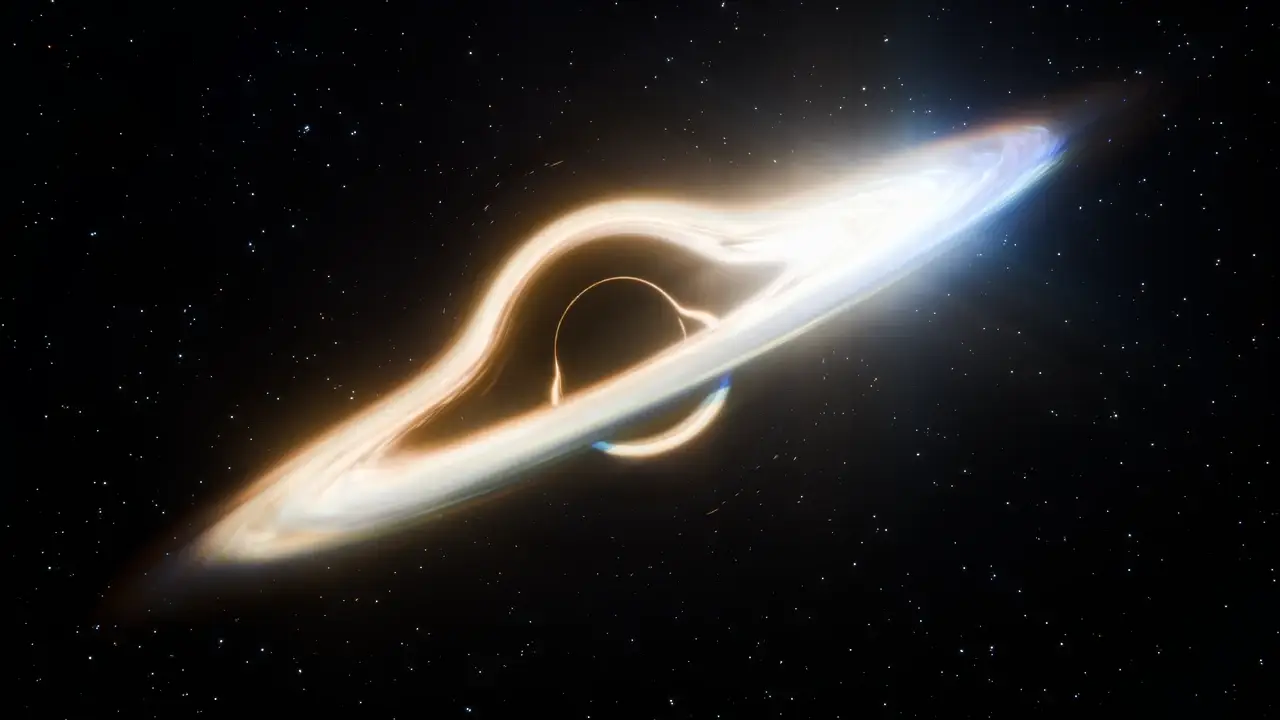
Gravity's field can break apart and reconnect in new configurations, much like magnetic fields on the Sun — according to new calculations published in Physical Review D by physicists Luca Comisso of Columbia University and Felipe A. Asenjo of Adolfo Ibáñez University in Chile.
The process, which the researchers call gravitational reconnection, emerges purely from Einstein's theory of general relativity, more than a century after that theory first appeared. "We are not modifying general relativity or introducing new physics beyond it," Comisso told ScienceAlert. "Rather, we are identifying physical principles that have remained unrecognized for more than a century."
What exactly did the researchers find?
In everyday life, gravity feels like simple attraction. Relativity describes it differently: as a field — the curvature of spacetime caused by mass and energy, shaping how matter and light move. Those equations have passed test after test, predicting everything from the bending of starlight to the gravitational waves from colliding black holes.
Other fields in the Universe behave in striking ways. The Sun's magnetic fields thread through its charged plasma in tangled strands that can snap and rearrange — a process called magnetic reconnection — releasing the energy that powers solar flares.
Comisso and Asenjo have now shown mathematically that gravity may do something analogous. Their starting point was an earlier paper, published with a third co-author, Maricarmen A. Winkler of Adolfo Ibáñez University. That work showed that under certain conditions, gravitational fields behave as though their connections are frozen in place, preserving links between regions even as spacetime evolves — mirroring how magnetic field lines stay connected in flowing plasma.
The natural follow-up question: when those preserving conditions break down, do gravitational connections rearrange, too? The researchers returned to Einstein's equations, using a formulation that highlights the mathematical resemblance between gravity and electromagnetism, and found that the fields can indeed reconnect in new configurations.
"We had suspected that gravity might share some properties with magnetic fields, since it has long been known that Einstein's equations can be rewritten in forms that resemble the equations of electromagnetism," Comisso explained. "However, we did not know how far this analogy would extend. It was only after working through the analytical calculations, step by step at the blackboard, that we realized just how closely gravitational fields could follow the same principles that govern magnetic fields in plasmas."
Does this mean spacetime tears?
No — and the distinction matters. In gravity's case, the relevant structures aren't lines in three-dimensional space but sheets in four-dimensional spacetime: three of space plus one of time.
"Like magnetic field lines, these sheets are not physical objects, but mathematical structures that help us visualize the gravitational field," Comisso explained. "As spacetime evolves, these sheets can stretch, bend, and, under certain conditions, break and reconnect in a new arrangement."
He added: "This does not mean that spacetime itself tears apart, but rather that the gravitational field changes how different regions of spacetime are connected."
Why it matters, even if we can't feel it
If gravitational reconnection happens in the Universe, its effects would likely be imperceptible. For scale: gravitational waves from colliding black holes — among the most violent events the cosmos can produce — change the length of LIGO's 4-kilometer detector arms by less than the width of a proton.
The significance lies in explanation, not observation. Supercomputers can already simulate spacetime during black hole mergers or core-collapse supernovae, but simulating evolution doesn't reveal the underlying mechanisms driving energy transfer. Solar physics offers the precedent: researchers can simulate solar plasma, yet naming magnetic reconnection as the energy-release mechanism gave them real understanding of what's happening and why.
"What I find particularly remarkable is that these principles give us a new way to understand the complex dynamics of spacetime in relatively simple physical terms," Comisso said. "Just as magnetic reconnection has transformed our understanding of how magnetic energy is released in plasmas, gravitational reconnection could provide a similarly powerful framework for understanding how gravitational fields evolve and exchange energy and momentum with matter."
What comes next?
For now, gravitational reconnection is a theoretical possibility, not an observed phenomenon. The researchers think it could occur in settings such as merging black holes or collapsing stars, and numerical simulations could pin down the conditions under which it unfolds.
One tantalizing prospect: the process might leave a distinctive signature in gravitational waves from colliding black holes. If simulations confirm that, researchers would know what to hunt for in data from LIGO, Virgo and KAGRA.
"Our work provides the theoretical foundations for gravitational reconnection, but we still need to determine the precise conditions under which it occurs in nature and understand its role in astrophysical phenomena," Comisso said. "For us, this is one of the most exciting questions that our research has opened up, and one we are eager to investigate further."
via sciencealert.com (Source)
More from Nathan Brooks
Show full bio
Market editor covering companies, deals and strategy in general science news at SciBeat.
325 articles
Nearby plates
- Gravity can snap and reconnect like the sun's magnetic field, study finds
- Newton's gravity law passes largest test yet, dark matter gains ground
- Early star collisions may seed supermassive black holes
- Milky Way may have begun as thousands of small galaxies, model shows
- Black Holes of All Sizes Fire Jets at the Same 2% Threshold