Plate Nº 82 · recorded October 10, 2026
Health & Medicine ResearchReported finding
Blood Pressure Enzyme Found to Build Sulfur Rings That Shield Cells
A study in Science reveals that eNOS, an enzyme that regulates blood pressure, also produces eight-atom sulfur rings that cells convert into antioxidants.
By Nathan Brooks3 min read606 words
In brief
- A study published in Science (2026) shows eNOS produces cyclooctasulfur (S₈), a ring of eight sulfur atoms.
- eNOS was previously known only for producing nitric oxide, which regulates blood pressure.
- The team was led by Takaaki Akaike (Tohoku University) and Uladzimir Barayeu (Max Planck Institute for Polymer Research, Mainz).
- Sulfur rings were found in high concentrations in mitochondria and lipid droplets.
- S₈ serves as raw material for hydropersulfides, sulfur compounds that act as antioxidants.
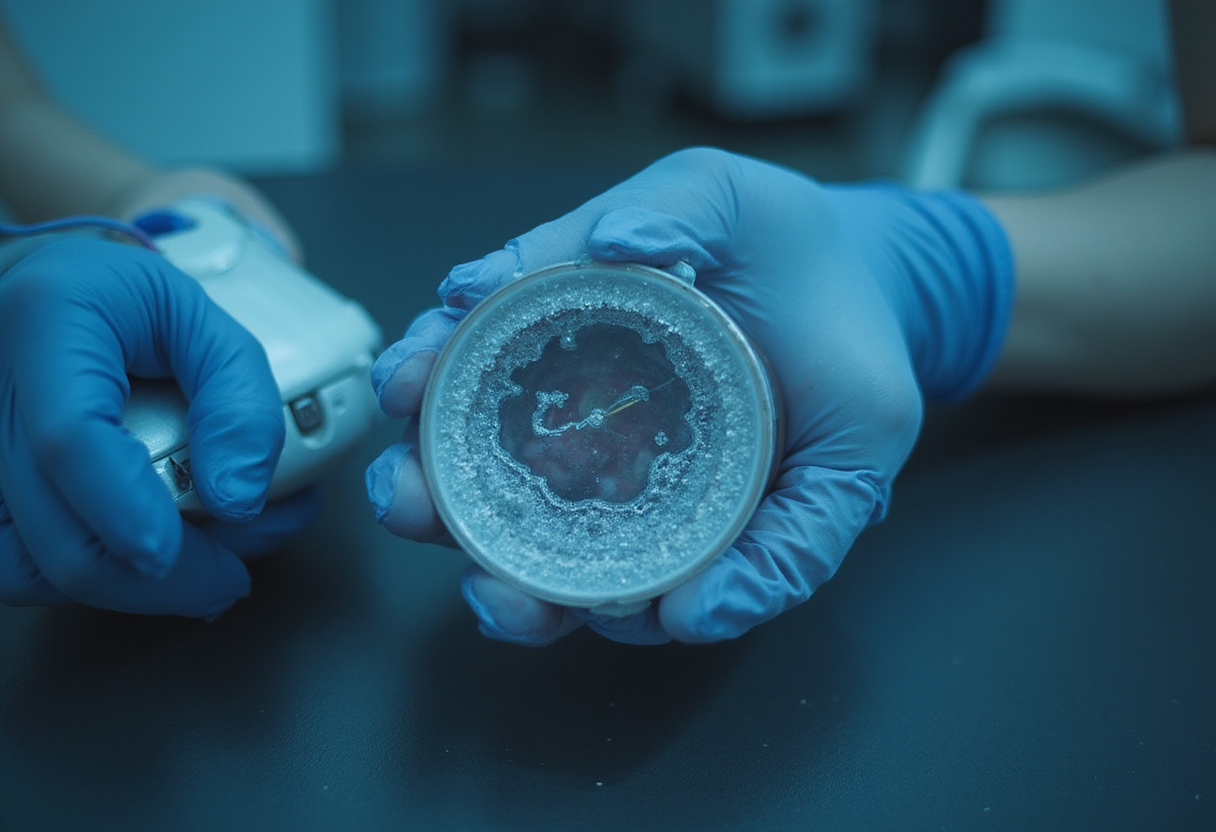
An enzyme best known for regulating blood pressure also builds tiny rings of eight sulfur atoms that help mammalian cells make their own antioxidants, according to a new study published in the journal Science in 2026.
The enzyme, called eNOS, normally produces nitric oxide (NO) — a gas molecule that relaxes blood vessels and keeps blood pressure in check. The international research team, led by Takaaki Akaike, a professor at Tohoku University in Sendai, and Dr. Uladzimir Barayeu, a research group leader at the Max Planck Institute for Polymer Research in Mainz, has now shown for the first time that eNOS has a second job: it manufactures cyclooctasulfur, abbreviated S₈, a molecule made of exactly eight sulfur atoms arranged in a ring.
Why does this matter for cell health?
Antioxidants such as vitamins C and E protect cells by neutralizing free radicals — highly reactive molecules, including so-called reactive oxygen species, that can damage genetic material or cell membranes. This kind of damage can contribute to neurodegenerative diseases, so antioxidants play a key role in preventing cellular harm.
But the body does not rely on diet alone for this protection. It can also synthesize antioxidants internally, with the help of various enzymes. The new findings reveal a previously unknown mechanism in this internal production line.
Here is how the chain works:
- eNOS produces cyclooctasulfur (S₈), which serves as a controlled storage form of elemental sulfur inside cells.
- Through chemical reactions, the body converts this stored S₈ into specialized sulfur compounds called hydropersulfides.
- Hydropersulfides act as antioxidants, neutralizing damaging reactive molecules before they harm the cell.
Where do cells keep their sulfur rings?
The researchers found particularly high concentrations of these sulfur rings in two locations: mitochondria and lipid droplets.
Mitochondria are the oxygen-dependent powerhouses of the cell, converting nutrients into usable energy. Lipid droplets are the cell's fat stores. Both sites are exposed to oxidative stress — mitochondria because they handle oxygen constantly, and lipid droplets because their fats are vulnerable to a damaging process called lipid peroxidation, in which free radicals attack fat molecules.
The study's full title, published as Uladzimir Barayeu et al., Mammals produce cyclo-octasulfur to suppress lipid peroxidation and ferroptosis, Science (2026), points to this protective role. Ferroptosis is a form of cell death driven by lipid peroxidation, and the sulfur-ring system appears to help suppress it.
A biochemical echo from early life?
The findings carry an evolutionary twist. Sulfur was a central component of the metabolism of many early forms of life on Earth. Mitochondria themselves evolved from bacteria, which ancient cells absorbed as internal partners. The presence of S₈ inside mitochondria may therefore reflect a biochemical legacy billions of years old — primordial sulfur chemistry surviving inside modern, oxygen-breathing mammalian cells.
The team states that its results reveal, for the first time, a link between this ancient sulfur chemistry and present-day mammalian biology.
What comes next?
For now, the study offers a new perspective on how cells defend themselves from the inside, rather than depending solely on antioxidants absorbed from food.
In the long term, the researchers suggest, this knowledge could open new avenues for understanding neurodegenerative disorders more fully and eventually treating them more precisely. Those possibilities, however, remain distant. The findings are preliminary in their medical implications, and the authors themselves emphasize that further research will be needed before any of this can be translated into clinical applications.
What is established today is more fundamental: mammalian cells produce and store elemental sulfur in a controlled molecular form, and a blood-pressure enzyme sits at the center of that process. One enzyme, two essential tasks.
via Phys.org Chemistry (Source)
More from Nathan Brooks
Nearby plates
- MSU Team Finds 'Impossible' Cell Survival Pathway Cancer May Exploit
- Mystery Enzyme Identified After 30 Years — and It Shields Healthy Cells
- Harvard review ties oxidized lipids to cancer and chronic inflammation
- High-risk MDS stem cells show 'energy addiction' to NAD molecule
- Eight Common Food Preservatives Linked to Heart Disease Risk