Plate Nº 69 · recorded October 10, 2026
Health & Medicine ResearchReported finding
High-risk MDS stem cells show 'energy addiction' to NAD molecule
A study published October 2026 in Blood Cancer Discovery found that stem cells driving high-risk MDS depend heavily on NAD. Blocking the recycling enzyme NAMPT selectively weakened the cancer cells in patient-derived samples and mouse models.
By Nathan Brooks3 min read623 words
In brief
- The study was published October 2, 2026 in Blood Cancer Discovery.
- An estimated 10,000 to 20,000 people are diagnosed with MDS in the U.S. each year.
- Blocking the NAD-recycling enzyme NAMPT selectively weakened disease-driving MDS stem cells while sparing healthy blood-forming stem cells in patient-derived cells and animal models.
- High-risk MDS can progress to acute myeloid leukemia (AML), an aggressive leukemia that is hard to treat with current therapies.
- The research was co-led by Eric M. Pietras, PhD, and Craig T. Jordan, PhD, at the University of Colorado Anschutz Cancer Center.
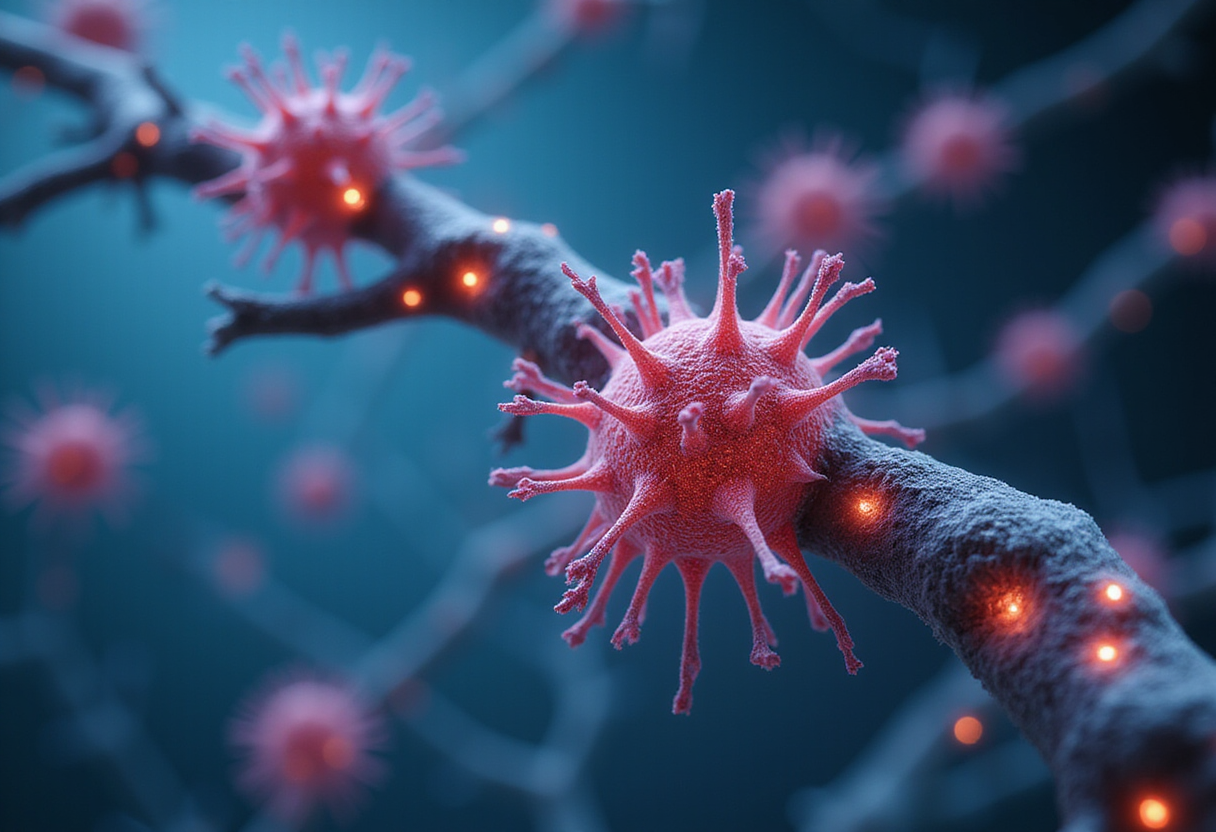
Published October 2, 2026 in Blood Cancer Discovery, the study shows that stem cells driving high-risk MDS depend unusually heavily on NAD — a molecule that helps cells produce energy. Blocking the enzyme that recycles NAD selectively weakened the cancer-driving cells while leaving healthy blood-forming stem cells largely intact.
What did the researchers actually discover?
A team at the University of Colorado Anschutz Cancer Center found that high-risk MDS stem cells lean on the NAD salvage pathway far more than normal blood-forming stem cells do. One enzyme in this pathway, called nicotinamide phosphoribosyltransferase (NAMPT), stood out as the weak link.
The researchers set out to identify biological differences between these cancer stem cells and their healthy counterparts, focusing on metabolism — the chemical processes that keep cells alive.
When they blocked NAMPT, NAD levels fell sharply and the disease-driving stem cells entered what the authors describe as an "energy crisis." Healthy blood-forming stem cells shifted toward other energy sources and survived the treatment.
"They appear to use NAD at a much higher rate than normal cells," said Eric M. Pietras, PhD, associate professor at the University of Colorado Anschutz and co-lead author. "That creates a vulnerability we can exploit with new types of drugs."
Why does the NAD pathway matter?
NAD is a helper molecule that plays a role in hundreds of chemical reactions, including the conversion of nutrients into usable cellular energy. The NAD salvage pathway is the recycling system cells use to maintain their NAD supply. Most cells can produce NAD through several different routes and switch between them when supply runs low.
The new data suggest MDS stem cells have lost that flexibility. They consume NAD faster than normal cells while depending on a single recycling route to keep up — a dependence the authors call an "energy addiction."
How serious is high-risk MDS?
Myelodysplastic syndromes are blood cancers that disrupt the bone marrow's ability to make healthy blood cells. Patients often develop severe anemia, suffer frequent infections, and need repeated transfusions. The condition occurs mainly in older adults, with an estimated 10,000 to 20,000 new U.S. cases diagnosed each year.
High-risk MDS can also progress to acute myeloid leukemia (AML), an aggressive leukemia that remains difficult to treat with current therapies. That risk is what makes finding the cancer-driving stem cells especially urgent.
Could drugs that block NAMPT help patients?
The new findings rest on laboratory experiments using patient-derived MDS cells and mouse models. No patients have yet received NAMPT-blocking drugs in this line of research.
Several compounds that inhibit NAMPT — including the experimental drug FK866 — have already been tested in early clinical trials for other cancers. The Colorado group plans to pursue similar clinical studies in MDS and related blood cancers.
The caveat is real. Cell and animal results do not always translate to human patients, and earlier NAMPT inhibitors have shown dose-limiting toxicities in past trials that could complicate dosing.
What's next?
Co-lead authors Pietras and Craig T. Jordan, PhD, will continue to study NAMPT inhibition in MDS samples and animal models. Sweta B. Patel, PhD, led the laboratory work, with collaborators including Angelo D'Alessandro, PhD, and Julie Reisz Haines, PhD, both at the University of Colorado Anschutz.
"Our goal is to identify approaches that make these complex diseases more treatable by finding the differences between cancer cells and normal cells," Pietras said. "If we can understand those differences, we can begin to develop therapies that are more precise and more effective for patients."
Funding came from the National Institutes of Health, the Edward P. Evans Foundation, and Blood Cancer United, along with other partners supporting blood cancer research.
via dx.doi.org (Original)
More from Nathan Brooks
Nearby plates
- What Happens Within 48 Hours of Losing p53, Cancer's Guardian Gene
- Why a 70-Year-Old Leukemia Drug Still Surprises Scientists
- New Drug CS18 Reverses Cancer Treatment Resistance in Lab Tests
- Drug That Flips Cell 'Energy Saver' Switch Extends Animal Lifespans
- Blood Cells From an 80-Year-Old Rejuvenated to Under 20 in the Lab