Plate Nº 54 · recorded October 13, 2026
Chemistry & MaterialsReported finding
Bulrush waste turned into copper-loaded carbon for dye removal
A Japanese team has turned invasive bulrush weeds into a copper-enhanced carbon composite that removes up to 62.31 mg of dye per gram — at roughly ¥1,800 per kilogram.
By Marcus Bennett3 min read682 words
In brief
- ZVCu@BAC composite achieved methylene blue adsorption capacity of 62.31 mg/g
- Estimated production cost is approximately ¥1,800 per kilogram
- Surface area reached 984.5 m²/g with total pore volume of 0.615 cm³/g
- Retained 90.6% methylene blue and 88.0% methyl orange removal after six regeneration cycles with 0.1 M KOH/acetone eluent
- 20% of toxic, recalcitrant textile wastewater is discharged untreated, per the research team
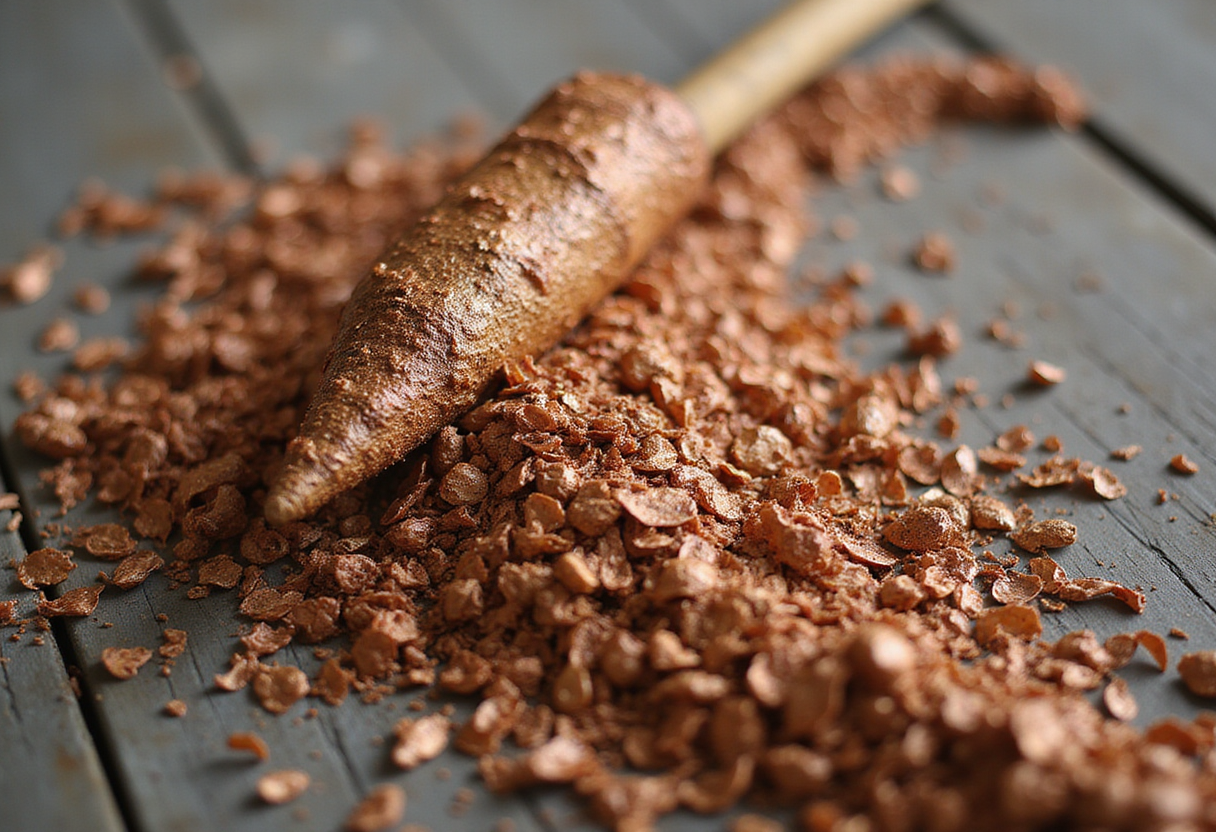
A Japanese team has turned invasive bulrush weeds into a copper-enhanced carbon composite that removes up to 62.31 milligrams of dye per gram of material — at an estimated production cost of around ¥1,800 per kilogram. The work, published in the Journal of Environmental Chemical Engineering, points toward a low-cost route for treating effluent streams loaded with synthetic colourants.
Why does dye-contaminated wastewater need new treatment options?
The motivation sits in untreated effluent. "An alarming 20% of toxic, recalcitrant textile wastewater is discharged untreated, causing severe damage to aquatic life and human health," Asif Ali, a Ph.D. student and MEXT scholar at Doshisha University, told SciBeat. "So far, no single wastewater treatment method is universally suitable."
Conventional routes carry trade-offs:
- Membrane separation demands high energy and frequent maintenance
- Advanced oxidation can generate secondary pollutants
- Commercial activated carbon works well but costs more to produce and regenerate
Bulrush is an invasive aquatic weed that colonises waterways and costs significant sums to remove. Converting it into a treatment feedstock turns a disposal problem into a control solution — and gives water utilities a use for a species they would otherwise have to destroy.
How does the bulrush composite work?
Ali worked with professors Michiaki Matsumoto and Yoshiro Tahara in Doshisha's Department of Applied Chemistry. The team ran a single-step co-pyrolysis. They heated bulrush biomass with copper(II) nitrate trihydrate and potassium hydroxide. The biomass's own volatile emissions — carbon monoxide and hydrogen — reduced the copper precursor into zero-valent copper nanoparticles (Cu⁰).
The result: Cu⁰ anchored uniformly inside a mesoporous carbon support, with no need for a separate chemical reductant.
Key characterisation figures:
- Surface area: 984.5 m²/g
- Total pore volume: 0.615 cm³/g
- Point of zero charge (pHpzc): ≈9.0 — the pH at which the surface carries no net electrical charge
The team confirmed structure and composition with SEM, TEM, EDX mapping, FTIR, BET, XRD and TGA/DTA. Bottom line: one furnace pass yields a structured composite with no secondary reductants.
How well does it perform against different dyes?
The composite is amphoteric — it interacts with both positively and negatively charged species — because of its high pHpzc. In batch tests, ZVCu@BAC adsorbed:
- Methylene blue (cationic): 62.31 mg/g
- Methyl orange (anionic): 56.37 mg/g
- Sunset yellow (anionic): 35.76 mg/g
Equilibrium data fit the Langmuir isotherm, a model assuming uniform monolayer coverage. Kinetics followed pseudo-second-order behaviour, meaning chemisorption — chemical bond formation between dye and surface — drove uptake.
Thermodynamics flagged spontaneous and exothermic adsorption, with both ΔG° and ΔH° negative. Four mechanisms cooperated: electrostatic attraction, π-π stacking (weak interactions between aromatic ring systems), pore filling and coordinate bonding at copper sites. Takeaway: one material handles three dye classes through several pathways working together.
Can the material be reused?
After six regeneration cycles with a 0.1 M KOH/acetone eluent, ZVCu@BAC retained:
- 90.6% of its methylene blue removal efficiency
- 88.0% of its methyl orange removal efficiency
Operators get at least six cycles before performance drops meaningfully — a real lifetime-cost lever for procurement teams.
What does this change downstream?
The headline cost — roughly ¥1,800 per kilogram — sets an early benchmark for scaling decisions. Combined with broad-spectrum dye capture and solvent-based regeneration, the composite fits the profile of a candidate adsorbent for textile, paper, leather and food-processing effluent.
"Our study findings present the opportunity to advance a circular economy: valorizing invasive, zero-cost bulrush weed biomass into a functional carbon framework through an eco-friendly, single-step co-pyrolysis route," Matsumoto told SciBeat.
The work is one laboratory study. Pilot-scale trials, real effluent matrices and long-term stability data lie ahead. For practitioners, the composite slots into existing adsorption columns as a direct substitute for commercial activated carbon — at least on paper. Pilot data on real textile streams, multi-cycle fouling behaviour and printed-cost comparisons at scale still need to land before procurement teams sign off. The team's next move: scale-up trials on mixed-dye industrial effluent.
via Phys.org Chemistry (Source)
More from Marcus Bennett
Show full bio
News editor covering regulation, policy and their impact on general science news at SciBeat.
243 articles
Nearby plates
- Blue Light Kills Every Strain of Chicken Food-Poisoning Bug Tested
- Sulfur-Powered Material Splits Water Into Hydrogen Using Sunlight
- Light-Powered Iron Complex Turns Nitrate Pollution into Usable Fuel
- 3D-Printed Bioreactor Turns Waste Methane Into Chemicals With 10x Efficiency
- One gram of MOF powder pulls half a gram of lead from water