Recorded November 22, 2026
Neuroscience & MindReported finding
Bumblebee Brains Under a Million Neurons Rethink What Intelligence Requires
Bumblebees with under a million neurons plan routes and learn from others. A Science review says their wiring, not brain size, may explain sophisticated insect cognition.
By Priya Raman3 min read635 words
In brief
- Bumblebee brains contain fewer than 1 million neurons, yet show planning and social learning.
- A 2026 perspective in Science by Lars Chittka and Stanley Heinze reviewed prior bumblebee and fruit fly brain studies.
- Bumblebees have about 50 times more memory-forming nerve cells in the mushroom body than fruit flies.
- The authors state bee cognition "may not have required them to evolve entirely new neural algorithms."
- The work is a review of existing research; only a few bee brain regions have been mapped in detail.
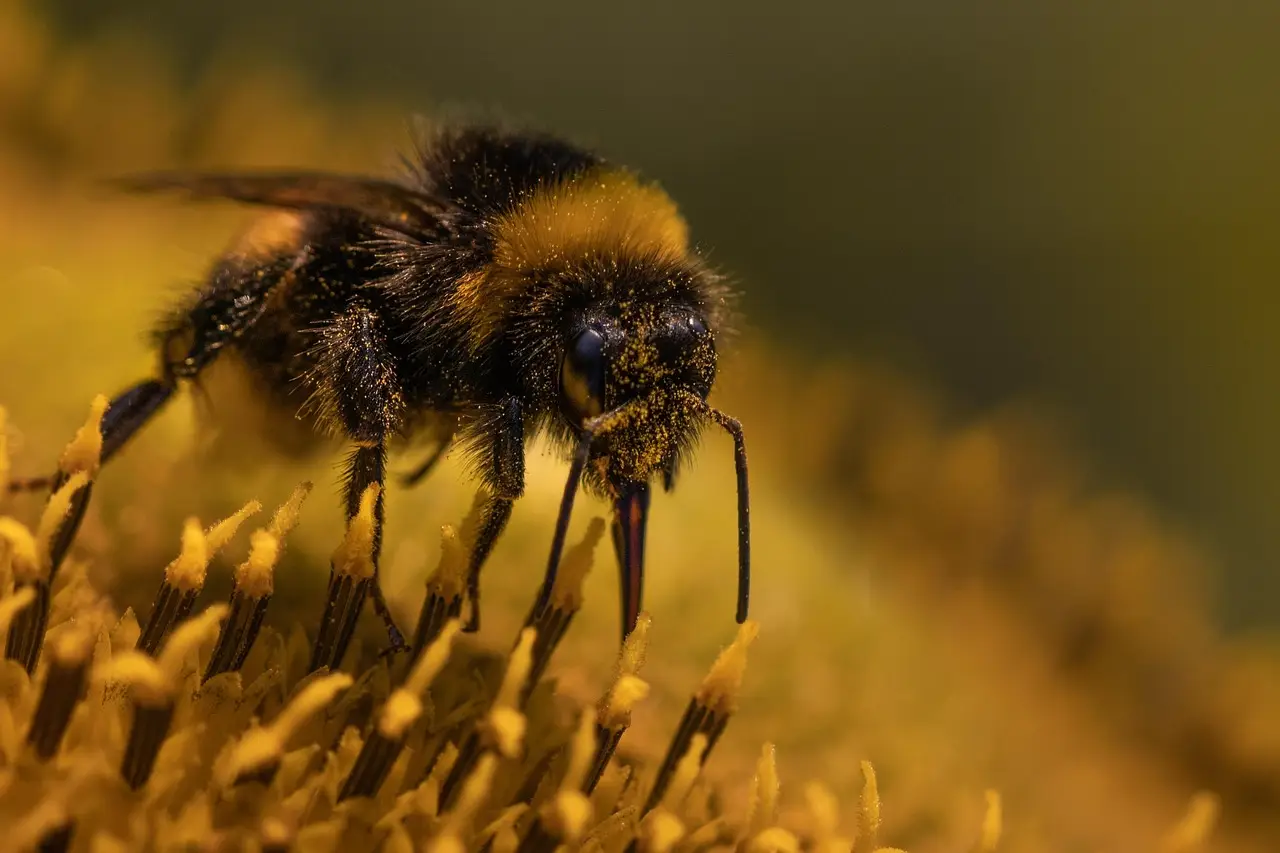
A bumblebee's brain contains fewer than one million neurons — roughly the computing budget of a poppy seed's worth of tissue — yet two neuroscientists argue it can plan routes, weigh options and learn from watching others.
In a perspective published in Science in 2026, Lars Chittka of Queen Mary University of London and Stanley Heinze of Lund University reviewed existing studies rather than running new experiments. Their conclusion challenges a stubborn piece of conventional wisdom: that bigger brains mean smarter animals.
The intuition is easy to understand. Humans possess much larger brains than most other creatures and are generally regarded as the planet's most intelligent species. But Chittka and Heinze suggest that even animals with tiny brains may manage surprisingly sophisticated thinking — and that the path by which such abilities evolved may be simpler than scientists assumed.
What can a bumblebee actually do?
Earlier experiments, which the pair re-examined, documented behaviors that sit awkwardly with the small-brain stereotype.
- In one enclosure with a ceiling too low for flight, bumblebees moved a ball and climbed onto it to reach nectar — a spontaneous physical solution to an artificial problem.
- In other studies, bees learned to solve complex puzzles simply by watching other bees do it first, a form of social learning.
Impressive as these feats are, the experiments alone could not explain how such abilities arise from so little neural hardware. That is where brain-wiring research entered the picture.
Where in the brain does the cleverness live?
Chittka and Heinze drew on two bodies of work: behavioral studies of bumblebees, and wiring maps of insect brains showing how individual nerve cells connect. The fruit fly brain has been mapped in this way; bee brains have been mapped in detail in only a few regions so far. From these partial maps, the authors focused on two structures.
The first is the mushroom body, a region central to learning and memory. It lets insects associate things they see, smell or hear with positive or negative experiences. Fruit flies have one too, but bumblebees possess around 50 times as many of the nerve cells that form these memories. According to the authors, that surplus gives bees a greater capacity to store different memories without the memories interfering with one another.
The second structure is the central complex, which helps insects navigate and make decisions. Bumblebees carry additional neural circuits in this region — circuits that may let them store information about several possible routes between food sources. The researchers suggest these same circuits could help a bee weigh competing options and plan its actions before taking them.
Did bees need entirely new brain mechanisms?
Probably not, the authors argue — and this is the more provocative half of their claim. "The remarkable cognitive abilities of bees may not have required them to evolve entirely new neural algorithms," Chittka and Heinze write. In plain terms, sophisticated insect thinking may arise from expansions of existing wiring patterns rather than from the invention of fundamentally new ones.
How evolution scaled up existing circuits, rather than redesigning them, is the question the perspective leaves for future experiments to answer.
What are the limits of the argument?
Readers should hold the findings with care. This was a review, not a study of new data, and the bee brain remains mapped in detail only in patches. The links between the mushroom body and central complex circuits and specific behaviors such as route planning are suggested by wiring studies, not yet demonstrated by direct experiment in every case.
Still, the perspective shifts the terms of an old debate. If a brain smaller than a grain of rice can coordinate memory, navigation and planning, then sheer size looks less like a measure of intelligence and more like one variable among many.
Small brain, long memory.
via phys.org/rss-feed/ (Source)
More from Priya Raman
Show full bio
Senior reporter covering people, launches and day-to-day practice in general science news at SciBeat.
549 articles
Nearby plates
- Fruit fly brain map inspired Doom and bitcoin experiments
- Fruit Fly Brains Reveal How a Neural Gate Switches Memory On
- Researchers Publish First Complete Fruit Fly Brain Wiring Map
- No 'Lizard Brain': Evolution Trades Brain Wiring Styles, Study Finds
- Google Research Announces Complete Map of the Male Fruit Fly Brain