Plate Nº 65 · recorded October 2, 2026
Health & Medicine ResearchReported finding
Climate Change and Mosquitoes: Why Malaria Falls While Dengue Climbs
A Science Advances review finds malaria declining and dengue surging despite the same warming climate, pointing to urbanization, mosquito control, and drug therapies as decisive factors.
By Elena Vasquez3 min read566 words
In brief
- The world records close to 300 million malaria cases and nearly 400 million dengue infections each year.
- Over the past century of clear warming, malaria rates declined while dengue rates rose—driven by nonclimate factors such as urbanization, mosquito control, and drug therapies.
- Global malaria incidence has increased 8.5% over the past decade, despite its long-term decline.
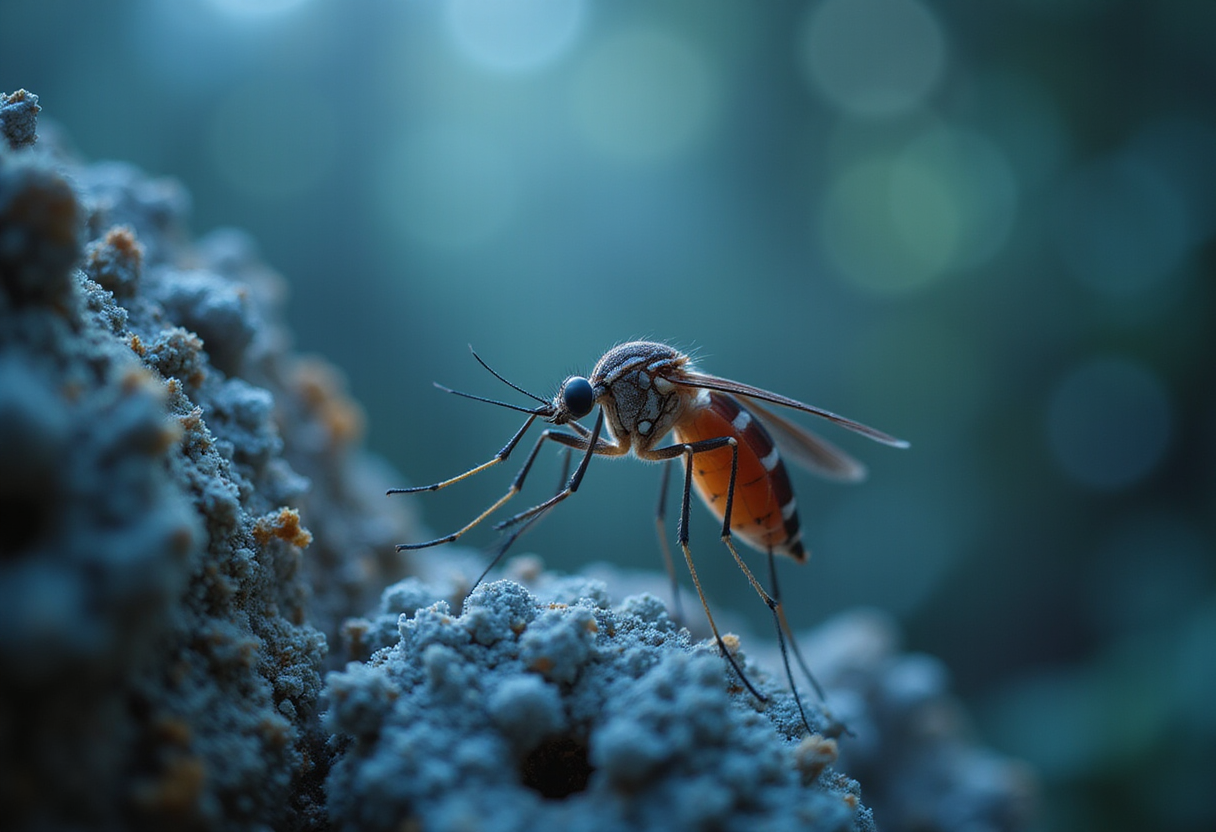
Mosquito-borne diseases remain one of the world's heaviest health burdens: nearly 300 million malaria cases and almost 400 million dengue infections occur every year. A new review by Monash University researchers, published in Science Advances, argues that fighting this burden requires a coordinated strategy combining mosquito control, vaccination, and cuts in greenhouse gas emissions.
The paper examines the ecological, epidemiological and socioeconomic factors shaping the spread of the two diseases. Both are transmitted by mosquito bites—malaria by a parasite carried by female Anopheles mosquitoes, dengue by a virus carried by female Aedes mosquitoes. Both place enormous pressure on public health systems worldwide.
Why climate alone cannot explain disease trends
Lead researcher Dr. Toby Cumming, a research fellow in the Health and Climate Initiative at the Monash School of Public Health and Preventive Medicine, says that understanding what actually drives transmission is essential for designing effective public health responses.
"As climate change increases temperatures and alters rainfall patterns, this expands the areas with climatic conditions in which Anopheles and Aedes mosquito populations can thrive," Cumming said.
In plain terms: warmer temperatures and shifting rain patterns open up new territory where these mosquitoes can survive and reproduce. The climate's influence, however, is far from simple. The relationships between weather and transmission are nonlinear—meaning small changes do not always produce proportionate effects—and they vary by season and by location. Still, the researchers found that climate factors affect malaria and dengue in broadly similar ways.
That similarity creates a puzzle. "Yet over the last century, during a time of unambiguous warming, rates of malaria have declined while rates of dengue have risen," Cumming said.
The review points to nonclimate factors to explain the divergence. Malaria has benefited from decades of mosquito control interventions and drug therapies, which have driven major reductions in transmission. Dengue, by contrast, has no therapeutics available, and increasing urbanization has favored Aedes mosquitoes—city environments offer them abundant breeding sites and human hosts. The result: two diseases moving in opposite directions despite the same warming planet.
Rising cases demand stronger prevention
Cumming warned against complacency. Malaria may be in long-term decline, but its global incidence has still risen 8.5% over the past decade. "Recent malaria trends and the rapid growth in dengue are both serious concerns, and we must escalate our prevention and control efforts," he said.
New preventive tools for dengue are emerging, including vaccines and innovative vector control strategies—one of the terms public health researchers use for methods that target the mosquitoes spreading disease. One such strategy, developed by the World Mosquito Program, a not-for-profit group of companies owned by Monash University, involves introducing a bacterium called Wolbachia into Aedes mosquito populations. Wolbachia reduces the mosquitoes' ability to transmit dengue.
The review's central message is that no single intervention will suffice. "Ultimately, our research reinforces the need for a coordinated approach, encompassing interventions to address the many climate and nonclimate factors that contribute to the spread of mosquito-borne disease," Cumming said.
As with any review, the findings describe broad patterns rather than predict outcomes in specific locations, and the effectiveness of newer tools such as Wolbachia deployment continues to be evaluated in real-world settings. Still, the evidence points clearly in one direction: prevention—through vector control, vaccination, and limiting global warming—remains the strongest defense against a shifting disease burden.
via Medical Xpress (Source)
More from Elena Vasquez
Nearby plates
- Florida's Dengue Outbreak Is the Largest in the Continental US in Decades
- Climate Change Is Already Harming Skin Health, Global Study Finds
- Insects Keep Vertebrates Alive as Food, Medicine and Home Builders
- COVID-19 immunity may shield against other bat coronaviruses
- Tracking 4,581 Animals Reveals a Hidden Human Effect on Wildlife