Plate Nº 68 · recorded October 10, 2026
Space & AstronomyReported finding
Crew-13 Launches: Four Astronauts Head to Space Station
A SpaceX Falcon 9 launched NASA's Crew-13 on Oct. 1, 2026, flying astronauts from the U.S., Canada, and Russia to the space station, docking set for 7 p.m. EDT.
By Elena Vasquez3 min read556 words
In brief
- SpaceX Falcon 9 launched NASA's Crew-13 mission on Oct. 1, 2026, from Cape Canaveral Space Force Station in Florida.
- The Dragon spacecraft carries four crew: NASA astronauts Jessica Watkins and Luke Delaney, CSA astronaut Joshua Kutryk, and Roscosmos cosmonaut Sergey Teteryatnikov.
- Docking at the International Space Station is expected at 7 p.m. EDT.
- NASA's live coverage of the arrival begins at 5:20 p.m. EDT at nasa.gov/live.
- The crew is beginning a long-duration science mission aboard the orbiting laboratory.
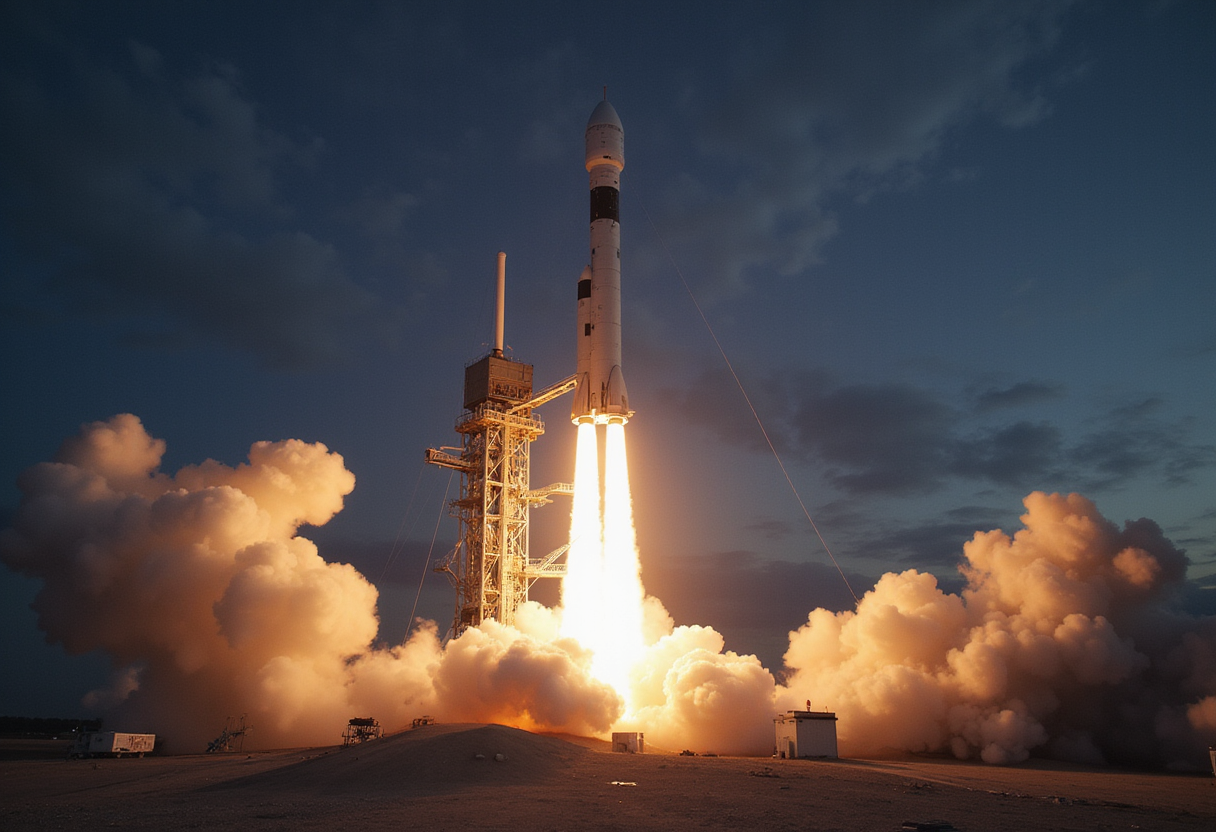
A SpaceX Falcon 9 rocket lifted off at Cape Canaveral on Oct. 1, 2026, carrying four crew members to the International Space Station on NASA's Crew-13 mission.
The launch took place from Space Launch Complex 40 at Cape Canaveral Space Force Station in Florida. The rocket carried a SpaceX Dragon spacecraft, which is expected to dock at the space station at 7 p.m. EDT the same day.
The four-person crew reflects the international character of the station itself. Flying together are:
- Jessica Watkins, NASA astronaut
- Luke Delaney, NASA astronaut
- Joshua Kutryk, astronaut with the Canadian Space Agency (CSA)
- Sergey Teteryatnikov, cosmonaut with Roscosmos, Russia's space agency
NASA has not detailed the specific experiments of the flight in its launch announcement, but the agency describes the mission as a long-duration science mission aboard the orbiting laboratory. Crew rotations of this type typically support hundreds of experiments in biology, physics, and human health over months in orbit.
What is Crew-13?
Crew-13 is the thirteenth operational rotational flight under NASA's Commercial Crew Program, in which the agency buys astronaut transportation services from private companies — in this case, SpaceX.
Under that arrangement, SpaceX provides the Falcon 9 rocket and the Dragon spacecraft. Dragon is a capsule designed to carry people to and from the space station and to splash down in the ocean at the end of a mission. The Falcon 9 is a reusable two-stage rocket whose first stage returns to Earth after launch.
A "long-duration" mission means the crew will live and work aboard the station for an extended stay rather than a short visit, joining the astronauts and cosmonauts already aboard the outpost.
Who is on board?
The crew mixes three space agencies in a single spacecraft.
Jessica Watkins and Luke Delaney fly for NASA, the U.S. space agency that operates the U.S. segment of the station and commissioned the flight.
Joshua Kutryk represents the Canadian Space Agency. Sergey Teteryatnikov represents Roscosmos. The station itself has been continuously crewed by international crews since November 2000, and shared flights like this one are part of how partner agencies keep it staffed.
When will they arrive — and how can you watch?
The Dragon spacecraft is expected to dock with the International Space Station at 7 p.m. EDT.
NASA will stream the arrival live across multiple platforms. Coverage begins at 5:20 p.m. EDT, roughly an hour and forty minutes before the scheduled docking. Viewers can watch at nasa.gov/live.
What happens next?
After docking, the crew will open the hatches and join the station's current residents. Their stay is described by NASA as a long-duration science mission, meaning their time in orbit is devoted to research that can only be performed in the microgravity environment of the station.
The Oct. 1 launch continues a cadence of routine crew rotations that NASA and SpaceX have maintained since the first operational Crew Dragon flight, a shift that replaced U.S. reliance on other vehicles for astronaut transport with a service the agency purchases commercially.
The image accompanying NASA's announcement, photographed by Joel Kowsky, shows the Falcon 9 ascending on a column of fire, with vapor clouds spreading beneath the rocket and blending into the clouds in the Florida sky above Cape Canaveral.
via NASA Breaking News (Source)
More from Elena Vasquez
Nearby plates
- NASA's SpaceX Crew-13 Set for Oct. 1 Launch to Space Station
- Crew-13 Reaches Orbit: Fastest ISS Docking by a US Spacecraft
- SpaceX Launches Crew-13: Fast Track to Space Station Begins
- SpaceX Crew-12 Splashes Down After 237 Days Aboard Space Station
- SpaceX Crew Dragon Freedom Splashes Down After Eight Months in Orbit