Plate Nº 63 · recorded October 13, 2026
Biology & EvolutionReported finding
Denser Forests Do Not Always Mean More Bird Species, Island Study Finds
A 422-species study across 1,410 sites in Borneo and Wallacea finds denser forests do not always host more bird species — evolutionary trees, not counts, better measure what forests preserve.
By Priya Raman3 min read699 words
In brief
- Researchers recorded 422 bird species across 1,410 sites on seven islands in Borneo and the Wallacea region.
- Densely forested areas did not necessarily host more bird species than more disturbed sites.
- Forest cover was measured within a 250-meter radius of each survey point and tracked from 2010 to 2022.
- The Sulawesi maleo is the only surviving species in its genus and is classified as endangered.
- Conversion of Colombian forest to pasture has been estimated to erase around 2.3 billion years of avian evolutionary history.
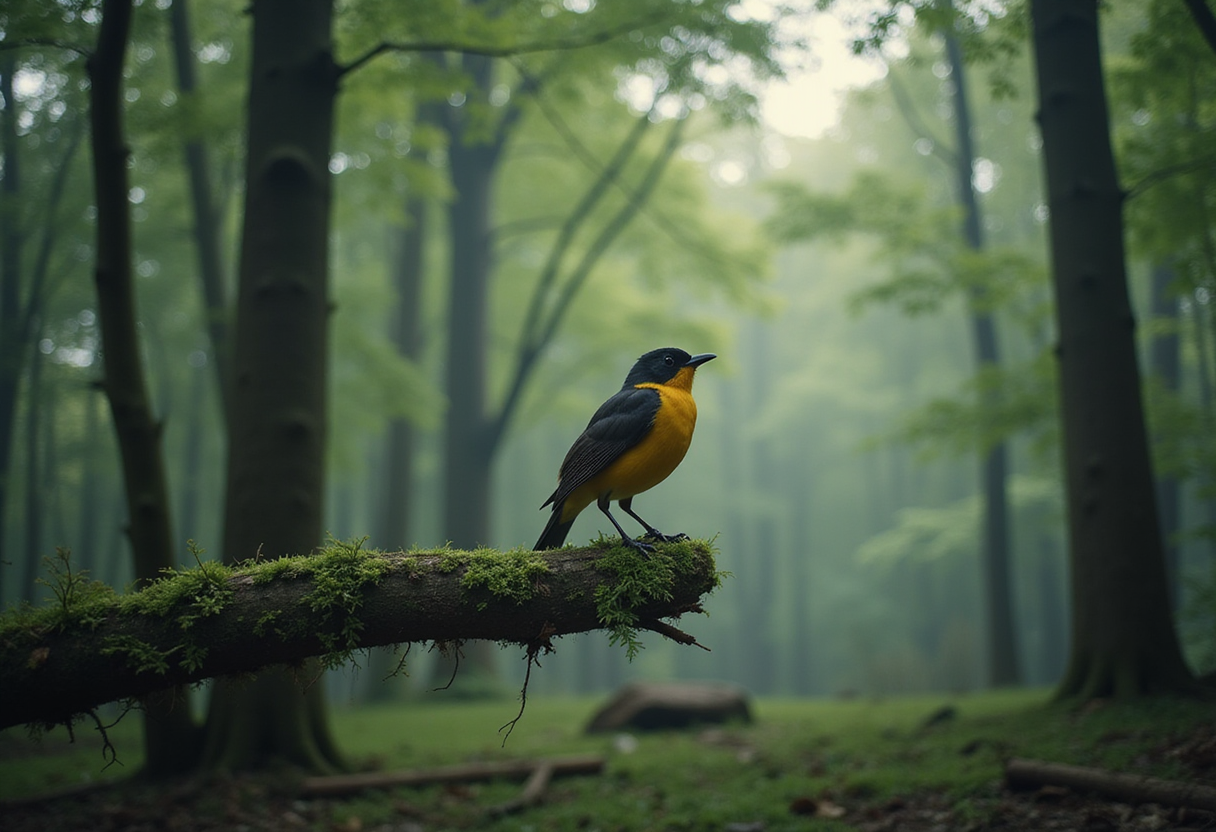
A research team has recorded 422 bird species across 1,410 sites on seven islands in Borneo and the Wallacea region, and reports that densely forested tracts do not always host a greater variety of species than more disturbed ones. The work, published in the Journal of Biogeography, reframes a long-standing assumption in tropical conservation: that more trees equal more birds.
The researchers, led by Halvina G. Saiya, measured forest cover within a 250-meter radius of each survey point and tracked changes from 2010 to 2022. They then applied three evolutionary yardsticks to the species lists at each site:
- Phylogenetic diversity (PD): the total length of branches on the evolutionary tree connecting the species present, used as a proxy for how much evolutionary history a community preserves.
- Mean pairwise distance (MPD): the average evolutionary gap between any two species in a community.
- Mean nearest taxon distance (MNTD): the gap between each species and its closest relative at the site.
These measures capture something that species counts cannot. Two forests can hold the same number of species and yet carry different conservation weight, because one may be dominated by closely related, disturbance-tolerant lineages and the other by evolutionarily distinct ones.
What did the team find?
In relatively undisturbed forests on Buru Island in Maluku, three birds illustrate the point. The Buru racket-tail (Prioniturus mada) and red lory (Eos bornea) share the hooked bill of parrots. The Buru flowerpecker (Dicaeum erythrothorax) belongs to a different evolutionary branch, connected to the parrots only through the deep Psittacopasseres clade (a grouping that unites parrots and songbirds at a very ancient split). Stable forest conditions allowed those lineages to persist side by side.
On the Sangihe and Talaud islands of North Sulawesi, where forest cover has declined since 2010, communities look thinner and more uniform. The yellow-sided flowerpecker (Dicaeum aureolimbatum) and gray-sided flowerpecker (Dicaeum celebicum) on Sangihe both belong to the same genus, as do the elegant imperial pigeon (Ducula concinna) and gray imperial pigeon (Ducula pickeringii) on Talaud. Closely related species tend to forage together, a pattern the authors link to environmental filtering, the process by which local conditions favor particular lineages.
On Buton Island in Southeast Sulawesi, the team found an additional layer. The Sulawesi drongo (Dicrurus montanus), black sunbird (Leptocoma sericea) and yellow-sided flowerpecker all belong to the large order Passeriformes, whose presence reflects Buton's proximity to Sulawesi across shallow straits and the food resources the island offers. Karst and ultrabasic substrates (limestone and magnesium-rich soils) further shape the vegetation, favoring specific bird groups.
Why do evolutionarily distinct species matter?
The team applied the EDGE metric (Evolutionarily Distinct and Globally Endangered, a score that combines how isolated a species sits on the tree of life with its extinction risk) alongside the International Union for Conservation of Nature Red List. One standout: the Sulawesi maleo (Macrocephalon maleo), an endangered bird whose genus contains no other surviving species. Loss of the maleo would erase the last representative of an ancient branch.
Nearly half of all species in the maleo's wider family, the Megapodiidae (a group of ground-nesting birds found from Sulawesi to the Pacific), are classified as vulnerable to critically endangered. Forests that host such lineages therefore carry disproportionate conservation weight.
What does this mean beyond islands?
The authors note parallels elsewhere. On Mount Cameroon, closely related bird groups dominate both low and high elevations, a pattern linked to the history of African forests as they repeatedly expanded, contracted and broke apart. Selective logging in the Brazilian Amazon appears to prune away parts of birds' evolutionary history, and the conversion of Colombian forest to pasture has been estimated to erase around 2.3 billion years of avian evolutionary history.
The study has limits. It covers seven islands, and the authors describe a follow-up analysis on isolation between islands that has not yet been published. Results therefore remain preliminary, and patterns may not extend uniformly across all tropical regions.
The team frames its work plainly: birdsong tells only part of a forest's story. To judge what a forest protects, they argue, one must also read the family tree behind the sound.
via Phys.org Biology (Source)
More from Priya Raman
Show full bio
Senior reporter covering people, launches and day-to-day practice in general science news at SciBeat.
222 articles
Nearby plates
- Protecting Standing Amazon Forests Beats Restoration, Study Finds
- Over 80% of Insect Species Live in the Tropics. Science Keeps Missing Them
- Zoos Rarely Rearrange Collections When Species Risk Shifts
- Colombia's First National Bee Checklist Counts 738 Species
- Aldabra's giant tortoises near 183,000 in first rigorous atoll-wide count