Recorded November 24, 2026
Space & AstronomyReported finding
Earth Gained Four Radiation Belts for Weeks After 2024 Superstorm
ESA's PROBA-V satellite tracked four distinct electron radiation belts around Earth for over four weeks after the May 2024 storm — the first direct observation of such a structure.
By Marcus Bennett3 min read677 words
In brief
- Four distinct electron radiation belts persisted around Earth for more than four weeks in June–July 2024.
- The trigger was the May 2024 'Mother's Day' geomagnetic storm, the strongest in 20 years.
- ESA's PROBA-V satellite, orbiting at about 820 km, supplied the electron measurements.
- A belt or gap counted only if it persisted longer than five days; the two-belt layout returned in August 2024.
- Study published in npj Space Exploration (2026), DOI: 10.1038/s44453-026-00064-7.
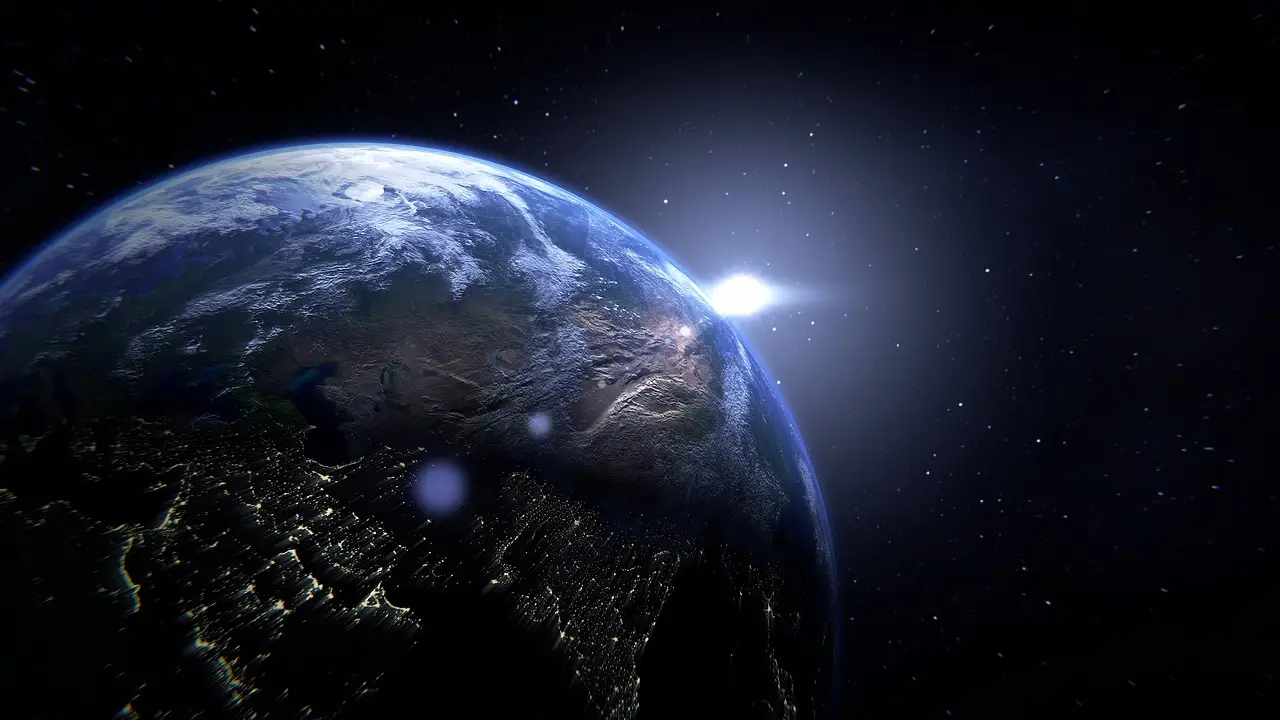
For more than four weeks in mid-2024, Earth was ringed by four distinct radiation belts instead of the usual two. Viviane Pierrard of the Royal Belgian Institute for Space Aeronomy and her team report the first direct observation of this four-belt structure in npj Space Exploration, based on electron measurements from ESA's PROBA-V satellite.
Normally, Earth's magnetic field traps energetic electrons in two doughnut-shaped Van Allen radiation belts, separated by a gap where particles are sparse. Solar storms can rearrange this structure dramatically, but astronomers have never fully understood how. The May 2024 "Mother's Day" geomagnetic storm — the strongest in 20 years — handed researchers their best chance in years to watch the process unfold.
What did the satellite actually see?
PROBA-V orbits about 820 km above Earth and carries a particle telescope that measures energetic electrons. Pierrard's team tracked how particle concentrations changed over time, then mapped those measurements along Earth's magnetic field lines to reconstruct the overall shape of the belts.
To avoid being fooled by brief fluctuations, the team counted a belt or gap only if it persisted for more than five days. By that standard, four distinct belts developed in June 2024 and lasted over four weeks. The familiar two-belt arrangement returned in August.
Three-belt structures reappeared after several later storms between 2024 and 2026, showing that extra belts are a recurring response to solar storms, not a one-off anomaly.
Takeaway: the two-belt picture is a default state, not a rule — major storms can carve the radiation environment into three or even four parts for weeks at a time.
How do extra belts form?
The mechanism resembles one proposed earlier. In 2012, NASA's Van Allen Probes spotted a temporary third belt after a solar storm, which lasted around four weeks. Astronomers suggested then that the storm pushed electrons into the normally sparse region between the two belts, while electromagnetic waves stripped electrons away elsewhere.
The 2024 event fits that pattern, with a twist. Storm-driven electrons were injected into the usual gap, and new sparse gaps formed elsewhere, dividing the radiation environment into additional belts.
The structure also depended on electron energy: four belts appeared across several of the measured energy ranges, but not at the highest energies.
The researchers suggest the new gaps most likely formed as electromagnetic waves knocked electrons out of the belts and into the atmosphere. They caution that the precise causes remain unclear.
Takeaway: storms fill the old gap, and waves hollow out new ones — but the details of who does what are still unresolved.
Why the 2014–15 peak complicates the story
One earlier result sharpened the puzzle. When solar activity peaked in 2014–15, the same three-belt pattern did not appear, even though storms were frequent. That mismatch is one reason astronomers have hesitated to treat the 2012 observation as a template. The 2024 data, showing extra belts that recur, help pin down when the rearrangement actually happens.
What comes next?
Pierrard's team now plans simulations and modeling to explain how the new gaps form. Further observations could separate the roles of natural electromagnetic waves and human-generated radio signals — including powerful transmitters used to communicate with submarines, which can also strip electrons from the belts.
The stakes reach beyond planetary physics. A deeper account of Earth's fast-changing radiation environment could inform better satellite designs, sharpen radiation assessments for astronauts, and help the satellite-based systems we depend on prepare for solar storms.
The study is published as Viviane Pierrard et al., "Exceptional observation of multiple electron radiation belts after the 11 May 2024 geomagnetic storm," npj Space Exploration (2026), DOI: 10.1038/s44453-026-00064-7. The findings are preliminary in one sense — the wave-driven gap mechanism is a suggestion, not a settled conclusion — but the four-belt observation itself is a first, and a direct one.
Until the simulations catch up, the radiation belts will keep doing what they did in June 2024: adding rings.
via phys.org/rss-feed/ (Source)
More from Marcus Bennett
Show full bio
News editor covering regulation, policy and their impact on general science news at SciBeat.
602 articles
Nearby plates
- Four heliotail lobes shift across 14 years of solar-cycle data
- Asteroid 1995 BJ4 Grew a Tail — and It May Be the Largest Main-Belt Comet
- Webb Telescope Spots Mars-Sized Worlds Smashing Together
- Hidden Star Siwarha Appears to Plow Through Betelgeuse's Atmosphere
- NASA dust study finds signs of ancient ice beyond Neptune