Recorded November 22, 2026
Space & AstronomyReported finding
NASA dust study finds signs of ancient ice beyond Neptune
NASA scientists traced 12 stratosphere dust grains to the Kuiper Belt and found mineral evidence of ancient, heavy-oxygen water beyond Neptune — a new clue to how planets formed.
By Marcus Bennett3 min read601 words
In brief
- NASA scientists analyzed 12 dust particles collected from Earth's stratosphere by the agency's ER-2 high-altitude research aircraft
- Solar energetic particle traces in the grains helped trace their origins to the Kuiper Belt
- NASA Johnson Space Center and UCLA teams used advanced electron microscopy and an ion microprobe to read minerals and oxygen isotope ratios
- Minerals formed by early water carried signatures indicating water enriched in heavier oxygen isotopes
- Genesis mission isotope measurements served as the comparison reference, while the same signatures remain scarce in meteorites, suggesting limited mixing between the outer and inner solar system
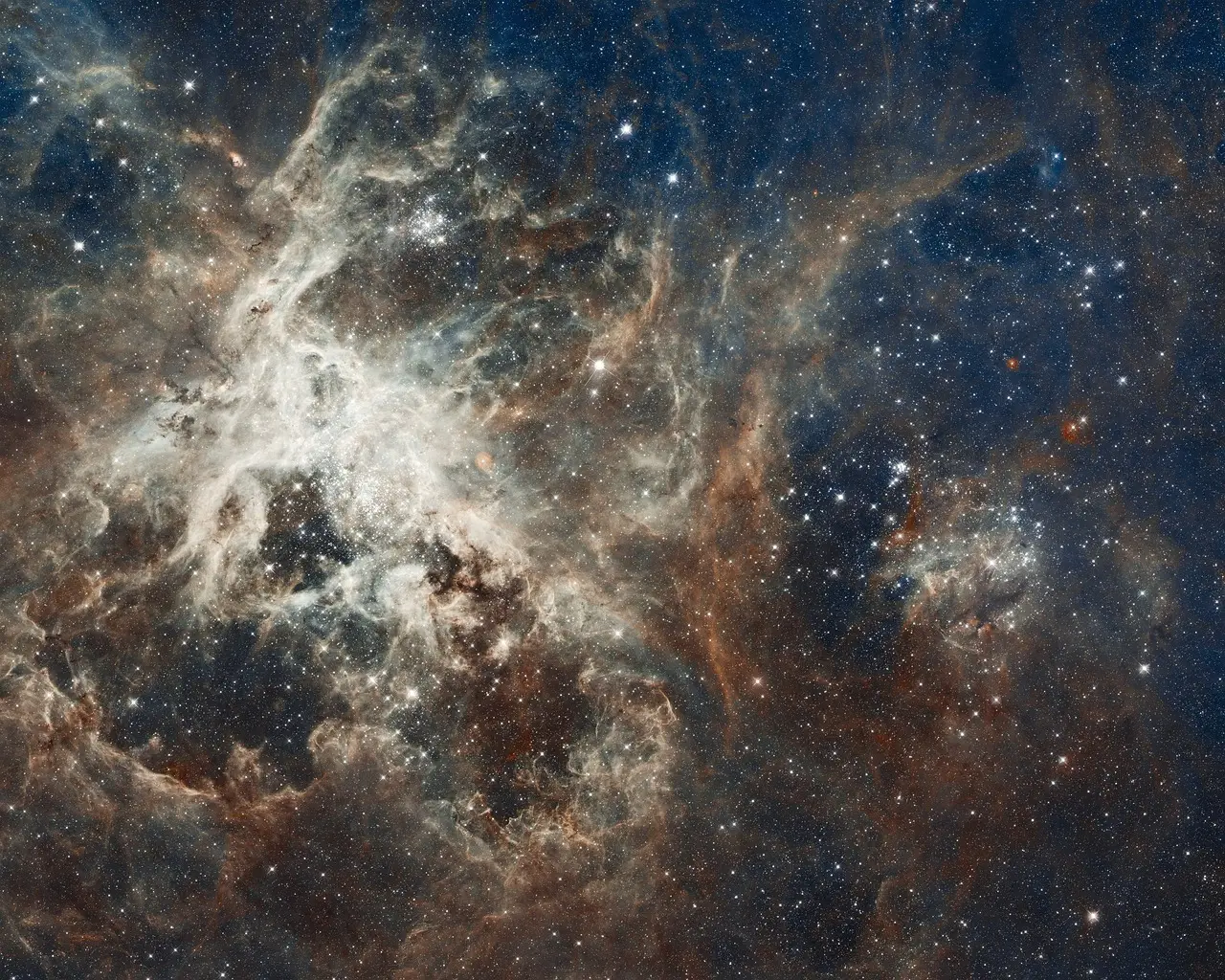
NASA scientists have traced 12 dust grains collected from Earth's stratosphere to the Kuiper Belt, the distant population of icy bodies beyond Neptune, and found mineral evidence that water froze onto dust in the outer solar system when the solar system was young.
The finding gives planetary scientists new evidence on how materials moved through the early solar system and helped supply the planets that formed around the Sun.
What did the researchers actually measure?
Researchers at NASA's Johnson Space Center in Houston analyzed 12 dust particles collected from Earth's stratosphere by the agency's ER-2 high-altitude research aircraft. High concentrations of solar energetic particle tracks — tiny streaks left when charged particles from the Sun pass through a solid grain — helped the scientists trace the particles' origins to the Kuiper Belt.
Working with colleagues at the University of California, Los Angeles (UCLA), the team used advanced electron microscopy at NASA and an ion microprobe at UCLA to study the particles' minerals and oxygen isotopic compositions. The microprobe fires a focused beam of ions at a tiny target and measures the elements and isotope ratios that come back, one mineral at a time.
The researchers identified minerals that formed when water interacted with dust early in the solar system's history. Their chemical signatures indicate the ancient water was enriched with heavier oxygen isotopes — variants of oxygen that carry an extra neutron.
In plain terms: the grains contain minerals made by early water, and that water carried an oxygen fingerprint unlike most water closer to the Sun.
Why do heavier oxygen isotopes point to a distant ice reservoir?
Oxygen has two stable forms, or isotopes, that differ only in neutron number, and the balance between them shifts with where and when water and rock formed. Scientists therefore treat that ratio as a tracer of origin, not just a chemistry check.
The dust grains' minerals preserve a balance recorded out in the cold beyond Neptune, and it matches what NASA's Genesis mission measured, which gives the team a reference point for comparison.
The scarcity of the same signatures in meteorites supplies the second half of the argument. Their absence suggests the giant planets may have limited how much material moved between the outer and inner solar system, leaving some ice-rich material isolated beyond Neptune for far longer than others.
In plain terms: a rare oxygen signature shows up in outer-system dust but rarely in meteorites, pointing to limited mixing between the two regions.
What does this change for models of planet formation?
For researchers, the result turns a long-standing suspicion into something measurable with instruments on Earth. Meteorite studies and samples returned from carbon-rich asteroids had provided clues before, but the evidence stayed limited; the dust grains now add a physical sample of the outer reservoir itself.
The limits remain equally clear. Twelve grains make a small sample, and the claim rests on chemical signatures rather than on direct sampling of Kuiper Belt ice. The researchers frame the result as compelling evidence that an ancient reservoir of ice existed there, not as final confirmation of its size or extent.
An artist's illustration accompanying the finding shows the view from a Kuiper Belt object, where the solar system's four largest planets appear as bright dots while the inner planets stay too close to the Sun to be seen.
Bottom line: 12 stratospheric dust grains give planetary scientists their strongest evidence yet that ice survived in the outer solar system, and they will use it to test how material reached the inner planets.
via spacecoastdaily.com (Source)
More from Marcus Bennett
Show full bio
News editor covering regulation, policy and their impact on general science news at SciBeat.
584 articles
Nearby plates
- Bennu Samples Rewrite the Asteroid's Birthplace — and Jupiter's Role
- First Solar System Planetesimals Were 83–92% Chondrules, Study Finds
- Webb Telescope Spots Mars-Sized Worlds Smashing Together
- Mars Dust Measured Down to 100 Nanometers Aboard Perseverance Rover
- Webb Telescope Witnesses Planet-Smashing Collisions Around Young Stars