Plate Nº 74 · recorded September 29, 2026
Space & AstronomyReported finding
Faint Young Stars Suggest Messier 74 Is Nearly Twice as Large as Thought
Ultra-deep telescope images reveal faint young stars extending 97,800 light-years from Messier 74's center, nearly doubling the galaxy's known size. A flyby may explain it.
By Priya Raman4 min read728 words
In brief
- Deep optical imaging detected a faint blue stellar structure extending 30 kiloparsecs (~97,800 light-years) from M74's center, versus a previously known disk radius of about 14 kiloparsecs (~45,600 light-years).
- The study, led by Ignacio Ruiz Cejudo (Institute of Astrophysics of the Canary Islands), was published Sept. 4 in Astronomy & Astrophysics.
- Color analysis suggests the young stars formed roughly 640 million years ago; the team proposes a flyby of satellite galaxy UGC 1176 as the likely trigger.
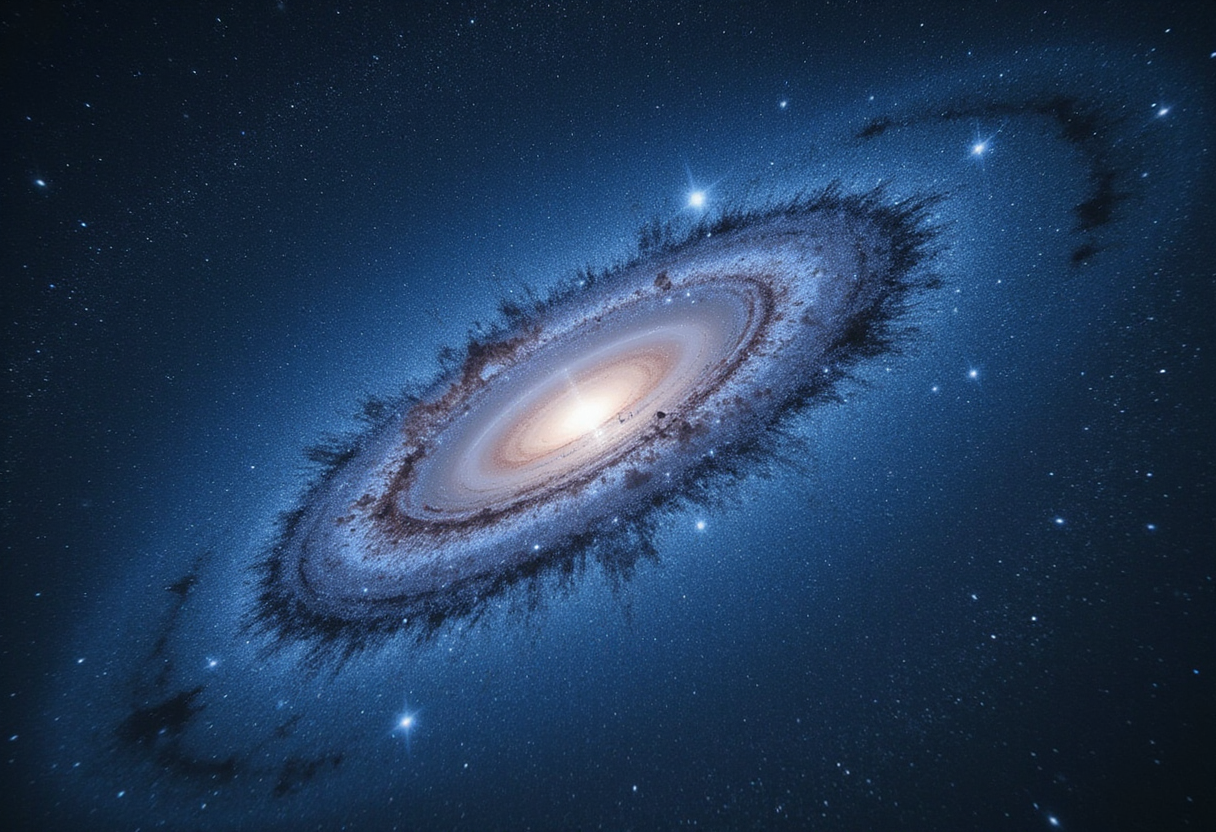
Astronomers have spotted a faint population of young stars stretching far beyond the known edge of the spiral galaxy Messier 74. The discovery suggests the galaxy is nearly twice as large as previously measured.
The finding comes from a study published Sept. 4 in the journal Astronomy & Astrophysics, led by Ignacio Ruiz Cejudo of the Institute of Astrophysics of the Canary Islands.
Catching light standard surveys miss
To find these stars, the team turned to a new instrument: the Transient Survey Telescope (TST) at Teide Observatory. They took extremely long-exposure images—between 5.4 and 6.5 hours per filter—which allowed them to detect much fainter light than standard optical surveys such as the Sloan Digital Sky Survey (SDSS) can capture.
That sensitivity paid off. The images revealed an extremely faint, distinctly blue stellar structure extending 30 kiloparsecs—about 97,800 light-years—from the galaxy's center. The previously known disk of M74 reached only about 14 kiloparsecs, or roughly 45,600 light-years. In other words, the new detection nearly doubles the galaxy's measured size.
M74 sits roughly 30 million light-years from Earth and was already considered an interesting case. It has a grand-design spiral structure, meaning its arms are well defined and prominently organized. It also shows several signs of stellar population buildup: its disk of neutral hydrogen gas (known to astronomers as HI) is unusually messy, warped, and extended, pointing to a recent accumulation of gas. Four supernovae have been detected in the galaxy, and a 2007 study flagged it as hosting an "extended ultraviolet disk," or XUV disk—ultraviolet light that traces young stars beyond a galaxy's traditional boundary as seen in optical light.
The researchers compared their new optical images with archival data: HI measurements from the THINGS survey and ultraviolet observations from the GALEX satellite. The faint stellar structure they found lines up with the outer contours of the hydrogen gas and with the previously known ultraviolet-extended disk.
"Now, our ultra-deep optical data reconcile the galaxy's apparent size with the observed HI and UV extents," the team wrote in its paper.
How galaxies grow
The result speaks to a broader question in astronomy: how do galaxies grow? Over time, galaxies accumulate gas from their surroundings. Because this incoming gas spins faster relative to the center, it cannot collapse all the way to the core. Instead, it settles into the outer disk, where it eventually sparks the formation of new stars. Astronomers have observed this process, but they still do not know whether it proceeds smoothly and gradually or in fast, episodic bursts. Mergers or interactions with satellite galaxies can also trigger bursts of star formation in the outskirts of galactic disks, making them grow bigger.
One challenge in identifying such growth is definitional. Astronomers still debate how to draw a galaxy's "optical boundary," which makes XUV disks difficult to classify in the first place.
A possible culprit: a passing satellite
To understand what lit up M74's outskirts, the researchers analyzed the colors of the newly found stars using a stellar population model—a tool that links a star population's color to its age and chemical makeup. The analysis suggests the stars formed roughly 640 million years ago. The estimate depends on metallicity, the abundance of elements heavier than hydrogen and helium; possible ages range from about 260 million years to just over 1 billion years. Even the upper end of that range is extremely recent on galactic timescales.
Based on that age estimate, the team favors a specific trigger: a close gravitational encounter with an irregular, blue satellite galaxy. "Given this and the visual inspection of the field, we propose a recent flyby of UGC 1176 at least 1 Gyr ago as the trigger for the new star formation in the outer regions," they conclude. A gigayear, abbreviated Gyr, is one billion years.
The researchers reached this scenario by comparing the estimated age of the new stars with how long such an encounter would take to trigger star formation in a galaxy's outskirts. It is worth keeping in mind that this is one interpretation of the evidence rather than a settled conclusion. Whether rapid, flyby-triggered disk growth like this is common across the universe—or whether M74 is simply unusual—remains an open question for future work.
via Phys.org Space & Astronomy (Source)
More from Priya Raman
Show full bio
Senior reporter covering industry trends and analytics at SciBeat.
57 articles
Nearby plates
- A Mysterious Radio Signal Pointed at a Super-Earth. Was It Aliens?
- Astronomers Find First Stellar Stream Beyond the Milky Way
- Webb Telescope Witnesses Planet-Smashing Collisions Around Young Stars
- Simulations Reconstruct How the First Stars Forged the Universe
- Simulations Trace First Stars to Chemical Clues in Today's Universe