Plate Nº 60 · recorded October 15, 2026
Biology & EvolutionReported finding
Forgotten Museum Fossil Reveals New European Clawed Dinosaur
A skull fragment collected in 1924 and left in a drawer for a century turns out to be a new tiger-sized dinosaur — the first megaraptoran known from Europe.
By Elena Vasquez5 min read983 words
In brief
- The fossil was acquired by the Natural History Museum in 1924 and went unrecognized for nearly 100 years.
- Invictibellatrix amberina lived about 120 million years ago and measured 3–4 meters long.
- It is the first megaraptoran dinosaur ever identified in Europe.
- Later megaraptorans in Gondwana grew up to 9–10 meters long with claws up to 35 cm.
- The study appears in Royal Society Open Science, October 2026.
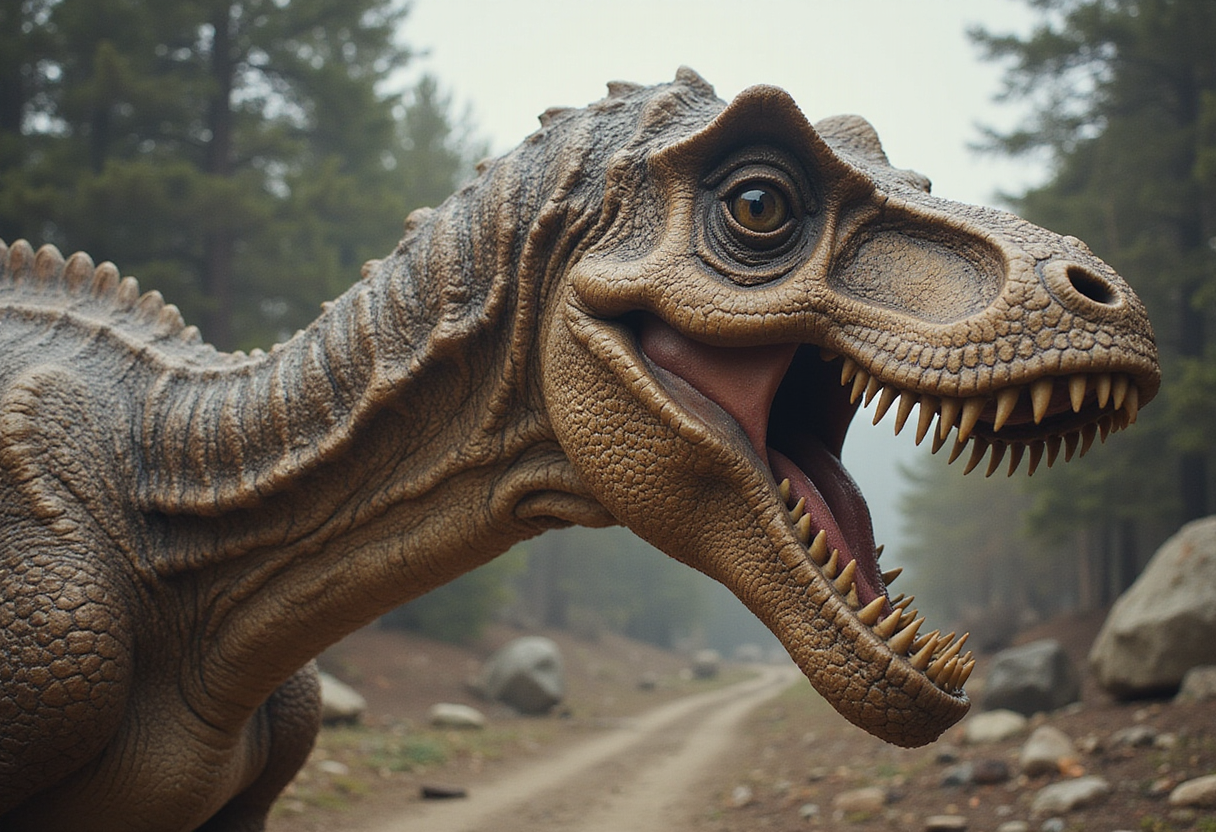
A fossil skull fragment that sat in a museum drawer for nearly a century has turned out to be a new species of dinosaur — and the first evidence that a mysterious group of clawed predators ever lived in Europe. Researchers led by University College London describe the animal, named Invictibellatrix amberina, in Royal Society Open Science on October 14, 2026.
The creature was about the size of a large tiger. It roamed what is now Britain roughly 120 million years ago, during the Early Cretaceous period, armed with curved claws that may have reached 20 centimeters long.
It belonged to the megaraptorans, a poorly understood group of two-legged carnivores closely related to tyrannosaurs. Until now, no megaraptoran had ever been found in Europe. That gap mattered.
Why does one skull fragment matter?
The Natural History Museum acquired the fragment in 1924. It came from the collection of Reginald Walter Tooley, an amateur paleontologist who gathered more than 1,000 fossil specimens along the southwest coast of the Isle of Wight before his death. Its scientific value went unrecognized for generations.
Lead author Dr. Cassius Morrison of UCL Earth Sciences said: "It is a real mystery that this fossil was overlooked for so long, sitting in a drawer for nearly 100 years. Lots of bones are found on the Isle of Wight — who knows what else is waiting to be discovered."
By comparing the fragment with fossils from related dinosaurs, the team estimated the animal's size and habits. Morrison said Invictibellatrix would have measured:
- three to four meters long
- just over a meter and a half tall, about human height
- likely feathered, with claws of 10 to 20 centimeters
- a hunter of small dinosaurs, lizards and mammals — occupying a food-chain role similar to today's hyena
Would it have hunted humans?
Humans never met this dinosaur. But Morrison offered a striking comparison about predator size.
"For humans this dinosaur would have been more dangerous than a T. rex," he said. "We would have been perfectly sized prey, about a third of their body weight. They definitely would have chased us. A T. rex would not have bothered, as we would have been too small."
The logic is simple. A mid-sized carnivore sees a person as a meal. A giant like Tyrannosaurus rex prefers far bigger targets. Size determines danger.
How did the researchers identify it?
Megaraptorans looked nothing like their famous cousins. Instead of massive jaws, they had narrow skulls, powerful arms and huge curved claws for seizing prey — a very different hunting toolkit.
To pin down the identity of the Isle of Wight fragment, the team used CT scanning, the same imaging technology hospitals use. The scans let them build a 3D reconstruction of the fragment and a model of its internal cavity, which once housed the brain.
Comparisons with tyrannosaurs, spinosaurs, raptors and other two-legged predators revealed unusual features. These included an oval opening where the spinal cord connected to the brain, and a distinctive crest shaped like an hourglass. Computer algorithms comparing skeletal features consistently placed the specimen within the megaraptoran group.
In short: an unknown animal, confirmed twice over.
What does it tell us about dinosaur migration?
Megaraptoran fossils are exceptionally rare, which makes the group one of the least understood among large meat-eaters. Scientists long suspected these animals first evolved in Asia, then spread through Europe before reaching Gondwana, the southern supercontinent that included present-day Africa, South America and Antarctica.
One problem dogged that theory. Europe had yielded nothing.
Co-author Charlie Scherer, a PhD student at UCL Earth Sciences, said: "This new species is the first proof we have that megaraptorans were also present in Europe and that they reached Gondwana this way rather than island-hopping further south."
The finding suggests Europe was a key stop on the journey that carried these predators to the southern continents.
How big did these dinosaurs eventually get?
The team went beyond anatomy, using mathematical models that combined the fossil record, evolutionary relationships, ancient geography and climate to reconstruct how megaraptorans spread over millions of years.
The results suggest the group was widely distributed during the Early Cretaceous. But its fortunes shifted. By the Late Cretaceous, tens of millions of years later, megaraptorans had probably vanished from Laurasia, the northern supercontinent that included modern Europe.
In the south, they thrived. Descendants in Gondwana became some of the largest predators in their ecosystems. Some grew claws up to 35 centimeters long. One, Maip macrothorax, lived in what is now Argentina, stretched nine to 10 meters and weighed about as much as an elephant.
Why they disappeared from the north remains uncertain. The researchers point to possible culprits: climate change, shifting environments, and competition from other large carnivores such as tyrannosaurs.
What's in a name?
Plenty, in this case. Invictibellatrix means "unconquered female warrior" — a nod to the giant predators that later emerged from this lineage. In their paper, the authors say the name was chosen to "give hope and strength to all those who are bullied, discriminated, victimized, and oppressed that tomorrow will be theirs and not to give up in face of such odds."
The second part, amberina, honors amber found in the rock layers where the fossil originated and the female name Amberina.
Senior author Professor Paul Barrett of the Natural History Museum said: "Despite over 200 years of collecting, the Isle of Wight continues to surprise us with new dinosaur species, and finds of carnivorous dinosaurs, such as Invictibellatrix, have been particularly elusive."
He added: "Work like this shows the exceptional value of working with historical museum collections where there are still many discoveries to be made."
The study drew funding from the Palaeontographical Society, the Royal Society and UKRI. The takeaway is plain: some of paleontology's biggest discoveries may already sit in museum drawers, waiting for a second look.
via dx.doi.org (Original)
More from Elena Vasquez
Show full bio
Correspondent covering money, funding and market shifts around general science news at SciBeat.
239 articles
Nearby plates
- 240-Million-Year-Old Tanzania Fossil Reshapes Dinosaur Timeline
- Four-Winged Dinosaur From China Hints Flight Evolved Twice
- First Diplodocus Ever Found Outside North America Came From Spain
- Animals May Have Evolved 200 Million Years Earlier Than Thought
- "Lizzie" Fossil Loses Its Crown: Not the Oldest Reptile After All