Plate Nº 27 · recorded October 10, 2026
PhysicsReported finding
Francis Halzen wins Nobel Prize in Physics for IceCube neutrino work
Francis Halzen, an 82-year-old Belgian-born physicist, won the 2026 Nobel Prize in Physics on Tuesday for his work on the IceCube Neutrino Observatory and for detecting high-energy neutrinos from distant cosmic sources. The award carries about $1.2 million.
By Priya Raman3 min read618 words
In brief
- Francis Halzen, 82, won the 2026 Nobel Prize in Physics on Tuesday
- The prize, announced by the Royal Swedish Academy of Sciences, carries 12 million Swedish kronor (about $1.2 million)
- IceCube is a neutrino observatory at the South Pole led by the University of Wisconsin–Madison
- Halzen's research at the South Pole dates back to the 1980s
- The 2026 medicine Nobel went to three scientists for a light-based tool to study the brain
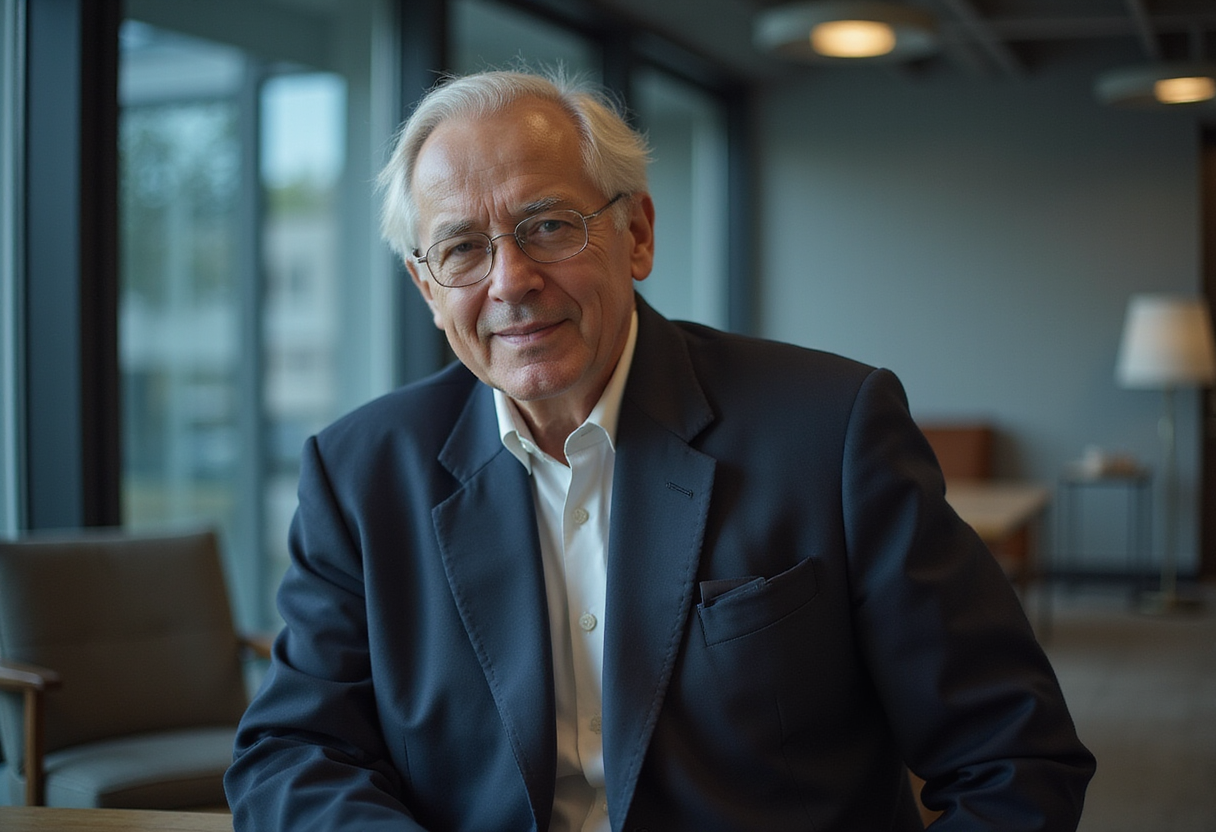
Francis Halzen, an 82-year-old Belgian-born physicist at the University of Wisconsin–Madison, won the Nobel Prize in Physics on Tuesday for his work on the IceCube Neutrino Observatory and for detecting high-energy neutrinos that travel to Earth from distant cosmic sources.
The Royal Swedish Academy of Sciences announced the prize in Stockholm, awarding Halzen 12 million Swedish kronor (about $1.2 million). The committee reached Halzen by phone while he was in Italy.
"It was a great surprise and I obviously didn't expect it," Halzen told reporters after the call. He added that his colleagues had previously predicted a Nobel for him, but the announcement still felt "strange."
What is the IceCube Neutrino Observatory?
IceCube is a research facility buried in the Antarctic ice at the South Pole. The University of Wisconsin–Madison is its lead institution. Halzen's effort to capture neutrinos there dates back to the 1980s, decades before the experiment recorded its first confirmed detections.
The facility functions as a giant particle detector. When a neutrino collides with another piece of matter frozen inside the ice, the impact produces a brief flash of light. Optical sensors strung through the ice register those flashes, allowing researchers to reconstruct the energy and direction of the incoming particle.
What are neutrinos?
Neutrinos are subatomic particles with a vanishingly small mass. They carry no electric charge, which means they almost never interact with ordinary matter. The sun pours them out constantly, and trillions zip through every human body each second without effect.
That near-invisibility is what makes neutrinos scientifically valuable: they travel through the universe essentially unimpeded, carrying information from regions of space that other signals cannot easily escape. The trade-off is that they are extraordinarily hard to catch. Scientists cannot glimpse neutrinos directly; they instead measure the secondary signals left behind by rare collisions.
Halzen focused his career on a rare population of neutrinos with extremely high energies, ones scientists treat as messengers from the cosmos. Tracking these particles back to their points of origin offers clues about how the universe evolved.
Why the committee honored Halzen
"Francis Halzen has led an international team of researchers and engineers who have provided us with a fantastic instrument. His tenacity and scientific vision has paved the way for a new kind of astronomy," said Mark Pearce, chair of the Nobel Committee for Physics, in a news release.
Halzen's push to capture cosmic neutrinos dates back to the 1980s. Turning the IceCube concept into a working observatory required years of construction in one of the most remote places on the planet.
Who is Francis Halzen?
Born in Belgium, Halzen built his research career in the United States at the University of Wisconsin–Madison, where he has long led the IceCube collaboration. The project assembled researchers from multiple countries and operates instruments in one of the harshest environments on Earth. The Associated Press reported that efforts to reach him directly on Tuesday were not immediately successful.
What else is happening this Nobel week?
The 2026 Nobel Prize in medicine, announced Monday, went to three scientists whose work led to a tool that uses light to help researchers study how the brain works. The chemistry prize will be announced Wednesday, followed by literature on Thursday and the peace prize on Friday. The Nobel Memorial Prize in Economic Sciences closes the week on Monday.
Last year's physics prize went to three scientists for studies of quantum tunneling, a quantum-mechanical effect in which subatomic particles pass through energy barriers that classical physics would block. That work enabled the ultra-sensitive measurements at the heart of MRI machines and laid groundwork for faster cellphones and computers.
via Phys.org Physics (Source)
More from Priya Raman
Show full bio
Senior reporter covering industry trends and analytics at SciBeat.
207 articles
Nearby plates
- Nobel physics winner Halzen credits early AI push in neutrino work
- Oswald Steward of UC Irvine Wins 2026 Kavli Prize in Neuroscience
- A 76-Square-Kilometer Ice Island Breaks Free From Petermann Glacier
- CERN's Super Proton Synchrotron Marks 50 Years of Particle Physics Firsts
- 76 km² Ice Island Breaks Off Greenland's Petermann Glacier