Plate Nº 62 · recorded November 10, 2026
PhysicsReported finding
Deep-Sea Neutrino Telescope Finds No Crack in Einstein's Relativity
A Mediterranean neutrino telescope analyzed 5,828 events and found no violation of Lorentz invariance, setting first-ever direct limits on muon and tau neutrino effects.
By James Calloway4 min read732 words
In brief
- KM3NeT analyzed 5,828 atmospheric neutrino candidates over 1.4 years and found no Lorentz invariance violation.
- The study, published November 4, 2026 in JCAP, set the first direct limits on possible violations involving muon and tau neutrinos.
- Results from just six detection units were competitive with IceCube and Super-Kamiokande.
- The detector sits at the bottom of the Mediterranean Sea; a companion detector, ARCA, will target higher-energy cosmic neutrinos.
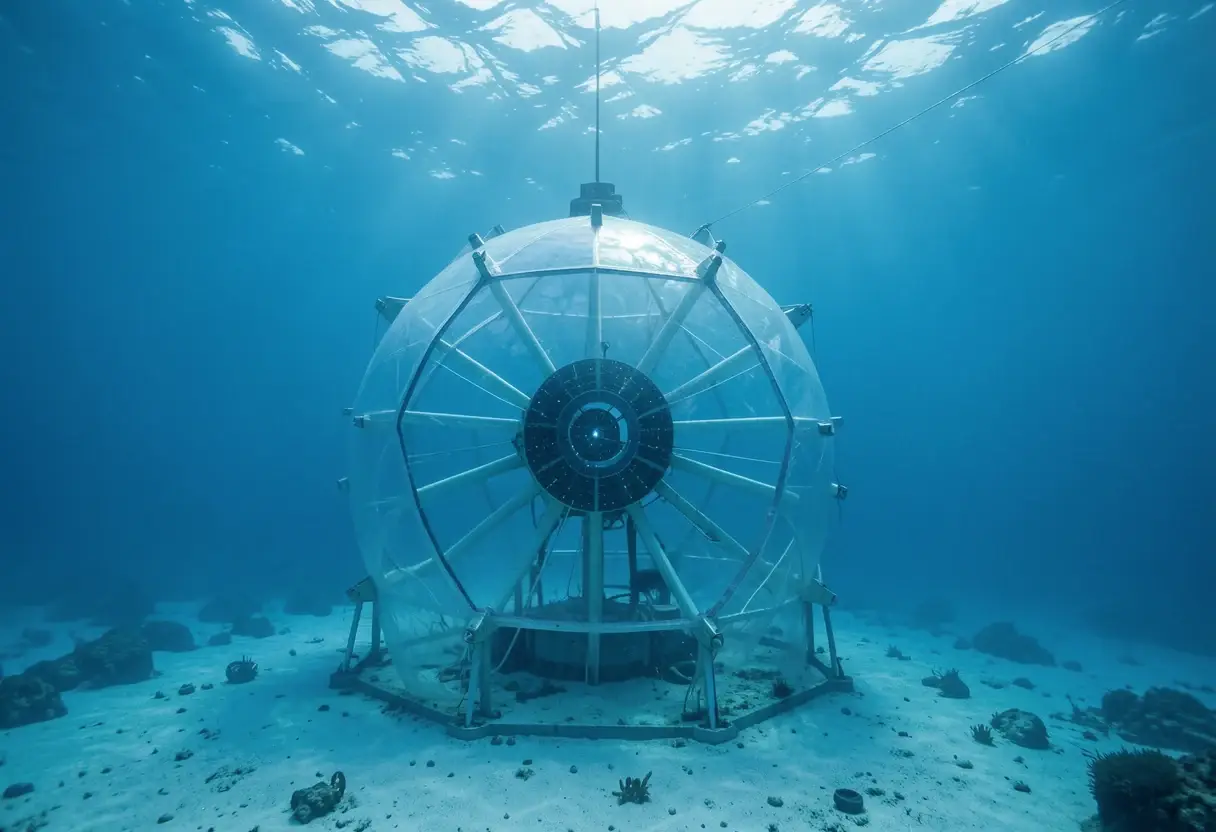
A neutrino telescope at the bottom of the Mediterranean Sea has tested one of Einstein's foundational principles — and found it intact. After analyzing 5,828 atmospheric neutrino candidate events, the international KM3NeT collaboration reported no evidence that Lorentz invariance, a cornerstone of relativity, breaks down anywhere they could see.
The study, published November 4, 2026 in the Journal of Cosmology and Astroparticle Physics, does more than confirm Einstein. It establishes the first direct experimental limits on certain possible violations involving muon and tau neutrinos, two of the three known types of these ghostly particles.
That's a real result. But let's be precise about what it doesn't say: it doesn't prove relativity holds everywhere, only that this detector, at this stage, saw nothing unusual.
What is Lorentz invariance, and why test it?
Lorentz invariance is the rule that the fundamental laws of physics look the same to all observers moving at constant velocities, whatever their direction. Einstein built relativity on it. Break it, and physics as we know it wobbles.
Some theories of quantum gravity — attempts to marry general relativity with quantum physics — suggest the principle might not hold perfectly at unimaginably small scales. One possibility: spacetime isn't smooth and continuous but made of tiny, discrete units, like pixels on a screen. If that structure exists, it could produce subtle deviations from relativity's predictions.
"We still don't know whether our spacetime is continuous or might be discrete," said Alba Domi of the Erlangen Center for Astroparticle Physics (ECAP) at Friedrich-Alexander-Universität Erlangen-Nürnberg, one of the study's corresponding authors. "Looking for violations of Lorentz invariance is one way to investigate this possibility."
Why neutrinos make good probes
Neutrinos barely interact with matter. Enormous numbers pass through Earth untouched, which lets them travel vast distances essentially undisturbed — a clean signal across cosmic real estate.
They also do something strange: they switch between types, or "flavors," as they travel. Scientists call this neutrino oscillation, and it follows precise mathematical predictions. Any unexpected change in those oscillations could hint at unknown physics, including Lorentz violations.
The team examined 1.4 years of data from KM3NeT/ORCA, an underwater detector built to study neutrino behavior. Here's the catch worth noting: at the time, the telescope ran with only six detection units. The researchers compared measured neutrino energies and arrival directions against theory to hunt for departures from established physics.
What did the analysis actually find?
No violation. Zero signal. The data showed no evidence that Lorentz invariance fails.
But a null result still narrows the field. The analysis set tighter constraints on possible effects, including those that could influence oscillations between muon and tau neutrinos. And despite relying on an early, partial version of the detector, the results were competitive with long-established experiments like IceCube and Super-Kamiokande, which have gathered data for far longer.
"These results show the potential of KM3NeT/ORCA to test fundamental principles of physics, even with a relatively small detector," said Lukas Hennig, a PhD student at ECAP and the study's other corresponding author. "With more data and an expanding detector, we will be able to search for even smaller effects."
What does this change for physics?
For now, not the textbooks. What changes is the search space: theories predicting large Lorentz violations in neutrino oscillations now have less room to hide, and a new instrument has proven it can compete.
The next step is ambitious. As KM3NeT/ORCA grows toward its full planned configuration, sensitivity should improve. Researchers also want to extend the work to KM3NeT/ARCA, a companion detector built for much higher-energy neutrinos from distant astrophysical sources.
That matters because some proposed violations grow stronger at higher energies or over longer travel distances. Cosmic neutrinos, arriving from far-flung sources, could expose effects too small for atmospheric neutrinos to reveal.
"ARCA could be particularly well suited to this kind of research, but we don't yet have enough astrophysical neutrino events to perform such an analysis," Domi said.
So the honest verdict: Einstein survives this round, constraints are tighter than before, and the real test — deep-space neutrinos — hasn't properly begun. The reference paper is "Atmospheric neutrino constraints on Lorentz invariance violation with the first six detection units of KM3NeT/ORCA" by O. Adriani et al. (DOI: 10.1088/1475-7516/2026/11/012).
via google.com (Original)
More from James Calloway
Show full bio
Staff writer covering regulation, policy and their impact on general science news at SciBeat.
346 articles
Nearby plates
- UK Reaches Halfway Mark in Global Push to Explain Matter's Existence
- A Forgotten Particle May Explain Why Anything Exists
- CERN physicists catch a one-in-ten-billion particle decay
- Neutrino 'Flavor' May Decide Whether Dying Stars Explode or Vanish
- MIT Calculations Show Why a Neutrino Laser May Be Impossible