Plate Nº 55 · recorded November 10, 2026
PhysicsReported finding
CERN physicists catch a one-in-ten-billion particle decay
CERN's LHCb collaboration reports 3.2 sigma evidence for a B meson decay expected once in ten billion times, tightening tests of the Standard Model.
By Marcus Bennett3 min read598 words
In brief
- The decay occurs about once in every ten billion decays of a neutral B meson.
- LHCb reached 3.2 sigma by combining 2024–2025 data with earlier runs; discovery requires five sigma.
- The upgraded silicon detector sits millimeters from the collider beams to trace particle paths.
- Measured rates agree with the Standard Model within uncertainty.
- LHCb expects to collect more data into the next decade.
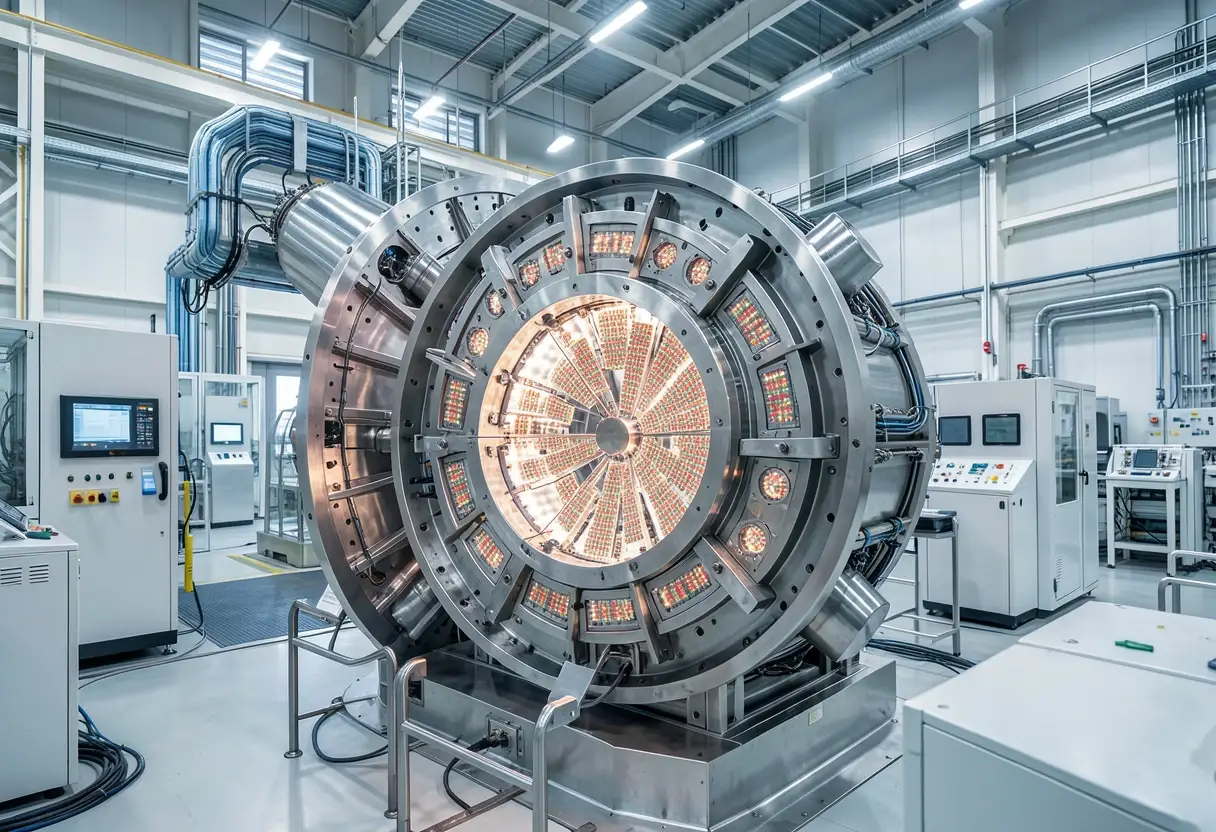
Physicists at CERN have found evidence for a particle decay so rare that it should occur roughly once in every ten billion decays of its parent particle, a neutral B meson. The LHCb collaboration reported the result in a preprint on arXiv and presented it at CERN, calling it the strongest evidence yet from a single experiment for a process scientists have chased for decades.
For practitioners, the value is immediate: this decay gives researchers a sharper test of the Standard Model, the theory that describes known elementary particles and most of the forces between them. An unexpected shift in how often the decay happens could point to particles or forces that have escaped other searches.
What exactly did the detector see?
The particle at the center of the study is the neutral B meson, which contains a beauty quark and a down antiquark. It survives for only a tiny fraction of a second before changing into other particles.
The team searched for cases in which a B meson produces two oppositely charged muons — heavier relatives of electrons. Muons also appear in many other processes, so scientists had to pick the pairs of interest out of a large background of lookalike pairs produced in collisions.
The upgraded detector recorded proton collisions in 2024 and 2025. Using those new data alone, the team found evidence at a level of three sigma. Combining the new data with earlier runs pushed the result to 3.2 sigma.
Sigma measures how strongly a signal stands out from what researchers would expect if only background processes were present. Particle physicists usually demand five sigma before calling a result a discovery, so this remains evidence, not a confirmed finding. Further observations are needed.
Takeaway: the signal is real enough to take seriously, but not yet strong enough to declare a discovery.
What changed in the hardware?
Part of the LHCb upgrade matters directly for this measurement. A new detector uses small silicon sensors to trace particle paths, and it sits just millimeters from the collider beams. That proximity helps identify where a particle was formed and where it decayed — the precision needed to isolate such a rare process from background noise.
The collaboration also improved measurements of a related decay in a different B meson, giving researchers a second channel to compare against theory.
Takeaway: better vertex resolution near the beamline is what made a three-signal-sigma result possible on 2024–2025 data alone.
Does the result break the Standard Model?
Not yet. The measured rates agree with the Standard Model within their uncertainty. That agreement still does useful work: it narrows the range of effects that undiscovered particles could have, even though the measurement itself has not revealed any departure from the theory.
This is the practical logic of rare-decay searches. A process seen once in ten billion times can reveal subtle differences that would be hard to detect in a more common decay, where larger effects would already have shown up.
Takeaway: a null result here still constrains what new physics can look like.
What happens next?
LHCb is expected to gather more data into the next decade. With a larger sample, the team can measure the rare decay more precisely and check whether its rate continues to match predictions. If the rate drifts away from the Standard Model as statistics grow, that drift would become the signal worth chasing.
The work was reported by the University of Manchester and CERN's LHCb collaboration.
Rare decays reward patience: one anomaly in ten billion could rewrite what physicists think they know.
via knowridge.com (Source)
More from Marcus Bennett
Show full bio
News editor covering regulation, policy and their impact on general science news at SciBeat.
370 articles
Nearby plates
- One in Ten Billion: LHCb Catches First Glimpse of Rarest Beauty Particle Decay
- CERN Catches Ultra-Rare Particle Decay After 40-Year Hunt
- CERN Experiments See Fresh Hints of Cracks in the Standard Model
- CERN's Super Proton Synchrotron Marks 50 Years of Particle Physics Firsts
- CERN Experiment Sees Gluons Act Collectively at Record-Small Scales