Plate Nº 33 · recorded November 9, 2026
PhysicsReported finding
CERN Catches Ultra-Rare Particle Decay After 40-Year Hunt
LHCb physicists report evidence for a one-in-ten-billion beauty meson decay, first hunted in 1984, with a rate consistent with Standard Model predictions.
By Marcus Bennett4 min read790 words
In brief
- LHCb measured the B0 meson decay into two muons at about 1.26 per 10 billion decays, versus a Standard Model prediction of 1.03.
- Combined with earlier data, the signal reaches 3.2 standard deviations — evidence, not yet the 5 needed for discovery.
- The hunt began in 1984 with the CLEO experiment's first upper limit.
- The sibling B0s decay was measured at 3.31 per billion, the most precise determination to date.
- The paper is submitted to Physical Review X (arXiv: 2611.00230).
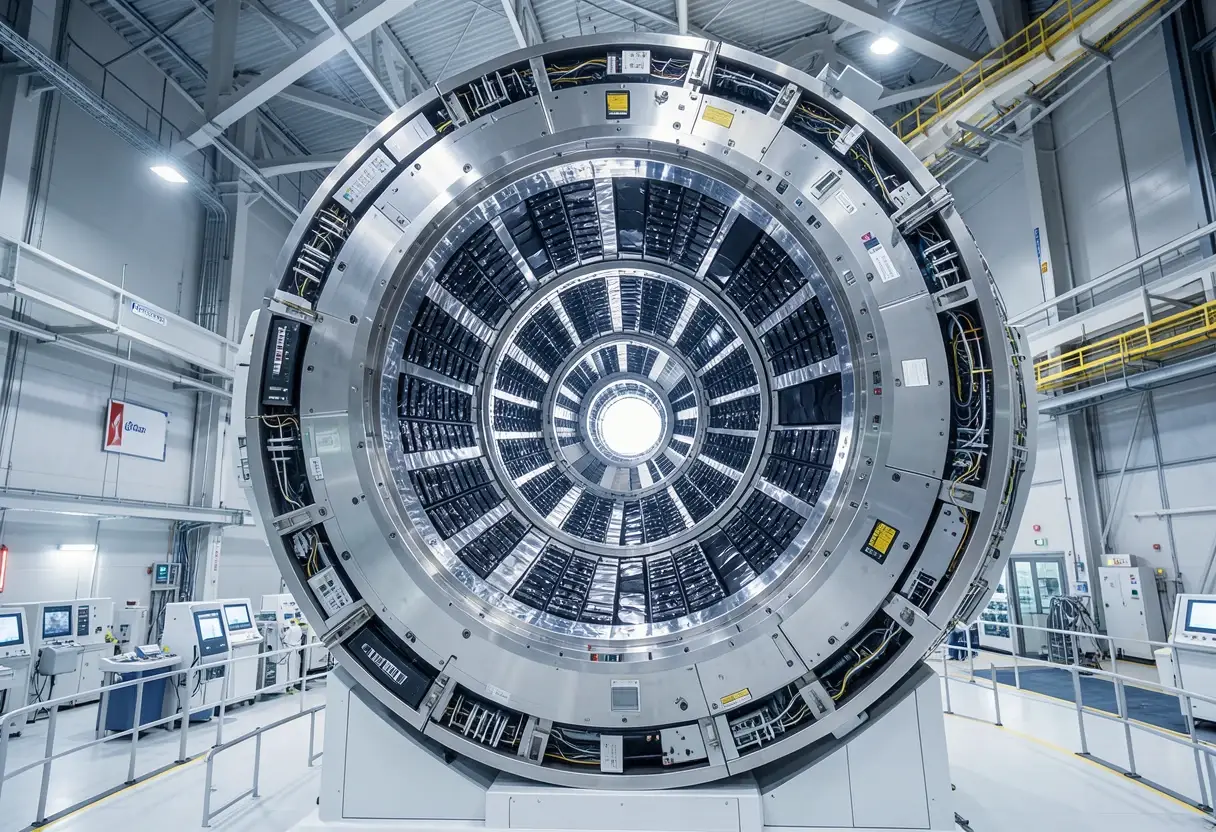
Physicists at CERN have announced evidence that the B0 meson decays into two muons roughly 1.26 times in every 10 billion decays — an ultra-rare process they have hunted since 1984. The result, reported today by the LHCb Collaboration at the Large Hadron Collider, agrees with the Standard Model of particle physics, the theory that describes known matter and forces.
The search outlasted the careers of many who started it. "Physicists have been chasing this decay for more than forty years," said Dr. Marco Santimaria of the INFN Laboratori Nazionali di Frascati. "Extreme precision is required to pick the muons out of the overwhelming background."
What exactly did LHCb see?
The decay involves a B0 (also written B0d or Bd) meson — a short-lived particle containing a beauty quark — turning into a pair of muons, the heavier cousins of the electron. The Standard Model predicts this should happen about once in every 10 billion B0 decays.
Dr. Harry Cliff, a physicist at the University of Cambridge's Cavendish Laboratory, put the difficulty plainly: "This process only happens for one in every ten billion beauty particles, so it's incredibly difficult to find."
The team submitted its paper to the journal Physical Review X (arXiv: 2611.00230). In the new data alone, they measured a branching fraction — the share of B0 mesons that decay this way — of about 1.26 in 10 billion, with a statistical uncertainty of roughly 0.5 in 10 billion. The Standard Model prediction is about 1.03 in 10 billion. Combined with earlier LHCb data, the measured value is 1.14 in 10 billion.
The observed excess over expected background carries a statistical significance of 3.0 standard deviations in the new data, rising to 3.2 when combined with earlier results. In plain terms: the odds such a signal would arise from random fluctuation are small, but the finding falls short of the 5-standard-deviation threshold physicists require to claim a discovery. Treat it as strong evidence, not confirmation.
The takeaway: the rarest B0 decay ever seen matches theory so far, but the case needs more data to close.
Why chase a one-in-ten-billion decay?
Because any deviation from the predicted rate would point to particles or forces the Standard Model does not include. Rare decays act as sensitive probes: new physics, if it exists, would distort their rates or timing in measurable ways.
Alongside the B0 result, the researchers improved measurements of a sibling process — the decay of the heavier B0s meson into two muons, which is more common but still extraordinarily rare. They measured its branching fraction at 3.31 per billion, against a Standard Model prediction of 3.66 per billion, and called it the most precise determination to date.
They also measured the B0s meson's effective lifetime in this decay, a quantity that can reveal contributions from new physics. The new result is 1.42 picoseconds — trillionths of a second — with a statistical uncertainty of 0.18; combined with earlier LHCb data, it is 1.60 picoseconds.
The takeaway: both the rate and the clock of these decays currently sit within reach of Standard Model expectations, tightening the leash on speculative new particles.
Four decades from first limit to evidence
The hunt began in 1984, when the CLEO experiment set the first upper limit on the decay's rate. Generations of experiments have refined that limit since. LHCb, one of four large detectors on the Large Hadron Collider, now does it with unprecedented sensitivity.
"When we saw the result for the first time, it was a really thrilling moment," Dr. Cliff said. "To see something that people had been searching for since before I was born was a real privilege."
Professor Guy Wilkinson of the University of Oxford tied the result to the experiment's long arc: "LHCb is a great success story of CERN, and one in which Oxford has been proud to play a leading role, dating back to the inception of the project in 1995. Today's announcement ushers in a new era of discovery for the experiment, and vividly demonstrates the increased sensitivity we have attained in our quest to probe beyond our current understanding of physics at the most fundamental level."
Professor Tim Gershon of the University of Warwick echoed the point: "This fantastic result showcases the extraordinary capabilities of LHCb to probe nature at the fundamental level."
Dr. Cliff framed what comes next in a single image: "We're knocking on the door of the Zeptoverse now. I can't wait to see what we find as we explore deeper."
The takeaway: after forty years, the signal is finally in hand — and the machine that found it keeps getting sharper.
via sci.news (Source)
More from Marcus Bennett
Show full bio
News editor covering regulation, policy and their impact on general science news at SciBeat.
370 articles
Nearby plates
- CERN physicists catch a one-in-ten-billion particle decay
- One in Ten Billion: LHCb Catches First Glimpse of Rarest Beauty Particle Decay
- CERN Experiments See Fresh Hints of Cracks in the Standard Model
- Big Bang Matter Appears in Small Collisions, Four LHC Teams Find
- CERN Experiment Sees Gluons Act Collectively at Record-Small Scales