Plate Nº 20 · recorded October 8, 2026
PhysicsReported finding
MIT Calculations Show Why a Neutrino Laser May Be Impossible
MIT calculations show violent atomic recoil and neutrinos' quantum nature prevent the particles from ever forming a laser-like beam, despite a bold proposal.
By Nathan Brooks3 min read552 words
In brief
- Trillions of neutrinos pass through every square inch of Earth each second.
- New MIT calculations show a proposed neutrino laser cannot take hold.
- Two blockers: violent atomic recoil and the neutrinos' quantum nature.
- Neutrinos interact almost solely via the weak force, passing through rock, stars, and bodies.
- The findings are theoretical calculations, not experimental measurements.
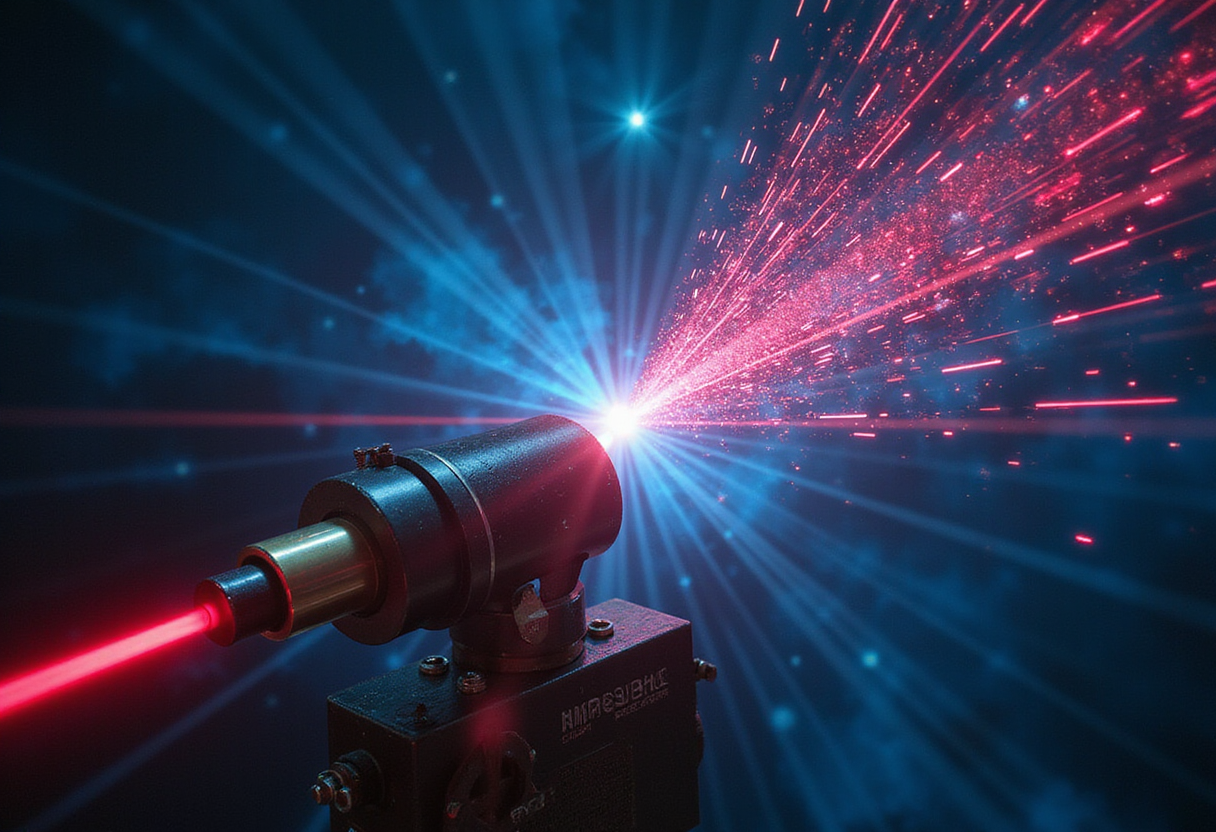
Trillions of neutrinos stream through every square inch of Earth every second, and a new MIT analysis explains why physicists will probably never corral them into a laser-like beam.
The study addresses a theoretical proposal: take these ghostly subatomic particles, which pass harmlessly through solid rock, massive stars, and human bodies, and focus them into a concentrated beam that works the way an ordinary laser focuses light. According to the MIT calculations, two factors block the idea — violent atomic recoil in any would-be emitter, and the neutrinos' own quantum nature.
Why are neutrinos so hard to capture?
Neutrinos are among the most elusive particles known. They carry no electric charge and interact with matter almost exclusively through the weak nuclear force, one of the four fundamental forces of nature. That weak interaction is what lets trillions of them cross every square inch of our planet each second without leaving a trace.
This same property makes them a terrible candidate for a laser. An ordinary laser works because photons — particles of light — are easy to emit, absorb, and stimulate. Neutrinos refuse to cooperate on all three counts. Any device trying to generate stimulated neutrino emission runs into the problem at the level of individual atoms.
What did the MIT calculations reveal?
The physicists calculated what would happen inside a hypothetical material engineered to emit neutrinos in an organized, laser-like cascade. Two obstacles emerged.
- Atomic recoil. When an atom emits a neutrino, it recoils like a gun firing a bullet. In the neutrino case, the researchers found this recoil is violent enough to disrupt the delicate alignment a laser needs.
- Quantum nature. Neutrinos behave as quantum objects, and their intrinsic quantum properties prevent the stimulated, coherent amplification that defines laser light from taking hold.
Together, these effects mean that even in principle, the conditions a neutrino laser requires fall apart before the beam can form.
How does a conventional laser work, and why doesn't the analogy hold?
A laser — the word stands for Light Amplification by Stimulated Emission of Radiation — builds a beam by prompting excited atoms to release photons of identical wavelength and phase. Mirrors bounce those photons back and forth, amplifying the cascade until a coherent beam escapes.
The proposal explored by the MIT team asked whether the same stimulated-emission logic could apply to neutrinos, potentially producing an intensely focused neutrino beam. The new calculations show the analogy breaks down. The mechanics of emission itself — recoil plus quantum behavior — works against coherence at every step.
What does this mean for physics?
The result is a negative finding, and those carry real weight in science. Ruling out a mechanism with careful calculations narrows the field of possibilities and sharpens future theoretical work. It also illustrates how the very properties that make neutrinos fascinating — their ability to pass through stars and planets untouched — are the same properties that make them nearly impossible to manipulate.
The findings are theoretical calculations rather than experimental measurements, so they describe what the mathematics predicts rather than what a laboratory test has confirmed. Still, for a particle this hard to catch, calculation is often the only practical tool.
For now, the trillions of neutrinos passing through your body each second will keep streaming, unfocused and unbothered, exactly as they have for billions of years.
via google.com (Original)