Plate Nº 46 · recorded October 10, 2026
Space & AstronomyReported finding
Gamma-Iron Phase Identified in Chang'e-6 Lunar Soil for First Time
Chinese scientists have identified face-centered cubic γ-Fe in Chang'e-6 lunar soil for the first time. The nanoscale particles in impact glass may preserve records of the moon's ancient magnetic field.
By Nathan Brooks2 min read486 words
In brief
- First confirmed identification of face-centered cubic γ-Fe in natural lunar samples, reported September 16 in PNAS.
- The team examined two impact-glass beads from the Chang'e-6 mission using focused ion beam and transmission electron microscopy.
- Larger γ-Fe nanoparticles formed a stable single-vortex magnetic state under an external field, measured by off-axis electron holography.
- Professor Du Haifeng of HFIPS led the study; first author is Pengfei Liu; DOI 10.1073/pnas.2608395123.
- γ-Fe normally requires temperatures above about 912 °C; trace carbon, rapid cooling, and a glassy matrix may have preserved it on the lunar surface.
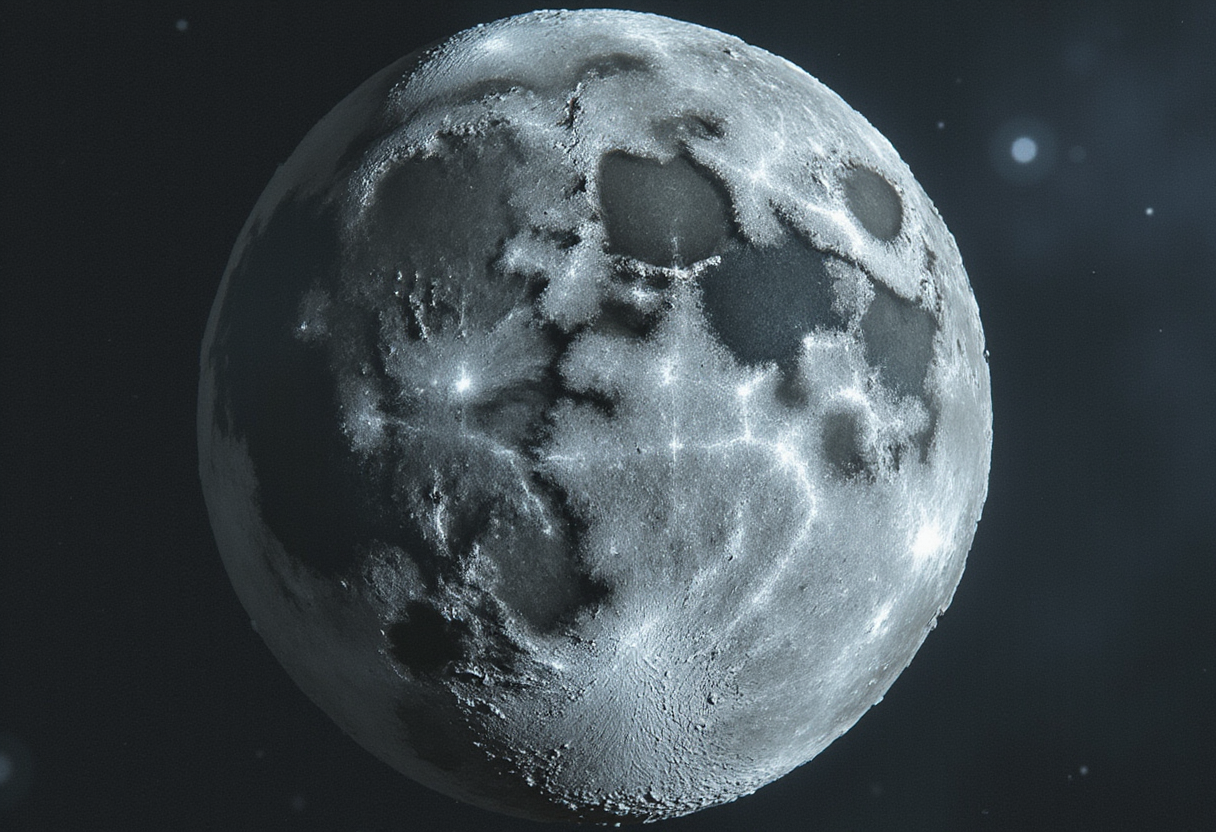
A Chinese research team has identified a rare form of metallic iron — face-centered cubic γ-Fe — inside glass particles from the Chang'e-6 lunar soil samples. It marks the first time scientists have confirmed this iron phase in natural lunar material.
The finding, published September 16 in the Proceedings of the National Academy of Sciences, could reshape how researchers read the moon's ancient magnetic record.
"This tiny magnetic fossil may help us better understand the moon's ancient magnetic history," said Dr. Li Long, a team member at the High Magnetic Field Laboratory of the Hefei Institutes of Physical Science (HFIPS), part of the Chinese Academy of Sciences (CAS).
What makes γ-Fe unusual?
Most metallic iron on Earth and in lunar samples takes the form of α-Fe, a body-centered cubic structure stable under ambient conditions. γ-Fe, by contrast, normally requires temperatures above about 912 °C. During cooling, it typically transforms back into α-Fe.
Professor Du Haifeng of HFIPS led the work. His team analyzed two impact-glass beads from Chang'e-6 and turned up numerous nanoscale iron particles. A fraction of those particles turned out to be γ-Fe. Researchers used focused ion beam preparation, transmission electron microscopy, and chemical analysis to confirm the identification.
How can γ-Fe survive on the lunar surface?
The team points to three factors that may have locked the high-temperature iron phase in place:
- Trace amounts of carbon and other impurity elements
- Rapid cooling of impact-generated melts
- The surrounding glassy matrix, which physically constrained the particles
Together, these conditions may have frozen γ-Fe in its high-temperature arrangement at lunar surface temperatures.
What does this tell us about the moon's magnetic past?
The moon lacks a global magnetic field today. Yet lunar rocks and soils still hold traces of an older field. Until now, scientists read that history mostly through α-Fe and other conventional magnetic minerals.
Using off-axis electron holography, the team mapped the magnetic structure of individual γ-Fe nanoparticles. Relatively large particles formed a stable single-vortex magnetic state and kept their magnetic response under an external field. Smaller particles behaved differently.
Because γ-Fe and α-Fe form under different conditions and carry different magnetic properties, they may preserve information from separate stages of lunar impacts.
What are the study's limits?
The researchers caution that their results are preliminary. They examined only two impact-glass samples. The exact conditions that stabilize γ-Fe on the lunar surface also remain incompletely understood.
The first author is Pengfei Liu. The team's paper, "Magnetic vortex state of natural lunar γ-Fe," appears in PNAS under DOI 10.1073/pnas.2608395123.
What comes next?
Follow-up studies with broader sample sets will test whether γ-Fe reliably records ancient magnetic fields — and whether it can refine the timeline of the moon's magnetic evolution.
via Phys.org Space & Astronomy (Source)
More from Nathan Brooks
Show full bio
Market editor covering companies, deals and strategy in general science news at SciBeat.
226 articles
Nearby plates
- Chang'e-6 Lunar Soil Hides a Microscopic Magnetic Time Capsule
- Electrons Crawl Together in a New Quantum State of Fe5GeTe2
- First Solar System Planetesimals Were 83–92% Chondrules, Study Finds
- 97-Million-Year-Old Magnetic Fossils May Be Oldest Animal 'GPS'
- Mercury's Surface Has Far Less Silicon Dioxide Than Expected