Plate Nº 98 · recorded October 10, 2026
Space & AstronomyReported finding
Mercury's Surface Has Far Less Silicon Dioxide Than Expected
Mercury's surface holds about 37 percent silicon dioxide — far less than expected — hinting its ancient lava rose from deeper, hotter mantle regions, a new study finds.
By Priya Raman4 min read709 words
In brief
- Mercury's surface contains about 37 percent silicon dioxide by mass, up to 25 percent less than previous estimates.
- The study, led by Christian Renggli, was published September 11, 2026, in the journal Planetary Research.
- Researchers calibrated infrared measurements using glass beads about half a millimeter across, then validated the method on the Moon using NASA Lunar Reconnaissance Orbiter data.
- ESA's BepiColombo mission is scheduled to enter Mercury orbit in November 2026; its MERTIS instrument will deliver higher-resolution infrared data.
- Mercury's volcanic activity may have largely ceased roughly one billion years after the planet formed.
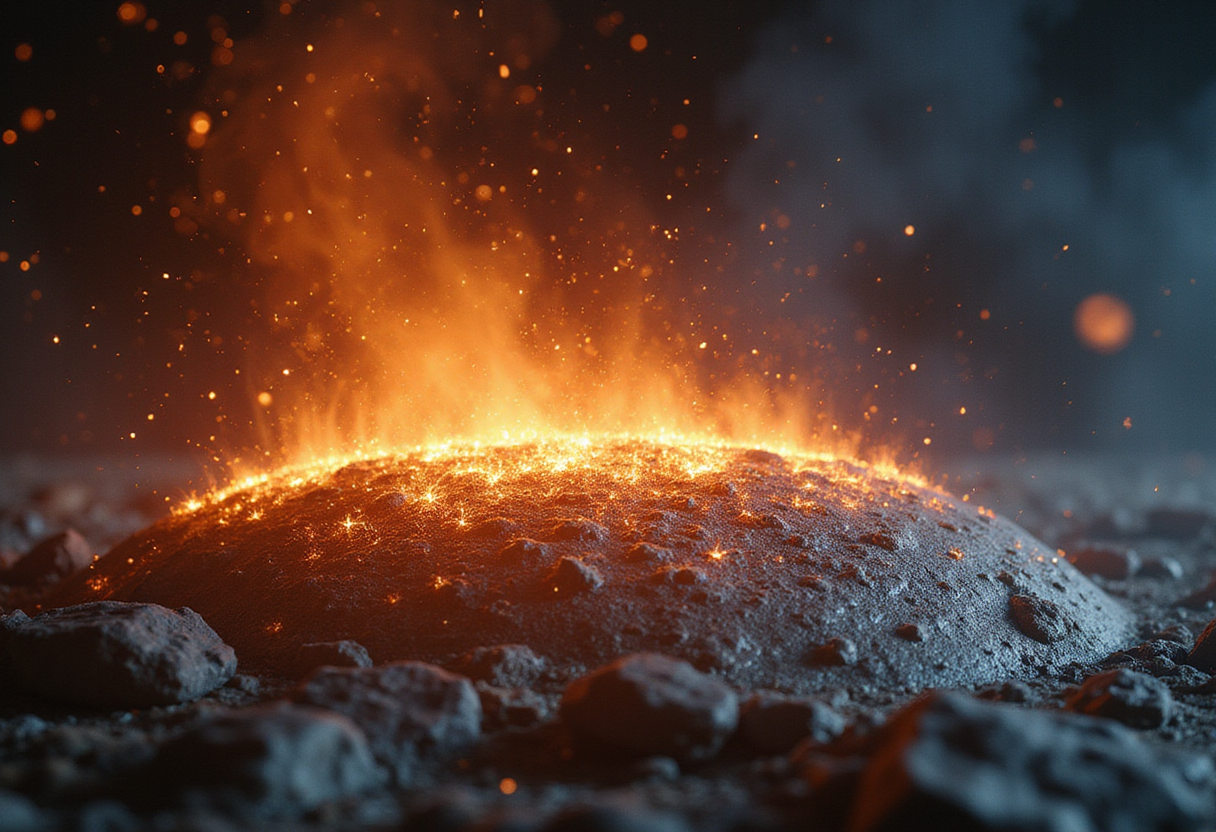
Mercury's surface contains about 37 percent silicon dioxide by mass — up to 25 percent less than earlier estimates — and that shortfall suggests the planet's ancient lava came from deeper, hotter parts of its mantle than scientists assumed.
Researchers at the Max Planck Institute for Solar System Research (MPS), together with the Universities of Münster and Göttingen in Germany, published the finding on September 11, 2026, in the journal Planetary Research. Their estimate is the most precise measurement yet of silicon dioxide — the chemical compound, made of one silicon atom and two oxygen atoms, that dominates sand and many volcanic rocks on Earth — on Mercury's surface.
"Our findings suggest that the volcanic rocks on Mercury formed from more deeply melted mantle material than previously assumed," said Christian Renggli, lead author of the study and head of the "Experimental Laboratory Magma Ocean" research group at MPS.
Why does a low silicon dioxide number matter?
The mantle is the layer beneath a planet's solid crust, and early in a planet's history much of it stays molten. As that melt cools, the first rocks to solidify contain relatively little silicon dioxide. Later lavas, crystallizing from the residual melt, carry progressively more of the compound.
By that logic, a surface unusually poor in silicon dioxide points to an unusual history. On Mercury, the new result suggests volcanic material rose from deeper mantle regions that melted extensively at very high temperatures — an interior hotter than scientists expected for a planet that apparently froze over early.
Roughly one billion years after Mercury formed, volcanic activity may already have largely ceased, leaving a solid, continuous rocky crust. Earth, by contrast, remains geologically active, with volcanoes and plate tectonics constantly reshaping its surface. An alternative explanation, the researchers note, is that Mercury's crust once held more silicon dioxide but gradually lost oxygen over time.
How do you measure a planet you've never touched?
No lander has ever operated on Mercury, and scientists have never collected a rock sample from its surface. Everything must be inferred from infrared radiation — heat radiation — emitted by the surface, which carries clues about which minerals and compounds are present. The hard part is translating those infrared signals into reliable chemistry estimates.
The team solved this with tiny glass beads, each about half a millimeter across and containing a precisely controlled amount of silicon dioxide. After measuring each bead's exact infrared properties, they used the beads as reference standards.
"The glass beads serve a similar function to calibration weights on a scale," explains Iris Weber of the University of Münster. "Their weight is known precisely. They therefore allow us to correctly interpret the scale's balance."
Why test the method on the Moon first?
Before pointing the technique at Mercury, the researchers validated it on the Moon, where they could check infrared estimates against real rocks returned by astronaut missions and unmanned spacecraft. Using measurements from NASA's Lunar Reconnaissance Orbiter, which has been circling the Moon since 2009, they produced the first complete map of silicon dioxide content across the lunar surface.
"The Moon is a kind of touchstone for us — and an important conceptual stepping stone on our way to Mercury," Renggli said.
Only after passing this "Moon test" did the team analyze infrared observations of Mercury taken from Earth, including data from the Bok Telescope at Steward Observatory in Arizona. Those observations produced the 37 percent estimate.
Can BepiColombo confirm the result?
A stronger test is coming soon. ESA's BepiColombo mission, built from two separable probes provided by ESA and JAXA, is scheduled to enter orbit around Mercury in November 2026. On September 3, 2026, both probes separated from their transport module, the first step toward that phase.
Once in position, the mission's MERTIS instrument — developed under the leadership of DLR with the Institute for Planetology at the University of Münster — will collect infrared measurements at substantially higher resolution. Those data could confirm whether Mercury truly carries so little silicon dioxide, and clarify the extreme conditions that shaped its crust billions of years ago.
"Our study lays the groundwork for deriving the most accurate information possible about the silicon dioxide content of Mercury's surface from BepiColombo's measurements," Renggli said.
via mps.mpg.de (Original)
More from Priya Raman
Show full bio
Senior reporter covering industry trends and analytics at SciBeat.
207 articles
Nearby plates
- Earth and Mars Were Built From Different Cosmic Recipes
- 3.1-Billion-Year-Old Rocks Show Water Fueled Early Volcanoes
- First Solar System Planetesimals Were 83–92% Chondrules, Study Finds
- Rocky Planets May Have Formed Just 100 Million Years After Big Bang
- Early galaxies were already seeding the universe with heavy elements