Plate Nº 48 · recorded October 30, 2026
Earth & ClimateReported finding
Deep-Earth Magma Can Store Hidden Oxygen, Study Finds
Experiments show magma absorbs over 5% of its weight in oxygen at 69,000 times surface pressure, hinting ancient eruptions helped oxygenate Earth's atmosphere between 2.5 and 2.0 billion years ago.
By Priya Raman4 min read838 words
In brief
- Magma at 7 gigapascals — about 69,000 times surface pressure — absorbed excess oxygen exceeding 5% of its weight.
- The study, led by HPSTAR researchers, was published in National Science Review on October 28, 2026.
- Experiments ran at 1200–1800 °C on synthetic mid-ocean ridge basalt.
- If magma erupted between 2.5 and 2.0 billion years ago released oxygen at 0.27% of its weight, it could theoretically match all oxygen in today's atmosphere.
- Raman spectroscopy confirmed the oxygen entered the glass structure rather than forming bubbles.
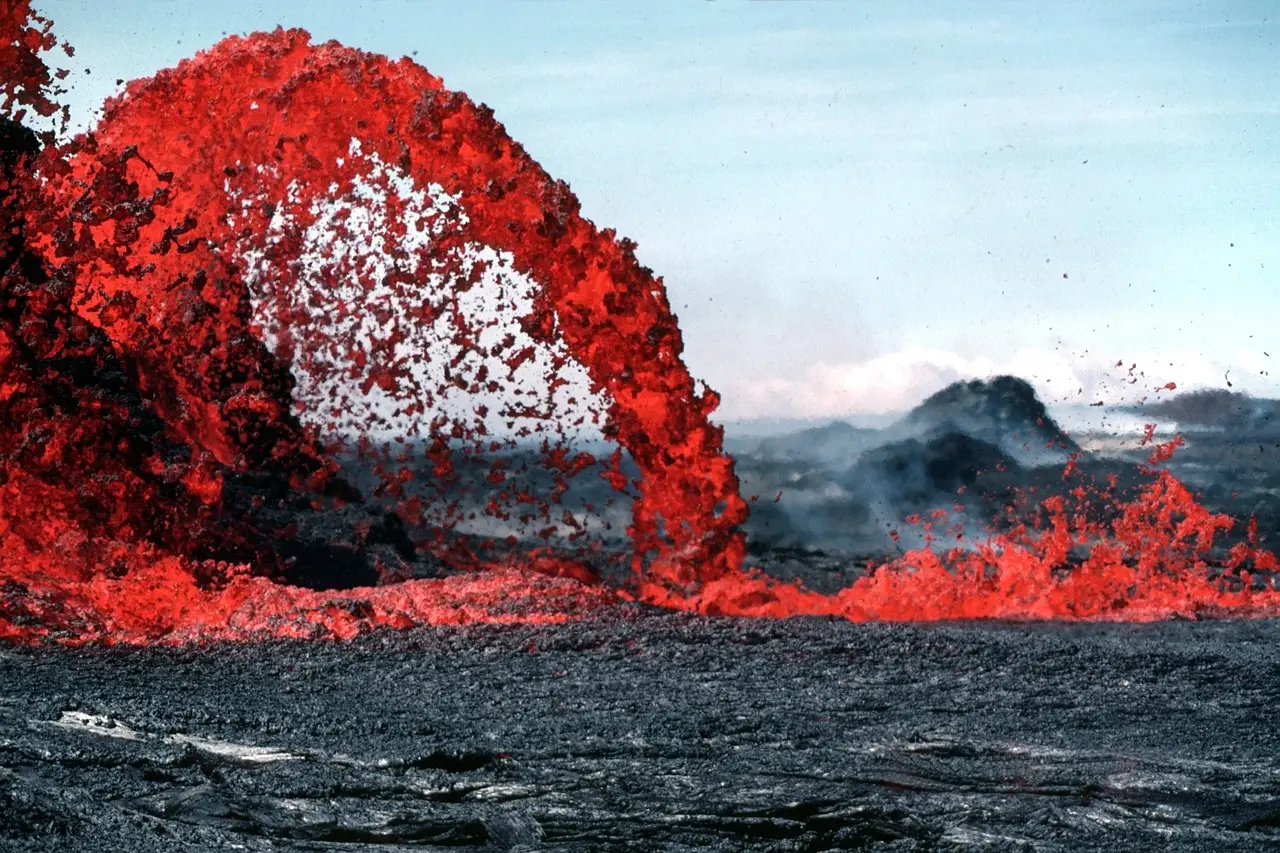
Magma held at pressures roughly 69,000 times that at Earth's surface absorbed oxygen equal to more than 5% of its weight, according to experiments published on October 28, 2026, in National Science Review. The finding challenges a long-standing assumption in geoscience: that molten rock can hold only the amount of oxygen dictated by its chemical composition.
The discovery emerged from a laboratory in which researchers recreated the conditions of Earth's deep interior. Dr. Yanhao Lin and Dr. Ho-kwang Mao of the Center for High Pressure Science and Technology Advanced Research (HPSTAR) led the work, together with Prof. Haiyang Niu of Northwestern Polytechnical University and Prof. Wim van Westrenen of Vrije Universiteit Amsterdam.
Why did scientists doubt magma could hold extra oxygen?
Oxygen accounts for more than half of the atoms in Earth's silicate interior — the minerals and molten materials, built mainly of silicon and oxygen, that form the mantle and crust. Yet researchers have traditionally assumed that magma's oxygen content is fixed by the quantities and electrical charge states of other elements it contains, such as silicon, magnesium and iron.
Water and carbon dioxide behave differently. These volatile components (substances that dissolve in magma and escape as gases when pressure drops) can be absorbed and released independently, and their escape drives volcanic activity. Oxygen, by contrast, has never been treated as an independent volatile substance in molten rock.
The new study suggests that assumption may need to change.
How did the team find the hidden oxygen?
The researchers heated a synthetic version of mid-ocean ridge basalt — the volcanic rock produced where tectonic plates pull apart beneath the oceans — in piston-cylinder and cubic presses. They exposed samples to pressures from normal atmospheric pressure up to 7 gigapascals, at temperatures between 1200 and 1800 °C, and added platinum oxide (PtO2) to create an oxygen-rich environment.
After rapidly cooling the melt into glass, the team measured its composition and calculated how much oxygen was needed to balance the other elements, together with the oxygen locked in water and carbon dioxide. Whatever remained unaccounted for they called "excess oxygen."
The results showed a clear pattern:
- At atmospheric pressure, the glass held almost no excess oxygen.
- At 7 gigapascals, excess oxygen exceeded 5% of the sample's weight.
- Control experiments without added platinum oxide yielded only 0.2% to 0.5% by weight.
Raman spectroscopy (a technique that identifies substances by how they interact with light) found no signature of oxygen gas in the glass, indicating the oxygen had entered the material's structure rather than forming trapped bubbles. Some oxygen may even have escaped during cooling, so the true storage capacity could be higher.
What did the computer simulations show?
Prof. Niu led theoretical simulations using deep neural network models, which approximate the accuracy of ab initio calculations — descriptions of atomic behavior based on quantum mechanics. Although the simulated system contained only magnesium, silicon and oxygen, it reproduced the experimental trend: oxygen storage rose with pressure.
The models revealed that as more oxygen entered the melt, the electrical charges on oxygen atoms became more varied, and a small fraction formed peroxide-like bonds, in which oxygen atoms bond to each other. These changes help explain how molten rock accommodates oxygen beyond conventional chemical predictions. The behavior mirrors that of water and carbon dioxide, which also grow more soluble in magma as pressure increases.
The researchers propose that oxygen should now be recognized as an independent component of silicate melts.
Could ancient volcanoes have oxygenated the atmosphere?
The discovery points to a possible mechanism linking Earth's interior to its air. Magma forming in oxidized regions of the mantle could absorb excess oxygen under immense pressure, then release it as it rises and pressure falls, gradually increasing the oxidation (electron-transfer processes) of the upper mantle, crust and atmosphere.
The timing is suggestive. Between roughly 2.5 billion and 2.0 billion years ago, atmospheric oxygen rose sharply — an interval overlapping the formation of some of Earth's largest large igneous provinces, vast regions of rock created by enormous magma outpourings.
The team's preliminary calculation illustrates the potential scale: if magma erupted during that period released excess oxygen equal to just 0.27% of its weight, the total could theoretically match all the oxygen in today's atmosphere. The researchers stress this does not prove volcanoes supplied that oxygen; it shows how a small fractional release from immense magma volumes could have planetary consequences.
What comes next?
The findings may reshape models of ancient magma oceans — molten regions thought to have existed during the early evolution of rocky planets — and add a new factor to volcanic degassing, the process by which gases escape molten rock. The work may also aid the study of habitable environments beyond Earth, though much remains uncertain about how much oxygen natural magmas carry and how much reaches the surface.
Some of the processes behind Earth's breathable air, it seems, may have begun far beneath our feet.
via dx.doi.org (Original)
More from Priya Raman
Show full bio
Senior reporter covering people, launches and day-to-day practice in general science news at SciBeat.
342 articles
Nearby plates
- Mercury's Surface Has Far Less Silicon Dioxide Than Expected
- Study suggests Earth’s core carbon came from outer solar system
- 3.1-Billion-Year-Old Rocks Show Water Fueled Early Volcanoes
- Mount Etna's Hidden Plumbing: Two Eruptions, Two Speeds
- Earth's Carbon May Have Arrived Late, From the Outer Solar System