Plate Nº 19 · recorded October 13, 2026
Earth & ClimateReported finding
Mount Etna's Hidden Plumbing: Two Eruptions, Two Speeds
A Cornell-led team found that Mount Etna's 122 B.C. eruption took weeks to reach the surface, while an older event rose from 24 to 30 kilometers and burst out in hours, with volcanic gas chemistry driving the difference.
By Priya Raman4 min read782 words
In brief
- Mount Etna's 122 B.C. eruption saw magma rise from about 22 kilometers, stall at 2 to 5 kilometers, and emerge weeks later after releasing gas.
- The earlier Fall Stratified event, roughly 4,000 years ago, sent magma from 24 to 30 kilometers underground to the surface within hours.
- High carbon dioxide concentrations are linked to fast, deep ascent; higher water content is linked to shallower, slower processes.
- The study used Raman spectroscopy to read microscopic bubbles, 1 to 10 percent the thickness of a human hair, inside crystals from the magma.
- Findings appeared in Geochemistry, Geophysics, Geosystems in 2026, led by Esteban Gazel and first author Maxim Gavrilenko of Cornell.
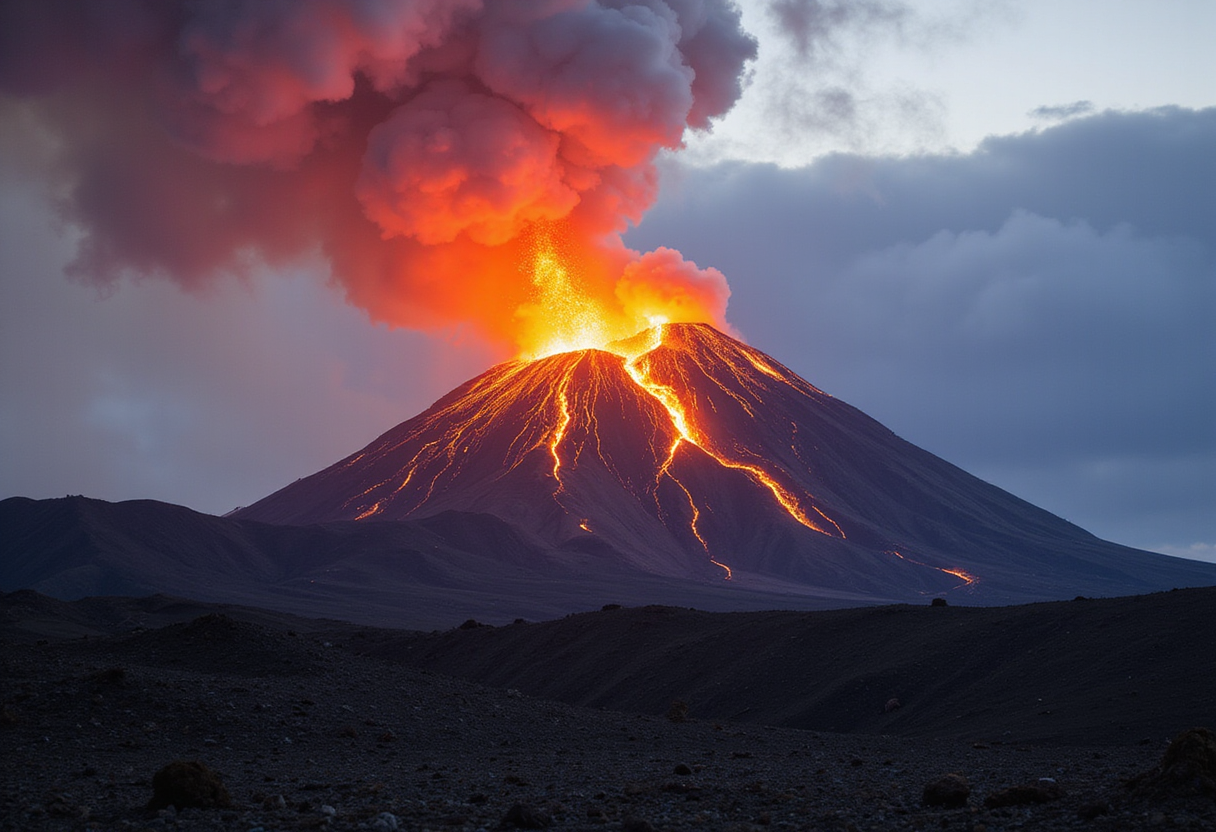
Mount Etna's 122 B.C. eruption took weeks to unfold. Magma rose from roughly 22 kilometers underground, stalled at 2 to 5 kilometers, and emerged after slowly releasing gas. The earlier Fall Stratified event, roughly 4,000 years ago, behaved with starkly different urgency: magma traveled from 24 to 30 kilometers down and surfaced within hours.
A Cornell-led team has now traced the contrast to volcanic gases, specifically the relative amounts of carbon dioxide and water dissolved in the rising melt. The findings, published recently in Geochemistry, Geophysics, Geosystems, suggest that gas chemistry can set the pace of an eruption.
How do scientists reconstruct volcanic plumbing?
The researchers built their timeline by examining crystals that grew inside the magma chamber. First author Maxim Gavrilenko, a former postdoctoral researcher at Cornell, used Raman spectroscopy (a laser-based technique that identifies molecules by how they scatter light) to measure carbon dioxide density in microscopic bubbles trapped inside those crystals.
"That technique gives us the density of CO₂, and using a state equation we can transform that density into pressure, and pressure can be transformed into depth," Gavrilenko said. "Then we apply those techniques to these explosive eruptions, and we are able to reconstruct the plumbing system with an unprecedented precision."
The bubbles measure about 1 to 10 percent the thickness of a human hair, yet they preserve a record of the pressure, and therefore the depth, at which the surrounding crystal formed.
What controls an eruption's speed?
Project leader Esteban Gazel, the Charles N. Mellowes Professor in the Department of Earth and Atmospheric Sciences at the Cornell Duffield College of Engineering, drew a comparison to a carbonated drink. "Imagine a bottle of soda. If you open that bottle without agitating it, you can drink it, but if you shake it up, all the bubbles get separated really fast, and you have an explosion," Gazel said. "Volcanoes work in a similar way, and my lab is trying to quantify these processes."
Volcanologists call those dissolved gases volatiles. Water has long stood as the dominant driver of eruptions. A 2023 paper from Gazel's group showed that carbon dioxide can also fuel explosive activity, and the new Etna work sharpens that picture.
The 122 B.C. eruption was a Plinian event, the most explosive class of volcanic eruption, named for Pliny the Elder, who described the 79 A.D. destruction of Pompeii. Its mafic magma (relatively fluid rock rich in magnesium and iron) stalled at shallow depth for weeks before breaking through.
The Fall Stratified event showed a much higher concentration of carbon dioxide, which the team linked to its swift ascent.
"Some volcanoes are only high CO₂, mostly in oceanic islands, and some volcanoes are mostly controlled by water, such as the ones in subduction zones," Gazel said. "Etna is one of the few volcanoes in the world where you have the two volatile species competing. This shows that at a certain threshold of CO₂, the eruption will come from very deep and really fast, but when you have a higher threshold of water, then the process is controlled at shallow levels."
What does the finding change for risk assessment?
Co-authors Terry Plank of Columbia University and Bruce Houghton of the University of Hawaiʻi at Mānoa collected samples directly from Etna. The team now applies the same Raman approach to volcanoes in Chile, Hawaiʻi, and elsewhere.
"Ideally this should be done in every volcano on the planet," Gazel said. "This is data we need for physical models of eruptions that are the base of risk assessment."
By determining where magma begins its ascent, how quickly it travels, and which gas dominates, researchers aim to build more realistic eruption models. The payoff could matter most for the communities that live on Etna's slopes, where even a "gentle" volcano has produced violent eruptions over the millennia.
Mythology beneath the mountain
Etna carries a cultural history that stretches back to antiquity. In Greek myth, the Olympian gods buried the giants Typhon and Enceladus beneath the volcano after defeating them. Gazel sees a parallel with the team's findings.
"There may be the two giant mythological monsters under Etna," Gazel said. "And if you look at the plumbing system of the Plinian eruption, it's like Typhon, because it's elongated and serpentine, and the other one is Enceladus, because it's kind of smaller. If you work in Etna, it's hard not to be connected to history, classical work and great food."
Additional co-authors include Cornell postdoctoral researchers Kyle Dayton and Ellyn Huggins, and Anna Barth of the University of California, Berkeley. The research was supported by the National Science Foundation.
via news.cornell.edu (Original)
More from Priya Raman
Show full bio
Senior reporter covering people, launches and day-to-day practice in general science news at SciBeat.
226 articles