Plate Nº 20 · recorded October 10, 2026
Earth & ClimateReported finding
Tonga Plume Broke Down Methane for 10 Days, Study Finds
Satellites tracked the Hunga Tonga plume for 10 days and spotted record formaldehyde levels — a fingerprint of methane destruction. The chemistry could reshape climate accounting and inspire methane-removal methods.
By Marcus Bennett4 min read813 words
In brief
- The Hunga Tonga-Hunga Ha'apai eruption in January 2022 destroyed methane in its plume for at least 10 days.
- The plume removed about 900 megagrams of methane per day, equal to the daily emissions of roughly two million cows.
- The volcano also released around 300 gigagrams of methane, about the annual methane output of more than two million cows.
- The findings were published on September 15, 2026 in Nature Communications.
- Methane is roughly 80 times more heat-trapping than carbon dioxide over a 20-year period and stays in the atmosphere for about 10 years.
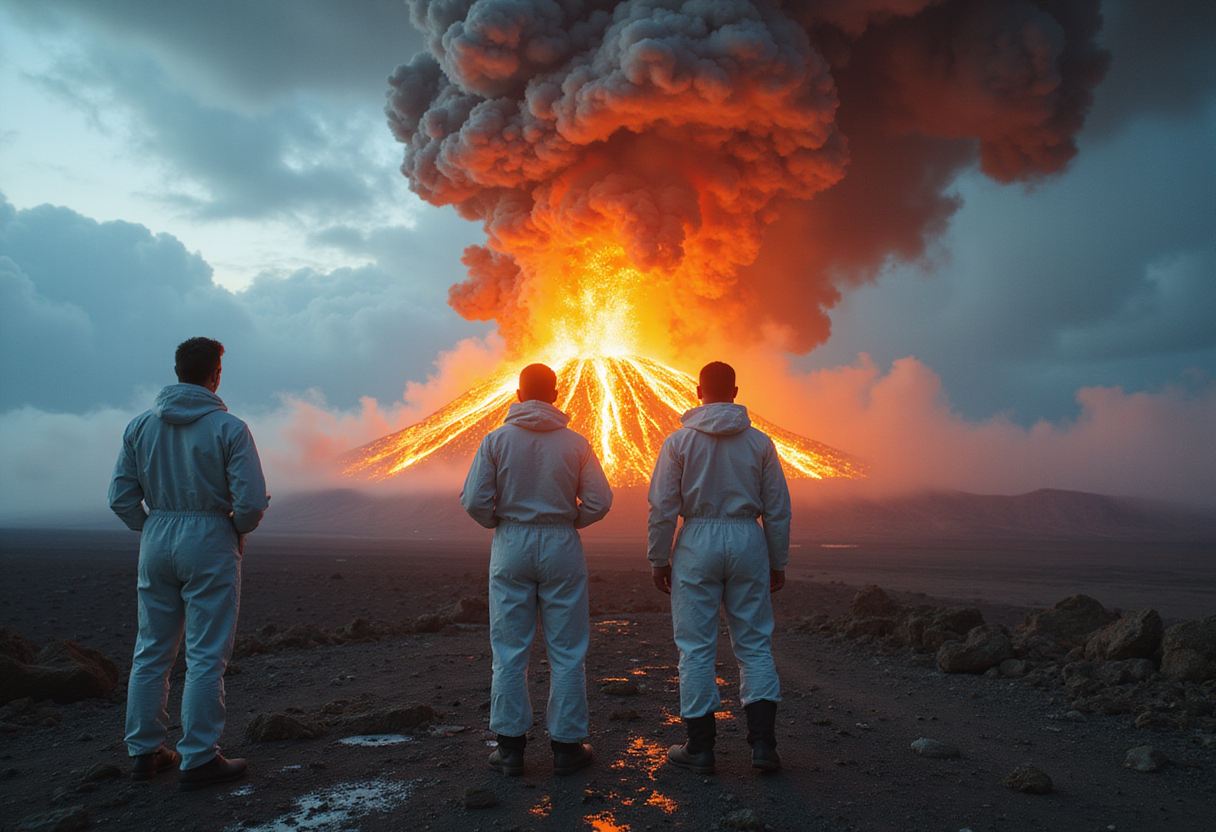
The January 2022 eruption of Hunga Tonga-Hunga Ha'apai, an undersea volcano in the South Pacific, destroyed methane in its own ash cloud for at least 10 days, according to satellite data published September 15, 2026 in Nature Communications. The plume removed roughly 900 megagrams of methane per day — about as much as two million dairy cows release daily.
What did the Tonga eruption do to methane?
When the volcano blew, it injected about 300 gigagrams (Gg) of methane into the atmosphere. That is roughly the annual methane output of more than two million cows.
Yet the eruption's massive plume also appears to have destroyed a portion of that methane. Scientists tracked the cloud across the Pacific to South America using TROPOMI, an instrument aboard the European Space Agency's Sentinel-5P satellite. They spotted record-high formaldehyde levels inside the plume.
Formaldehyde is a short-lived chemical. It forms during the reactions that break methane apart and survives only a few hours. So a continuous formaldehyde signal across 10 days acts as a fingerprint of ongoing methane destruction.
"When we analyzed the satellite images, we were surprised to see a cloud with a record-high concentration of formaldehyde," said Dr. Maarten van Herpen of Acacia Impact Innovation BV, the study's first author. "Because formaldehyde only exists for a few hours, this showed that the cloud must have been destroying methane continuously for more than a week."
How did volcanic ash help break down methane?
The mechanism was first identified in 2023, but in a very different setting. Saharan dust mixing with sea salt from breaking waves produced iron salt aerosols — tiny airborne particles. Sunlight striking those particles released chlorine atoms, which attacked methane.
The Tonga plume appears to have run the same chemistry, but high in the stratosphere, not near the ocean surface. Because the volcano erupted underwater, it blasted salty seawater upward with the ash. Sunlight striking that salty, dusty mix generated highly reactive chlorine, which then chewed through methane.
"What is new — and completely surprising — is that the same mechanism appears to occur in a volcanic plume high up in the stratosphere, where the physical conditions are entirely different," said Professor Matthew Johnson of the University of Copenhagen's Department of Chemistry.
The satellite also saw plenty of sulfur dioxide in the plume. That forced the team to recalibrate TROPOMI's sensitivity to formaldehyde at unusual altitudes.
"Retrieving formaldehyde from TROPOMI in a stratospheric volcanic plume is far outside the instrument's standard operating conditions," said Dr. Isabelle De Smedt of the Royal Belgian Institute for Space Aeronomy. "Getting these corrections right was essential to confirm that what we were seeing was real."
Why does destroying methane matter for climate?
Methane drives roughly one-third of today's warming. Though far less abundant than carbon dioxide, methane traps heat about 80 times more efficiently over 20 years. It also disappears faster — usually within about 10 years, while CO₂ lingers far longer.
That short lifetime makes methane an attractive target for quick climate action. Cut methane emissions now and the climate may begin responding within a decade. Researchers sometimes call methane cuts an "emergency brake" on near-term warming, though they warn it cannot replace deep cuts in CO₂.
Could scientists copy the volcano's trick?
The Tonga plume offers a natural proof of concept for atmospheric methane removal — a field that explores whether humans can speed up methane breakdown.
"It's an obvious idea for industry to try to replicate this natural phenomenon — but only if it can be proven to be safe and effective," Johnson said. "Our satellite method could offer a way to help figure out how humans might slow global warming."
A major hurdle lies in measurement. Atmospheric methane spreads across the entire globe, so small changes are hard to verify.
"How do you prove that methane has been removed from the atmosphere? How do you know your method works? It's very difficult," said Dr. Jos de Laat of the Royal Netherlands Meteorological Institute, the study's senior author. "But here we address that problem by showing that methane breakdown can in fact be observed using satellites."
How will this change climate accounting?
The methane budget is the ledger scientists use to track methane sources and sinks. Previous estimates have not accounted for the gas-destroying power of mineral dust.
"We now know that atmospheric dust — for example from a volcanic eruption — impacts the methane budget, meaning the budget of how much methane is added to the atmosphere and how much is removed," Johnson said. "Because dust has not previously been taken into account, it is important that we correct the data on which these estimates are based."
The research team included van Herpen, De Smedt, Daphne Meidan, Alfonso Saiz-Lopez, Johnson, Thomas Röckmann, and de Laat. Spark Climate Solutions funded the work.
via dx.doi.org (Original)
More from Marcus Bennett
Nearby plates
- Anak Krakatau Eruption Sent Ash 50,000 Feet, Disrupted 3,000 Flights
- Ancient Mars Rains May Have Delivered a Life-Starting Molecule
- A Famous 2-Billion-Year-Old Signal From Early Earth May Be Local, Not Global
- Diverting Food Scraps From Landfills Could Cut US Methane by 6%
- Indonesia's Underground Peat Fires Are Surging Early in 2026