Plate Nº 77 · recorded October 30, 2026
Earth & ClimateReported finding
Japan's Kikai Supervolcano Is Refilling With Fresh Magma, Study Finds
Seismic surveys show fresh magma refilling Japan's Kikai caldera 7,300 years after its giant eruption, offering clues to how Yellowstone-scale supervolcanoes recharge.
By Elena Vasquez4 min read824 words
In brief
- Kikai caldera erupted gigantly about 7,300 years ago — the largest known eruption of the Holocene.
- Seismic surveys revealed a large magma reservoir directly beneath the ancient eruption site.
- A lava dome has been growing near the caldera center for roughly 3,900 years.
- Chemical differences suggest the magma is newly injected, not leftover residue.
- The study, led by Nobukazu Seama, appeared in Communications Earth and Environment (2026).
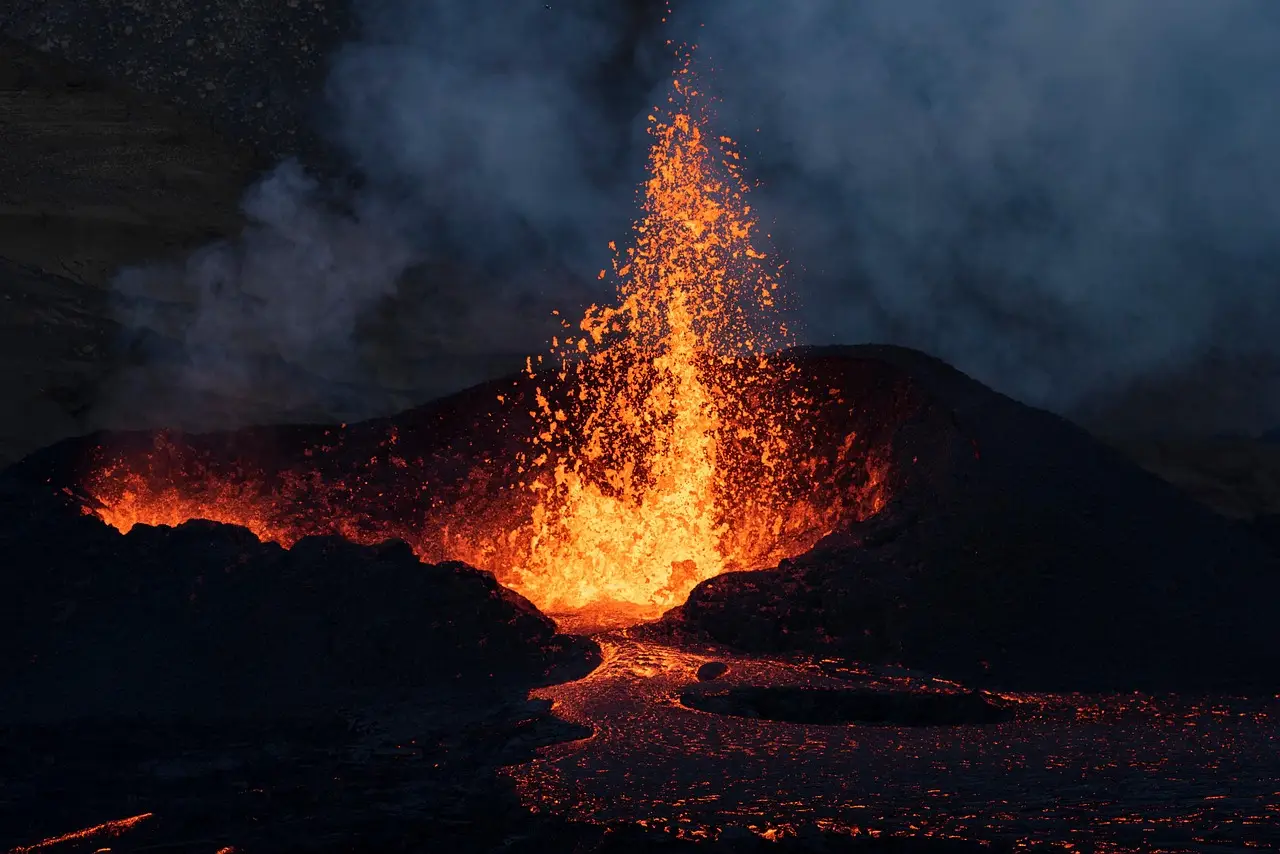
A giant magma reservoir is refilling beneath Japan's Kikai caldera, 7,300 years after the volcano produced the largest known eruption of the current geological epoch. Scientists at Kobe University say the molten rock now accumulating there is fresh material injected from deep in the Earth, not leftover from the ancient catastrophe.
The findings, published in Communications Earth and Environment, offer a rare window into how supervolcanoes rebuild their magma supplies after catastrophic eruptions. They could also help explain why other giant caldera systems, including Yellowstone in the United States and Toba in Indonesia, hold large magma reservoirs close to the surface.
"This means that the magma that is now present in the magma reservoir under the lava dome is likely newly injected magma," said Kobe University geophysicist Nobukazu Seama, who led the research.
What makes a supervolcano?
Some eruptions are so vast they reshape the landscape. The volumes involved are staggering: enough magma, in principle, to bury all of New York City's Central Park under a layer roughly 12 kilometers (7.5 miles) thick.
When that much material escapes, the ground above the emptied reservoir can collapse. The result is a caldera — a broad, shallow depression in the crust. Yellowstone, Toba and Kikai are all caldera systems.
Kikai, which lies mostly beneath the ocean south of Japan, last erupted gigantly about 7,300 years ago. That event was the largest known eruption of the Holocene, the geological epoch that began roughly 11,700 years ago and continues today.
Scientists know these systems can erupt more than once. What they don't fully understand is how the enormous quantities of magma required for such events accumulate underground. That gap makes it extremely hard to anticipate the next major eruption.
"We must understand how such large quantities of magma can accumulate to understand how giant caldera eruptions occur," Seama said.
How did the team see beneath the seafloor?
Kikai's underwater location is actually an advantage. The surrounding seafloor lets researchers run extensive geological surveys across the whole volcanic structure.
"The underwater location allows us to implement systematic, large-scale surveys," Seama explained.
The Kobe University team worked with the Japan Agency for Marine-Earth Science and Technology (JAMSTEC). They fired powerful airgun arrays to generate seismic pulses that traveled through the crust beneath the ocean floor. Ocean bottom seismometers — instruments sitting on the seabed — recorded how the waves moved through the rock.
The method works because seismic waves travel differently through solid rock than through zones containing molten material. Analyzing that behavior lets scientists map structures no camera can reach.
The surveys revealed a substantial region with a high proportion of magma directly beneath the site of the eruption 7,300 years ago. Its position and extent indicate it occupies the same storage system that fed the ancient blast.
"Due to its extent and location it is clear that this is in fact the same magma reservoir as in the previous eruption," Seama said.
Why is the magma considered fresh?
Two earlier lines of evidence point to recharge rather than residue.
- A new lava dome has been building near the center of the caldera for roughly the past 3,900 years. A lava dome forms when thick, sticky lava piles up around a vent instead of flowing away.
- Chemical analyses show material from that dome and other recent activity differs in composition from what the giant eruption released.
That compositional difference is the key clue. It suggests molten rock has entered the reservoir from deeper within the crust or mantle since the eruption.
The finding does not mean another catastrophe is imminent. Rather, it shows how a reservoir can refill over thousands of years — a process scientists must grasp before they can reliably assess a supervolcano's long-term behavior.
What does this mean for Yellowstone?
The implications reach beyond Japan. Researchers believe the same re-injection process may explain why calderas like Yellowstone and Toba hold large, shallow magma bodies.
"This magma re-injection model is consistent with the existence of large shallow magma reservoirs beneath other giant calderas like Yellowstone and Toba," Seama said.
Next, the team wants to sharpen the seismic techniques used at Kikai to track magma movement and storage in finer detail.
"We want to refine the methods that have proved to be so useful in this study to more deeply understand the re-injection processes," Seama said. "Our ultimate goal is to become better able to monitor the crucial indicators of future giant eruptions."
The research was funded by MEXT's Third Earthquake and Volcano Hazards Observation and Research Program and the Japan Society for the Promotion of Science (grant 20H00199). The study's full author list includes Akihiro Nagaya, Nobukazu Seama, Gou Fujie, Satoru Tanaka, Hiroko Sugioka and Shuichi Kodaira.
In short: a supervolcano that once remade the region is quietly rebuilding its fuel supply, and scientists now have a model for how it happens.
via kobe-u.ac.jp (Original)
More from Elena Vasquez
Show full bio
Correspondent covering money, funding and market shifts around general science news at SciBeat.
288 articles