Plate Nº 35 · recorded October 10, 2026
Earth & ClimateReported finding
Pacific Northwest Subduction Zone Is Tearing Itself Apart
Seismic images reveal a 75-kilometer tear ripping through the oceanic slab off Vancouver Island, offering the clearest view yet of a subduction zone in the act of shutting down piece by piece.
By James Calloway4 min read888 words
In brief
- Researchers identified a 75-kilometer-long tear running through the oceanic plate off Vancouver Island.
- One fault shows an offset where part of the slab has dropped by roughly 5 kilometers.
- The data came from the NSF-funded 2021 Cascadia Seismic Imaging Experiment (CASIE21) using a 15-kilometer-long streamer of underwater microphones.
- The study was published in Science Advances and led by Brandon Shuck of Louisiana State University.
- Each individual breakup episode can take several million years to complete.
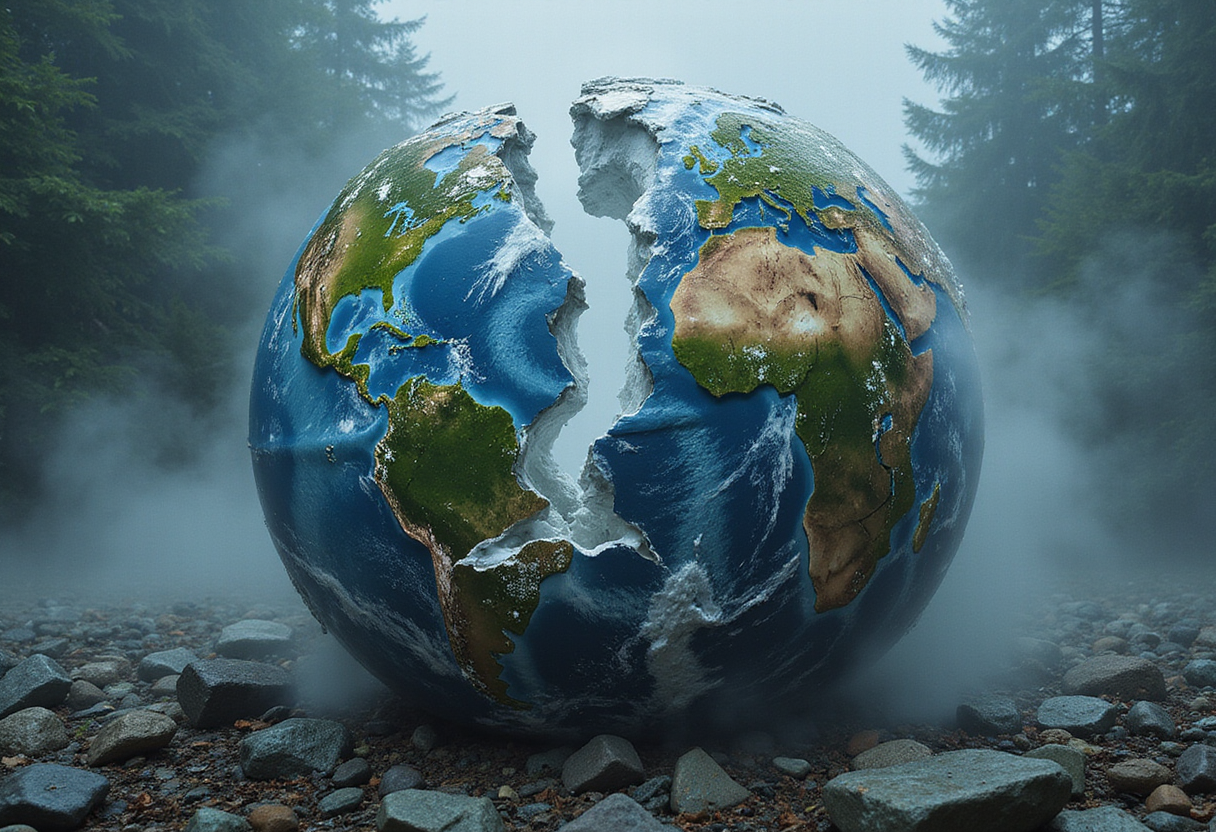
A 75-kilometer-long tear is ripping through the oceanic plate off Vancouver Island, according to a study published in Science Advances. The finding offers the clearest view yet of a subduction zone — a region where one of Earth's tectonic plates dives into the hot mantle — in the act of shutting down.
Subduction zones drive the planet's largest earthquakes and most explosive volcanoes. They can stay active for millions of years, but they must eventually stop. Otherwise, continents would collide into a single landmass and oceans would vanish.
What actually causes a mature subduction zone to end is a question that has long puzzled geologists. The new answer: it comes apart in pieces.
What does a dying subduction zone look like?
Brandon Shuck, a geologist at Louisiana State University and lead author of the study, compares subduction to a runaway train. "Getting a subduction zone started is like trying to push a train uphill -- it takes a huge effort," he said. "But once it's moving, it's like the train is racing downhill, impossible to stop. Ending it requires something dramatic — basically, a train wreck."
The Cascadia subduction zone, where the small Juan de Fuca and Explorer plates slide beneath the North American plate, appears to be experiencing just that kind of wreck — except spread across millions of years.
Researchers combined earthquake records with seismic reflection imaging during the NSF-funded 2021 Cascadia Seismic Imaging Experiment, known as CASIE21. A ship sent sound waves into the seafloor. A 15-kilometer-long streamer of underwater microphones recorded the echoes. The technique works much like a medical ultrasound for Earth.
How is the plate actually breaking?
Several large faults cut through the sinking slab. One especially dramatic feature shows an offset where part of the plate has dropped by roughly five kilometers. Along a separate tear stretching about 75 kilometers, some sections still produce earthquakes while others have gone silent.
That difference matters. Earthquakes occur when connected blocks of rock build up stress and suddenly slip. "Once a piece has completely broken off, it no longer produces earthquakes because the rocks aren't stuck together anymore," Shuck explained. The quiet stretches therefore mark plate that has already separated. That detached area is slowly expanding, according to the researchers.
"This is the first time we have a clear picture of a subduction zone caught in the act of dying," Shuck said. "Rather than shutting down all at once, the plate is ripping apart piece by piece, creating smaller microplates and new boundaries. So instead of a big train wreck, it's like watching a train slowly derail, one car at a time."
Geologists call the process episodic or "piecewise" termination. Transform faults — boundaries where rock slides sideways past its neighbor — act like geological scissors, slicing the plate into fragments that drift apart.
Why does this explain ancient rocks?
The new images help resolve puzzles found elsewhere. Off Baja California, for instance, fossil microplates mark the remains of the Farallon plate, an ancient oceanic plate that once stretched across a large portion of the eastern Pacific. Geologists knew those fragments existed, but not how they formed.
The Cascadia observations now offer a working answer: a dying subduction zone gradually unravels, leaving smaller plate pieces scattered behind as geological evidence.
The breakup can also reshape what happens deep underground. When a piece of the plate separates, a gap called a slab window opens, allowing hotter mantle material to rise toward the surface. The change can alter magma production and may help drive bursts of volcanic activity.
"It's a progressive breakdown, one episode at a time," Shuck said. "And it matches really well with what we see in the geologic record, where volcanic rocks get younger or older in a sequence that reflects this step-by-step tearing."
What does this mean for Cascadia earthquakes?
The findings raise a practical question for the Pacific Northwest: could these newly identified tears change how a future earthquake behaves?
Researchers now want to test whether a large rupture could travel across one of the breaks, or whether the damaged sections might redirect or halt one. A rupture is the rapid slip along a fault that produces shaking; the structures it crosses strongly influence an earthquake's size and behavior.
For now, the authors caution that the discovery does not significantly alter Cascadia's earthquake hazard on a human timescale. The region remains capable of producing extremely large earthquakes and tsunamis, and the breakup visible offshore is unfolding over millions of years, not decades.
Still, adding the new structures to earthquake models could sharpen forecasts of how a future rupture might travel. For geologists, Cascadia is offering something rare — a chance to watch one of Earth's great tectonic systems dismantle itself, one car at a time.
How solid is the evidence?
The study relies on a single, dense seismic survey plus regional earthquake catalogs. The interpretations of tearing rely on patterns of quieting along the plate, which researchers acknowledge as indirect signals. Other teams will need to repeat the imaging in adjacent areas to confirm how widely the tearing extends.
The team's co-authors include Brian Boston, Suzanne M. Carbotte, Shuoshuo Han, Anne Bécel, and ten other researchers from institutions including Columbia University, Dalhousie University, and the University of Texas at Austin.
via lsu.edu (Original)
More from James Calloway
Show full bio
Staff writer covering marketplaces and e-commerce at SciBeat.
205 articles
Nearby plates
- Cascadia megaquake could shake northern Oregon 17% harder than expected
- Two West Coast Faults May Rupture Hours Apart, Study Finds
- Southern California Faults Hit 1,000-Year Stress High, Study Finds
- A Lost Kilometer-High Cliff May Explain the Grand Canyon's Missing Billion Years
- African Superplume May Be Reshaping the East African Rift from Below