Plate Nº 85 · recorded October 10, 2026
Earth & ClimateReported finding
Droughts Can Flip Forests From Carbon Sinks to Carbon Sources
Forests absorb roughly one-quarter of human CO₂ emissions — yet drought can flip them into net carbon sources. The 400-to-1 water-to-CO₂ trade at every leaf is driving the shift worldwide.
By Priya Raman3 min read633 words
In brief
- For every CO₂ molecule a leaf absorbs through its stomata, roughly 400 water molecules escape into the atmosphere.
- Forests capture an estimated one-quarter of the CO₂ emitted by human activities each year.
- Up to 50% of rainfall in western Amazonia comes from water transpired in the eastern part of the basin and carried westward by trade winds.
- Irish botanist Henry Horatio Dixon formulated the tension-cohesion theory of water transport in plants in the late 19th century.
- Even drought-tolerant species such as holm oak operate near the embolism threshold, leaving all forests exposed to climate-driven droughts.
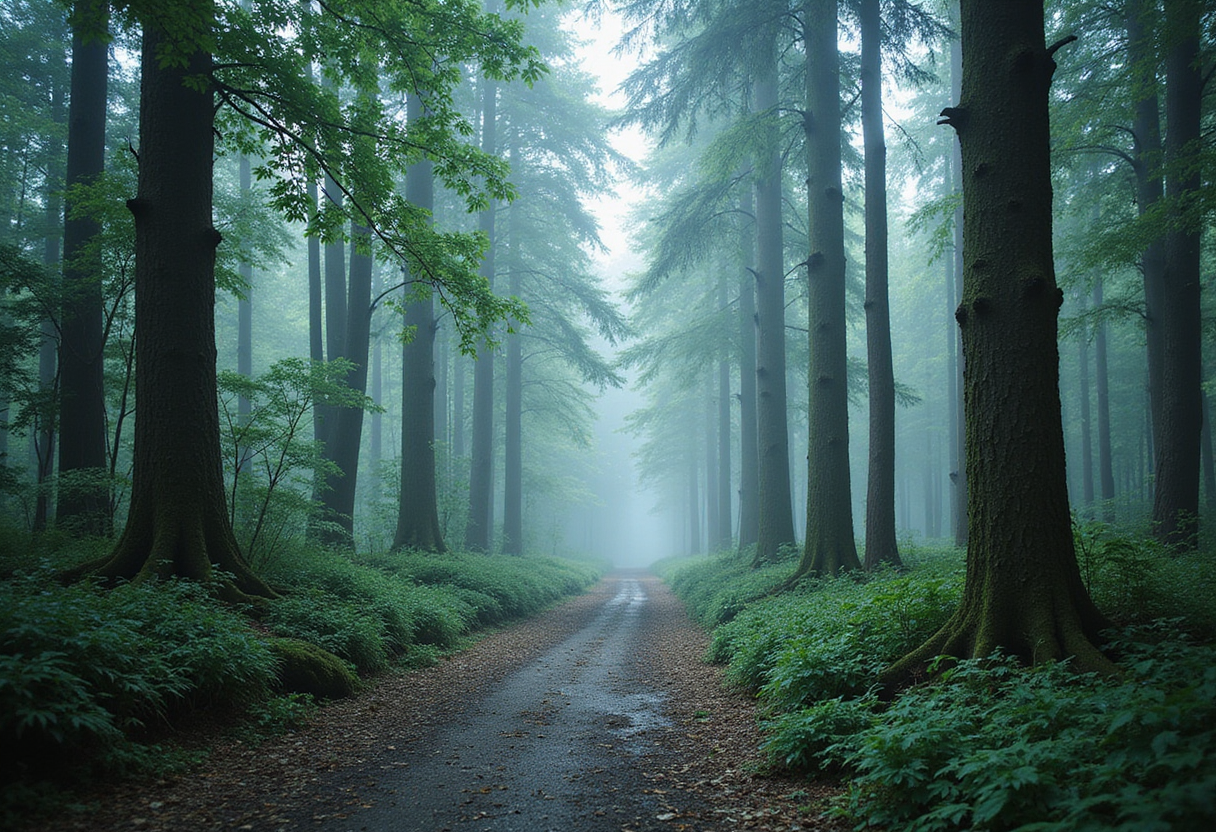
Forests absorb roughly one-quarter of the carbon dioxide that human activities emit each year — yet during drought, the same forest can release more CO₂ than it captures, according to a scientific explainer published in The Conversation.
The reversal hinges on a costly trade happening inside every leaf.
The 400-to-1 currency exchange
Tree leaves pull CO₂ from the atmosphere through tiny pores called stomata. The same openings release water vapor. The exchange is heavily lopsided: for every one CO₂ molecule a leaf absorbs, about 400 water molecules escape.
A mature tree loses several hundred liters of water per day during the growing season. A single hectare of forest — about 2.5 acres — releases tens of thousands of liters daily, an amount the article compares to several bathtubs per tree.
A passive straw several tens of meters long
Trees transport that water through a passive hydraulic system. Evaporation at the leaves creates tension that pulls water columns upward from the roots, much like a drinking straw tens of meters tall.
Irish botanist Henry Horatio Dixon described this mechanism in the late 19th century. His principle became known as "tension-cohesion." The system needs no energy from the tree.
The force needed to lift water to the canopy is enormous — equivalent, the article notes, to pumping water from a well several hundred meters deep.
When the straw boils
Water under that much tension sits in a "metastable" state. A small disturbance flashes it into vapor inside the plant's vessels. The resulting air bubbles — embolisms, or cavitation — block water flow permanently.
Cavitation typically strikes during extreme drought. Dry soil starves roots of moisture. Hot air accelerates leaf evaporation. The leaves and tissues desiccate irreversibly, and the tree cannot undo the damage.
Trees choose between thirst and hunger
Stomata open and close dynamically, within minutes, to balance two competing demands:
- Carbon for growth. Open pores let photosynthesis run, feeding the tree's metabolism.
- Water for survival. Closed pores protect the hydraulic system from embolism.
During drought, every vascular plant closes its stomata. Photosynthesis halts. Trees still respire, releasing CO₂ as they metabolize stored sugars. Dying trees release the carbon they once stored. A forest can swing from carbon sink to carbon source — especially where forestry practice relies on large-scale intervention.
Birch versus holm oak
Drought tolerance varies sharply by species. Birch, with a vulnerable hydraulic system, closes its stomata earlier than holm oak, whose pipes resist embolism. Still, every tree — even those in arid regions — operates near the embolism threshold. The world's forests all stand exposed to drought under climate change.
The fertilizer argument, and its flaw
For decades, researchers have argued that rising CO₂ should fertilize vegetation. The reasoning seemed straightforward: more CO₂, more photosynthesis, more growth, larger carbon sinks. Climate models sometimes lean on this assumption.
But the article flags two counterforces:
- Hot, dry air. Higher temperatures dry the atmosphere and deplete soil moisture, cutting the water trees need to keep stomata open.
- Smaller stomatal openings. With more CO₂ available, plants can absorb the same carbon through narrower pores. Trees save water at the leaf, yet forests transpire less overall. Less recycled rainfall can weaken continental climate patterns.
The second effect already shapes South America. Up to 50% of rainfall over western Amazonia comes from water transpired in the eastern basin and carried westward by trade winds. Stomatal closure in the east could shrink rainfall in the west, threatening the stability of the world's largest tropical forest.
Carbon and water cannot be separated
Predicting whether forests will keep absorbing CO₂ requires predicting how water moves across continents. The carbon cycle and the water cycle are joined at the leaf, the article argues. Models that treat them in isolation risk underestimating how quickly forests can flip from sink to source.
via Phys.org Biology (Source)
More from Priya Raman
Show full bio
Senior reporter covering industry trends and analytics at SciBeat.
207 articles
Nearby plates
- Drought Now Weakens Even Switzerland's High-Altitude Protective Forests
- U.S. Irrigation Avoids 6.86 Gigatons of Emissions via Spared Land
- Forests Climbing Higher May Release Long-Stored Mountain Carbon
- Heat Waves Make Coast Redwoods Slow Their 'Breathing' and 'Eating'
- Ultrafast X-rays capture nature's most efficient energy transfer