Plate Nº 32 · recorded October 1, 2026
Earth & ClimateReported finding
Drought Now Weakens Even Switzerland's High-Altitude Protective Forests
Swiss data from 1983–2022 show drought stress now weakening protective forests even at 2,200 meters, eroding a natural shield against avalanches and rockfalls.
By Priya Raman4 min read899 words
In brief
- In the lowland colline belt, the share of declining protective forest stands rose from 11.1% in 1983 to 30.4% by 2022.
- The long-standing link between higher altitude and lower drought stress disappeared from the data after 2017.
- Droughts are killing large, dominant trees even at 2,200 meters, progressively thinning forests that protect valleys from avalanches, rockfalls, landslides and floods.
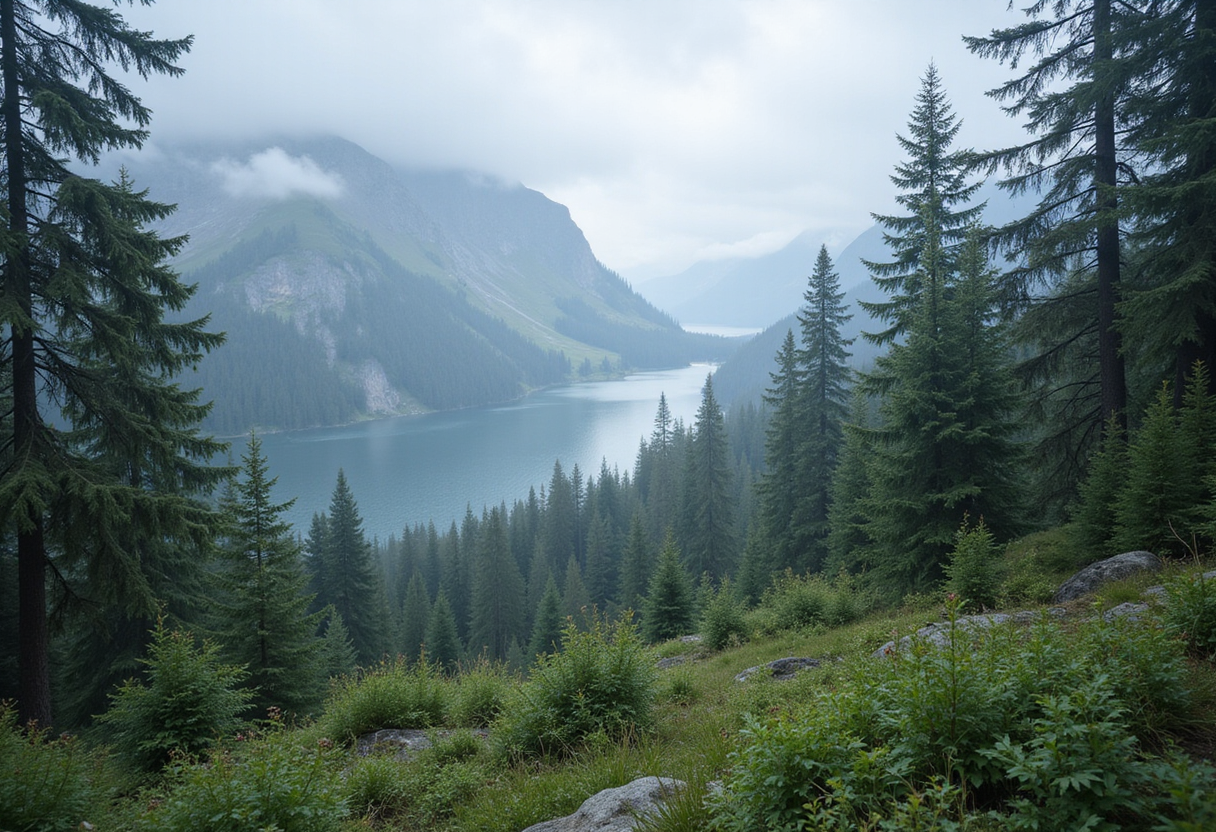
Swiss forests have reached a tipping point, according to new research: summer droughts are now overwhelming trees' tolerance at every altitude, including mountain slopes that scientists until recently considered largely shielded from drought stress. The finding matters far beyond the forests themselves, because these stands form the first line of defense for people living in the valleys below, protecting them from avalanches, rockfalls, landslides and floods.
"Here we show that it no longer holds true, as was until recently the case, that trees growing at the highest altitudes are mostly shielded from the worst effect of summer droughts," said Dr. Estelle Noyer, a researcher at Bern University of Applied Sciences and first author of the study, published in Frontiers in Forests and Global Change.
"Even as high as at 2,200 meters (7,220 feet) altitude, the number of trees per stand is reduced due to the decline or death of large, dominant trees in particular," she explained. "This causes a progressive decline of these precious forests which protect against natural hazards."
A shifting balance in the mountains
Summer drought has always posed a risk to forests, but its reach has changed. Historically, forests in low-altitude vegetation belts suffered most. These include the "colline" belt, which lies between 282 meters (925 feet) and 1,184 meters (3,880 feet) above sea level, and the "montane" belt, which spans 600 meters (1,970 feet) to 1,648 meters (5,410 feet). Higher up, in the "subalpine" belt between 1,235 meters (4,050 feet) and 2,219 meters (7,280 feet), cold temperatures and long-lasting snow cover kept soils moist and reduced how much water trees needed.
Subalpine trees could still experience drought, but researchers previously believed that warmer temperatures gave them a net growth boost overall, helping them recover faster. That assumption now looks shaky. Over recent decades, rapid warming at intermediate and high altitudes has made trees "thirstier" — meaning they lose and require more water. Meanwhile, reduced precipitation and retreating glaciers have cut the water available to mountain soils, making droughts more frequent.
Four decades of measurements
Noyer and her colleagues wanted to find out whether the altitudes where drought stress typically strikes Swiss protective forests have shifted over the past 40 years, and whether this is affecting the resilience of the forest canopy and the composition of forest stands. (A "stand" is a group of trees growing together in a distinct patch of forest.)
The team analyzed records collected between 1983 and 2022 by the Swiss national forest inventory (NFI), which catalogues forest stands across a nationwide grid. Foresters regularly measured the diameter at breast height — a standard way of gauging tree size — for all trees across hundreds of representative 200-square-meter plots. The researchers focused exclusively on protective forest stands in areas undisturbed by fires or forestry interventions such as selective logging. For each of five time periods within the inventory, they examined between 891 and 1,543 stands at altitudes from 282 to 2,219 meters.
Decline at every elevation
The results were clear. The share of declining stands increased over time in every vegetation belt, with the strongest deterioration at lower altitudes. In the colline belt, the proportion of protective stands classified as "declining" rose from 11.1% in 1983 to 30.4% by 2022. In the lower montane belt, it climbed from 17.4% to 21.4%, while the higher montane belt stayed roughly constant at around 10.8%.
The high-altitude belts told a subtler but equally worrying story. In the "subalpine inferior" belt (1,208 to 1,897 meters) and the "subalpine superior" belt (1,752 to 2,219 meters), the percentage of declining stands fell to its lowest values — between 10.3% and 15.3% — from the mid-1990s to the early 2000s, consistent with the idea that warming initially helped these trees. Since then, however, it has risen sharply to 18.8%.
Tree density decreased in all belts over the study period. Declining stands typically showed the highest drought indices and the strongest drop in basal area — a measure of the total cross-sectional area of tree trunks, which indicates how much living tree cover a stand has lost. Most tellingly, the historically strong link between higher altitude and less severe drought stress disappeared after 2017.
A thinner shield, and a pressing question
The authors concluded that droughts have selectively killed the largest and most vulnerable trees in Swiss protective forests over the past four decades, even at the greatest heights, changing the composition of forest stands. One silver lining: today's stands appear to contain more resilient tree species and size classes. But the researchers caution that this apparent resilience may falter when droughts arrive in quick succession, a pattern that is becoming increasingly common.
Noyer and her colleagues argue there is a pressing need for adaptive forestry strategies, not only in Switzerland but across European mountain ranges.
"The critical open questions center on how rapidly forest species composition will change, and how foresters can make forests more resilient by promoting multi-layered and diverse stands," Noyer said. "Our ongoing follow-up study is expected to yield actionable spatial data to help foresters achieve this."
The study, titled "Four decades of drought impacts on Swiss protective forests: a vanishing altitudinal gradient," appears in Frontiers in Forests and Global Change (DOI: 10.3389/ffgc.2026.1933304).
via Phys.org Biology (Source)
More from Priya Raman
Show full bio
Senior reporter covering industry trends and analytics at SciBeat.
57 articles
Nearby plates
- Lake Powell Hits Record Low as Snow Drought Strains the Colorado River
- Drones, Satellites and AI Team Up to Track Antarctica's Tiniest Life
- Climate Change Is Harming Indigenous Children Worldwide, 53-Study Review Finds
- Tracking 4,581 Animals Reveals a Hidden Human Effect on Wildlife
- Climate Change and Mosquitoes: Why Malaria Falls While Dengue Climbs