Plate Nº 20 · recorded October 2, 2026
Earth & ClimateReported finding
Underwater Umbrellas Helped Florida Corals Survive Record Heat Stress
Simple nylon-and-pipe shades cut light by 60% over Florida brain corals, reducing bleaching during the second-worst heat stress event on record at the study site.
By Priya Raman4 min read762 words
In brief
- 20 custom shades, each floating 30 cm above a coral and cutting light by 60%, were installed over brain coral colonies at Newfound Harbor, Florida Keys, in summer 2024.
- Shaded corals lost less color than controls despite the second-highest heat stress on record at the site, and regained some color after shading; no coral died in either group.
- Dr. Karen Neely of Nova Southeastern University led the study, published in Frontiers in Marine Science (DOI: 10.3389/fmars.2026.1910202).
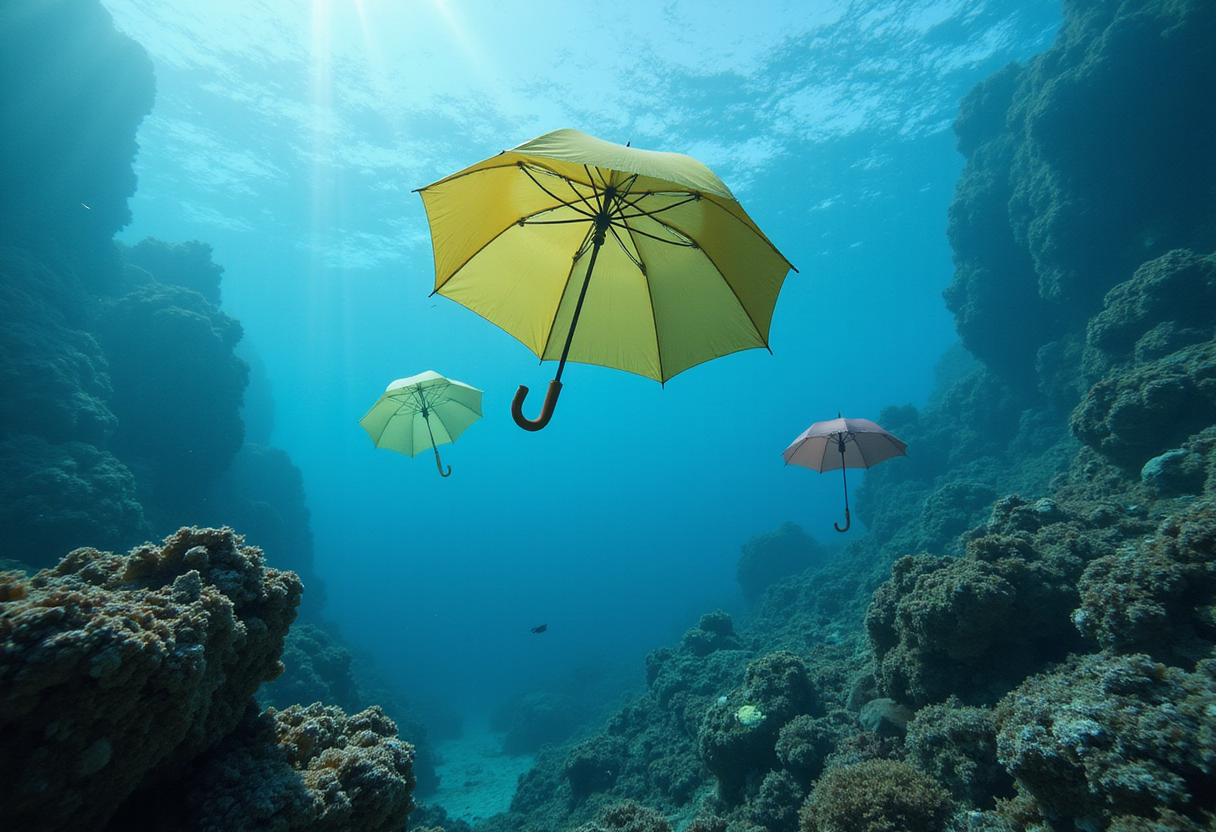
In the summer of 2024, scientists draped umbrella-like shades over corals in the Florida Keys. The result: the shaded corals lost less color than expected during what was the second-worst heat stress event on record at that site, and some even regained color after the shades went up.
The study, led by Dr. Karen Neely of Nova Southeastern University and published in Frontiers in Marine Science, tested a simple idea. High sea temperatures, driven by the climate crisis, bleach corals ghostly white and can kill them. Shading can't cool the water, but it blocks ultraviolet light and intense irradiance — factors that make heat damage to corals worse.
"Heat-related coral bleaching is probably the biggest threat to reefs worldwide, and we absolutely have to address climate change to have any hope of reefs as we know them existing in the future," Neely said. "Solutions like shading can offer temporary protection on small scales."
Why the stakes were high
The 2023 bleaching event in Florida essentially wiped out branching corals and, at some inshore sites, dealt a devastating blow to brain corals. That event motivated the study directly. "We wanted to provide proof of concept for tools to save targeted corals in similar future events," Neely explained.
Restoring dead reefs is possible but difficult and expensive, and restored corals remain vulnerable to future heat waves. Protecting corals before they die is far cheaper — which is where the shades come in.
How the experiment worked
Neely's team set up 20 custom-made shades over 10 colonies of two brain coral species, Pseudodiploria clivosa and Colpophyllia natans, at Newfound Harbor in the Florida Keys. Another 20 matching corals served as controls.
Each shade consisted of pipes with nylon cloth attached, fixed temporarily to the seabed with cord. It floated 30 centimeters (about 12 inches) above the coral and cut incoming light by 60%.
Divers visited every two weeks to track color changes and take tissue biopsies. The biopsies let the researchers monitor the microscopic algae living inside the corals' tissues. This partnership matters: the coral shelters the algae, and the algae supply most of the coral's nutrition. The algae also give corals their color. When corals turn white under heat stress, the partnership has collapsed and the coral is starving.
What they found
Despite the intense heat, shaded corals paled less than expected, and the gap between shaded and control corals was widest during the most severe thermal stress. Shaded corals even recovered some color after installation.
But the study comes with caveats. The team saw less bleaching overall than anticipated, and no coral died — not even the controls. One possible reason: the record 2023 heat wave had left most corals occupied by a heat-tolerant alga called Durusdinium, which tolerates high temperatures but is linked to slower coral growth and possibly greater disease susceptibility.
"Shades reversed the observed bleaching, but the event wasn't severe enough to cause mortality on control or shaded corals," Neely said. "However, we know that even bleaching that doesn't cause mortality can impact corals' future disease susceptibility and reproductive capacity. It would be interesting to quantify if and to what extent shade structures benefited these corals after their removal by tracking disease and reproductive output."
Limits of the approach
The biopsies showed no differences in algae density or algae species between shaded and control corals. The sampling location may explain this: permits required the team to sample from coral edges, which receive less light and bleach less — meaning even control samples got some shade.
Permit constraints also delayed installation until well after water temperatures had risen enough to bleach coral. Installed earlier, the shades might have worked better. Even so, the researchers measured a significant positive effect.
The bigger question is scale. "Shading is not a cure-all for coral reefs, and its use would require hard decisions about what corals are worth saving," Neely said. "We found it was effective on two highly susceptible coral species, so it is likely to be useful for most others, but additional studies would be needed to confirm that. It is also likely that thermal stress would reach a point at which no amount of shading could help a coral, but only future experimentation would be able to define the bounds of that."
In short: underwater umbrellas won't save reefs from climate change. But as a stopgap for precious individual corals during the next killer heat wave, they showed real promise — and could buy targeted corals time while the world grapples with the underlying problem.
via Phys.org Biology (Source)
More from Priya Raman
Show full bio
Senior reporter covering industry trends and analytics at SciBeat.
57 articles
Nearby plates
- Africa's Underwater Meadows Need Urgent Protection, Scientists Warn
- Fossil Teeth Suggest Some Dinosaurs Grazed on Seaweed
- Light-Activated Crystals Destroy DNA in Water, Could Curb Resistance
- Drones, Satellites and AI Team Up to Track Antarctica's Tiniest Life
- Ancient Ocean Chemistry Kept Earth Breathing, Study Finds