Plate Nº 45 · recorded October 10, 2026
Biology & EvolutionReported finding
Heat Waves Make Coast Redwoods Slow Their 'Breathing' and 'Eating'
UC Davis scientists found coast redwood leaves run up to 20°F hotter than the air during heat spikes, slowing photosynthesis even when water is plentiful.
By Marcus Bennett3 min read622 words
In brief
- Above 86°F (30°C) air temperature, some redwood leaves ran nearly 20°F hotter than the air, a sign of stress.
- Lab tests showed photosynthesis declined even at temperatures up to 110°F (43°C) with stomata open and carbon dioxide plentiful.
- The UC Davis study, led by Ph.D. candidate Lily Klinek, is the first to examine heat effects on coast redwood photosynthesis.
- Researchers collected measurements over three summers in a redwood forest in Mendocino County, including the hot summers of 2022 and 2024.
- Coast redwoods evolved in regions averaging 59°F (15°C), but heat waves now push temperatures above 100°F (38°C).
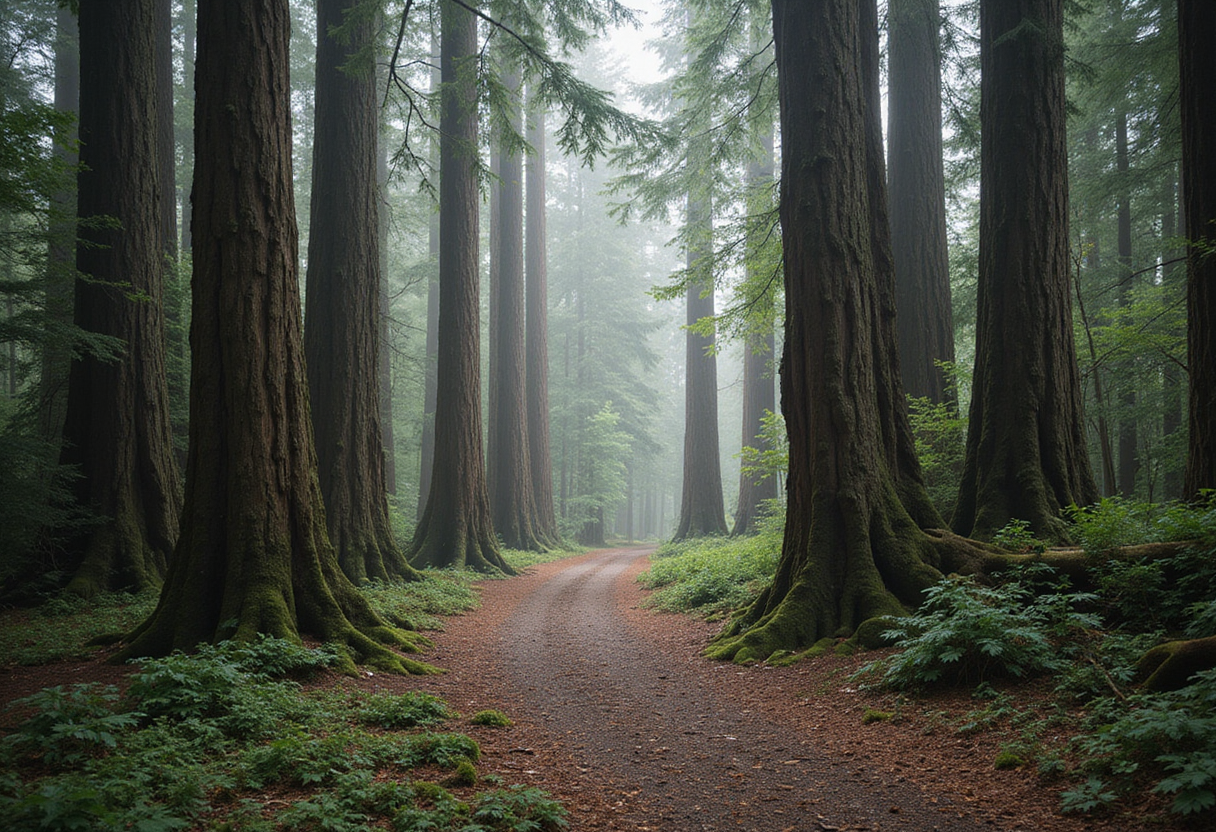
When air temperatures climb above 86 degrees Fahrenheit (30 degrees Celsius), coast redwood leaves can run nearly 20 degrees F hotter than the surrounding air — and the world's tallest trees respond by slowing the very process that feeds them, according to a new study from the University of California, Davis.
The study, published in JGR Biogeosciences, is the first to examine how heat affects photosynthesis in coast redwoods, said lead author Lily Klinek, a Ph.D. candidate with the Plant Optics Lab in the UC Davis Department of Plant Sciences.
Photosynthesis is the chemical reaction that turns sunlight, water and carbon dioxide from the air into the carbon trees use to grow and perform other essential processes. Under heat stress, redwoods slow this reaction — as if the trees are slowing their "breathing" and, as a result, their "eating." The findings raise concern about the fate of redwood forests, especially in their already vulnerable central, southern and eastern habitats in California.
How hot is too hot for a redwood?
Coast redwoods evolved in cool, coastal areas where the average temperature sits around 59 degrees F (15 degrees Celsius). But average yearly temperatures are rising, and heat waves now push temperatures above 100 degrees F (38 degrees Celsius).
Klinek's team took measurements over three summers in a redwood forest in Mendocino County. During the summers of 2022 and 2024, when air temperatures topped 86 degrees F, some leaves were nearly 20 degrees F warmer than the air. That gap is a sign of stress.
"The leaves aren't able to cool down," Klinek said. The leaves probably closed their stomata — the tiny, mouthlike pores that "breathe" in carbon dioxide from the air.
Lab tests confirmed the problem goes deeper. Even at temperatures up to 110 degrees F (43 degrees Celsius), photosynthesis dropped when the leaves' "mouths" were open and taking in plenty of carbon dioxide.
Why can't the trees just 'sweat' it out?
Trees can regulate their temperature through a process called evapotranspiration. They use their stomata to "sweat" out some of the moisture they hold inside to cool off.
"It's similar to the way we sweat to stay cool," Klinek said.
Heat spikes create a double problem. They raise air temperatures, and they burn off the coastal fog that redwoods depend on for much of their water. The large gap between air and leaf temperatures indicated the leaves likely closed their stomata to avoid losing precious water — and overheated as a result, Klinek explained.
To test what happens when water isn't the limiting factor, the researchers put leaf samples in jars of water in the lab, so the leaves had plenty to sweat with. Photosynthesis still dropped, even with the stomata wide open.
"This means that, even if the redwood trees have more water to sweat with, the heat might still impair their breathing and functioning," Klinek said.
What remains unknown?
The study is a first look, and key questions remain open. "We don't know what the upper temperature thresholds are for redwood photosynthesis and mortality," Klinek said.
"With this work, we see there's a significant impact of heat on photosynthesis and physiology," she added. "That's an important start for figuring out what parts of the redwood range are at risk, knowing what to expect and trying to intervene for the health of redwood ecosystems."
The research team measured conditions across three summer field seasons at a single Mendocino County site, so the results may not capture the full variation across the redwood range. Still, the findings give scientists a starting point for identifying which parts of California's redwood forests face the greatest heat risk — and for planning interventions to protect these iconic ecosystems.
via Phys.org Biology (Source)
More from Marcus Bennett
Nearby plates
- Boreal Forests May Shift Toward Deciduous Species as Climate Warms
- Forests Climbing Higher May Release Long-Stored Mountain Carbon
- Diseased Florida Keys Coral Faced Nearly 4x Death Risk in 2023 Heat Wave
- Drought Now Weakens Even Switzerland's High-Altitude Protective Forests
- Heat Waves Are Aging Wild Fairy-Wrens Faster, DNA Study Finds