Plate Nº 21 · recorded November 12, 2026
Space & AstronomyReported finding
JWST Finds Oldest Quasar Pair Yet — and It Shouldn't Exist
JWST has spotted the oldest, tightest quasar pair yet: two supermassive black holes just 18,100 light-years apart, only 900 million years after the Big Bang. Theory says they shouldn't exist.
By Elena Vasquez3 min read652 words
In brief
- The quasar pair J1602+4228AB was seen as it was 900 million years after the Big Bang.
- Its black holes weigh 1.5 billion and 400 million solar masses and sit 18,100 light-years apart, about one-fifth the Milky Way's diameter.
- JWST's Aether survey has found 200 quasars, nearly half of all known early-universe quasars.
- It is only the third quasar pair discovered at Cosmic Dawn.
- Results were published Nov. 10 in The Astrophysical Journal Letters.
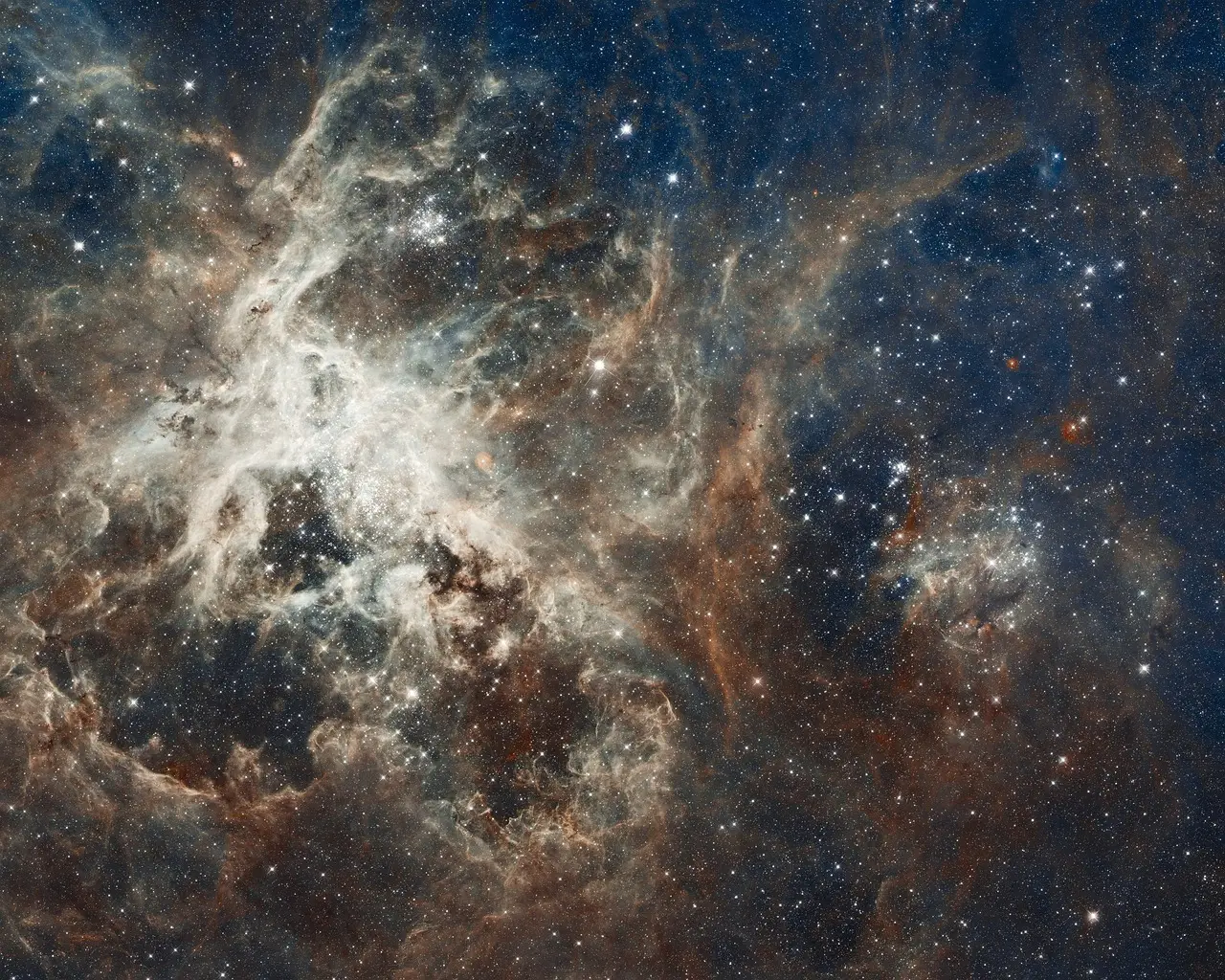
Astronomers using the James Webb Space Telescope have found the oldest and tightest pair of black hole-powered quasars ever seen — two monsters weighing 1.5 billion and 400 million suns, shining just 900 million years after the Big Bang. Current theory says they shouldn't exist.
The pair, designated J1602+4228AB and nicknamed Nāpōwawāʻenakaulua — Hawaiian for "Two celestial bodies of fathomless powerful darkness in the brilliance of heat reincarnating energy into the universe" — was confirmed with help from the Gemini North telescope on Maunakea, Hawai'i. The two supermassive black holes sit only 18,100 light-years apart, roughly one-fifth the diameter of the Milky Way. That makes it the most compact quasar pair known from Cosmic Dawn, the era shortly after the first stars, galaxies and black holes were born.
"There is no definitive theoretical explanation for how a single one of these giant quasars exists so early in the age of our universe, much less two," team leader Silvia Onorato of NOIRLab said in a statement.
Why does this pair break the rules?
A quasar is what we see when a supermassive black hole at a galaxy's heart feeds on a swirling disk of gas and dust, called an accretion disk. The disk's friction makes it glow — often brighter than every star in the host galaxy combined.
Quasars in the nearby universe aren't a puzzle. Compact pairs of them are simply rare. Galaxy mergers, which drag their central black holes together, happen constantly, so tight pairs should be everywhere. Three things hide them: the quasar phase is short on cosmic timescales, distant pairs are faint for ground-based telescopes, and the two members blur together at great distances.
The real trouble starts before the universe turned 1 billion years old. Standard models say black holes need at least 1 billion years to feed and merge their way to millions or billions of solar masses. Yet since it began operating in 2022, JWST has routinely found quasars as early as 400 million years after the Big Bang.
"We observed Nāpōwawāʻenakaulua at a time when the universe was only a thirteenth of its age and, astonishingly, its supermassive black holes are just as massive as those we see today," Onorato said.
This is only the third quasar pair ever found at Cosmic Dawn, and it piles pressure on existing models of black hole growth.
How was it found?
The discovery came from JWST's Aether survey, a census of early-universe objects. Using the telescope's NIRSpec instrument — a near-infrared spectrograph that splits light to reveal an object's properties — Aether has uncovered 200 quasars, just under half of all known early-universe quasars.
While browsing that dataset, the team realized the quasar J1602+4228A wasn't alone. It had a companion, now catalogued as J1602+4228B. Splitting the two from the ground should have been nearly impossible. Gemini North managed it thanks to perfect timing and clear skies over Maunakea, the dormant volcano that hosts the telescope.
What comes next?
The object remains a mystery, but a useful one. It gives astronomers a rare window onto how galaxies assembled during Cosmic Dawn, a pivotal stage in cosmic evolution.
"Nāpōwawāʻenakaulua is a really unique environment," Onorato said. "It's a laboratory for astronomers to study how the very first massive galaxies and their central black holes assembled together through direct galaxy interactions during these early times."
The findings, while peer-reviewed, describe a single system, and preliminary interpretation of a small sample — three Cosmic Dawn pairs — so conclusions about black hole growth models may shift as more data arrives. The team published its results on Nov. 10 in The Astrophysical Journal Letters.
The bottom line: the universe's first supermassive black holes keep showing up too early and too big, and this record-setting pair is the sharpest challenge yet to how we think they grew.
via space.com (Source)
More from Elena Vasquez
Show full bio
Correspondent covering money, funding and market shifts around general science news at SciBeat.
387 articles
Nearby plates
- Twin Black Holes From Cosmic Dawn Break Formation Models
- Two Monster Black Holes Defy Cosmic Clock Just 900 Million Years In
- Ancient Quasar Pair Puts Early Black Hole Growth on Trial
- Black Hole Winds Pack 100 Times More Power Than Scientists Expected
- Three active black holes found in a galaxy 12.5 billion years away