Plate Nº 84 · recorded November 11, 2026
PhysicsReported finding
Laser 'Nuisance' Speckle Powers Record 6-Femtometer Spectrometer
An Adelaide-led team built a shoebox-sized spectrometer with 6-femtometer resolution by reading laser speckle, measuring rubidium's hyperfine structure for the first time this way.
By Elena Vasquez3 min read678 words
In brief
- The device resolves wavelength differences of just 6 femtometers.
- It is the first speckle-based spectrometer to directly measure atomic hyperfine structure, in rubidium.
- The work, led by the University of Adelaide, was published in Nature Communications in 2026 (DOI: 10.1038/s41467-026-78325-y).
- The key component is an integrating sphere, a highly reflective hollow cavity.
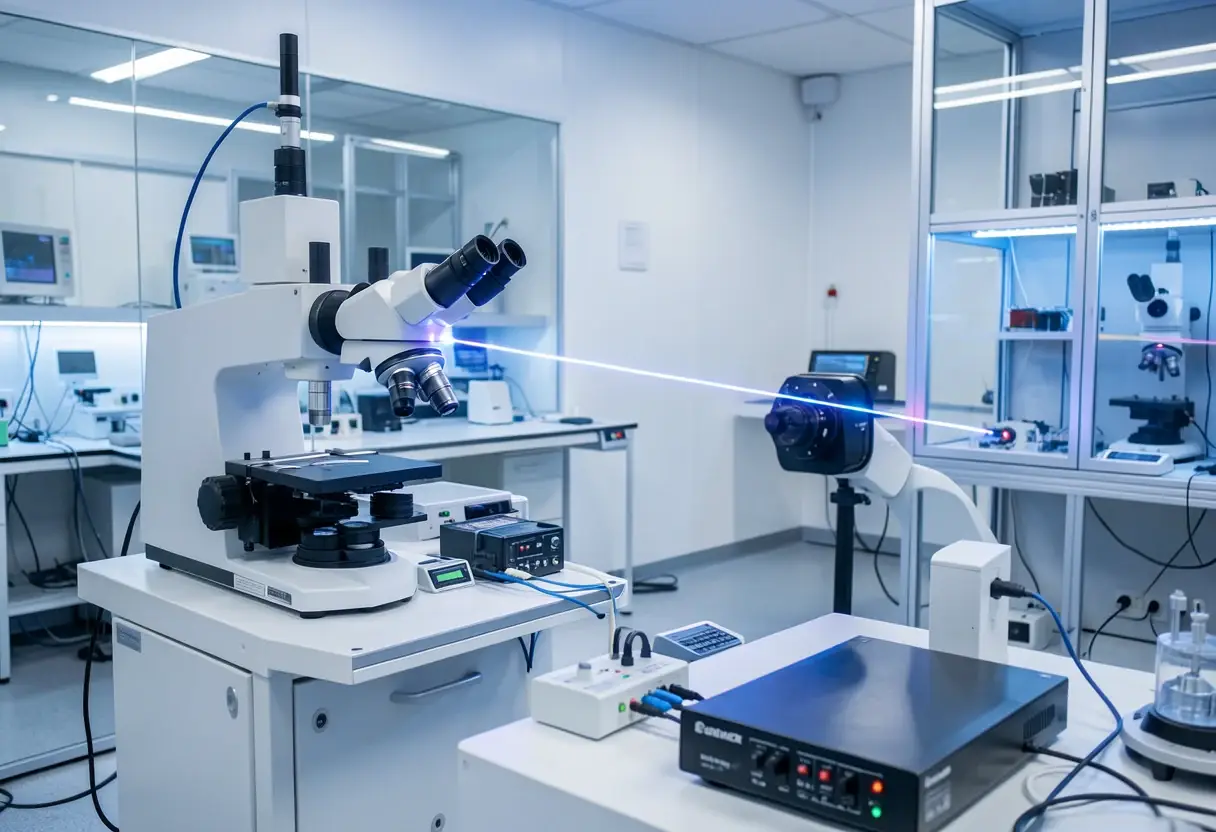
A shoebox-sized light-measuring device has achieved a record wavelength resolution of 6 femtometers — millionths of a millionth of a meter — according to new research led by the University of Adelaide and published in Nature Communications in 2026.
The international team behind the device achieved that precision by exploiting something optics researchers have long treated as a problem: laser speckle, the grainy, glitter-like pattern that appears when coherent light scatters off a rough or complex surface.
Lead author Gabriel Britto Monteiro, a PhD candidate, offered a vivid comparison of the device's sensitivity: "For perspective, this is like measuring the exact height of Mount Everest and knowing if someone laid a single strand of human hair on the very top of the peak."
What did the researchers actually build?
At the heart of the device sits an integrating sphere — a hollow cavity with highly reflective inner walls that forces light to bounce around inside many times before escaping. That repeated scattering is usually the enemy of clean optical measurements. Here, it became the engine of precision.
When laser light rattles around inside the sphere, it produces a speckle pattern on exit. The team found this pattern was extraordinarily sensitive to tiny changes in the light's wavelength, or color. Feed the pattern to the right analysis, and the device works as an ultra-high-resolution spectrometer.
"Optical spectrometers matter because they allow us to measure the color (wavelength) composition of light with extreme precision, and light carries information about the physical world," Britto Monteiro said. "A spectrometer shows us the ingredients that make up light and how much of each is present."
Why does the 6-femtometer number matter?
Resolution determines how fine a detail a spectrometer can distinguish. The finer the resolution, the more information a device can pull from light emitted, absorbed or scattered by matter.
Conventional spectrometers split light into its component colors, much like a prism. This device instead reads the fingerprint-like speckle pattern, which shifts detectably even when the wavelength changes by a few femtometers.
Speckle has historically been considered a nuisance in optics labs. Researchers have increasingly recognized the patterns carry rich information about the light that generated them. "By harnessing that rich information, we have demonstrated a completely new level of resolution," Britto Monteiro said.
What did they measure with it?
The team put the device to a demanding test: measuring the hyperfine structure of rubidium.
Hyperfine structure refers to extremely small splittings in an atom's energy levels caused by interactions between the nucleus and the electrons. In plain terms, the spectrometer could tell apart atomic energy states separated by differences far smaller than most instruments can resolve.
The experiment marks the first direct measurement of atomic hyperfine structure using a speckle-based spectrometer.
Rubidium is a workhorse element in atomic physics. It underpins next-generation atomic clocks, quantum processors and quantum sensors, so a compact, precise way to read its spectrum has clear appeal for laboratories and devices alike.
"The results demonstrate that speckle-based spectroscopy has matured from a laboratory curiosity into a practical precision measurement platform that could be used in future quantum technologies," Britto Monteiro said.
What comes next?
The researchers see a key next step in combining speckle spectroscopy with optical frequency combs — tools that act like ultra-precise rulers for light, revealing tiny details with absolute accuracy.
"This could assist us in better understanding complex gases to tell two similar-looking chemicals apart," Britto Monteiro said.
Beyond the lab, the team points to potential applications in:
- environmental sensing of pollutants;
- cancer diagnosis;
- quantum technologies.
Those applications remain prospects rather than products, and the findings come from a single published study. Still, the demonstration shows that a compact, low-complexity device can reach precision once reserved for far larger instruments. The takeaway: light's noise, read carefully, can outperform light split cleanly.
Publication details: Gabriel Britto Monteiro et al., "Ultra-high precision speckle spectrometer enabling radio-frequency scale resolution of atomic spectra," Nature Communications (2026). DOI: 10.1038/s41467-026-78325-y.
via phys.org/rss-feed/ (Source)
More from Elena Vasquez
Show full bio
Correspondent covering money, funding and market shifts around general science news at SciBeat.
384 articles
Nearby plates
- Cambridge's $10 Chip-Sized Sensor Matches Lab Instruments
- ANU's Atom-Precise Coatings Will Sharpen LIGO's Gravitational Wave Hunt
- Spinning Light Pattern Measures Laser Frequency in a Single Image
- NASA's CASALS Lidar Steers Light With Wavelength, Not Mirrors
- Physicists Spot the Optical Magnus Effect at the Atomic Scale