Plate Nº 30 · recorded September 30, 2026
Health & Medicine ResearchReported finding
Math Model Maps How Tumor Conditions Help or Hinder Cancer Drug
A new mathematical model explains how tumor fluid pressure and leaky vessels control delivery of an experimental IM-ADC therapy — and how to tip the balance.
By James Calloway3 min read592 words
In brief
- Researchers led by Rakesh Jain at Mass General Brigham, with the University of Cyprus, modeled the experimental IM-ADC therapy HE-S2 in the Journal for ImmunoTherapy of Cancer.
- Simulations calibrated to mouse data show a positive feedback loop: tumor shrinkage lowers interstitial fluid pressure, improving drug delivery and treatment effect.
- ADCs need vessel pores of at least 40 nanometers to penetrate tumors, so excessive vascular 'normalization' can block the large-molecule drugs from reaching their target.
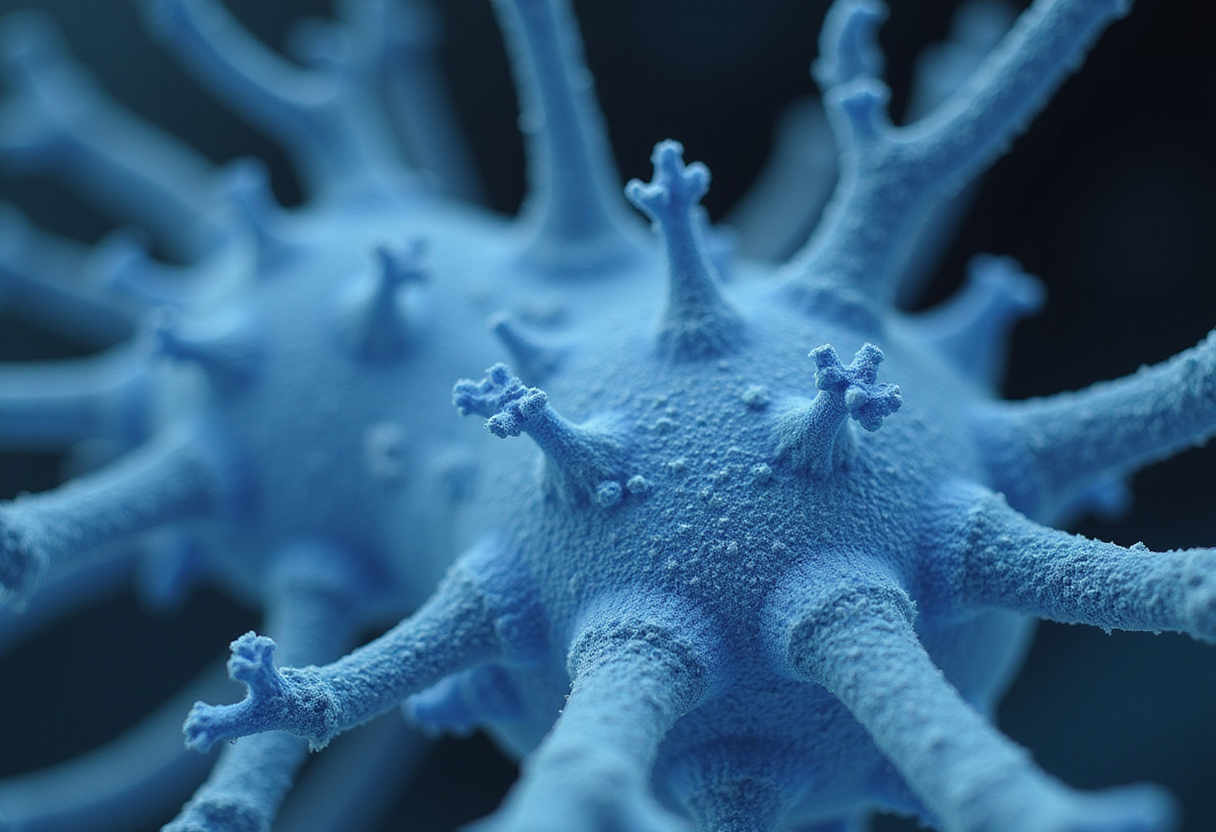
A mathematical model developed by researchers at Mass General Brigham and the University of Cyprus offers a clearer picture of why an experimental cancer therapy works better in some conditions than others — and how doctors might improve its effectiveness before ever giving the first dose.
The study, led by Rakesh Jain, Ph.D., of the Department of Radiation Oncology at Mass General Brigham, was published in the Journal for ImmunoTherapy of Cancer. First author Constantinos Harkos and colleagues built the model to simulate the behavior of a new class of treatment called an immunomodulatory antibody-drug conjugate, or IM-ADC.
To understand what that means, it helps to break the term apart. An antibody-drug conjugate (ADC) is a hybrid molecule: an antibody that homes in on cancer cells, carrying a toxic or immune-activating payload attached to it. An IM-ADC adds an immunomodulatory twist — the antibody portion also tweaks the immune system's behavior. The compound the team studied, HE-S2, pairs an anti-PD-L1 antibody (a checkpoint blocker that releases the brakes on immune cells) with an immune-stimulating payload called D18.
But a drug can only work if it reaches its target, and tumors are notoriously hostile terrain. The model accounts for several features of what scientists call the tumor microenvironment — the mix of blood vessels, fluid pressure, immune cells and drainage pathways surrounding a tumor. Specifically, it incorporates abnormal, poorly formed blood vessels; elevated interstitial fluid pressure (the pressure of fluid squeezed between cells, which pushes back against incoming drugs); immune cell activity; drug transport; and the tumor-draining lymph nodes.
The researchers calibrated the model against published mouse studies and found it could reproduce the tumor responses observed in those experiments. This validation mattered because it let the team explore biological processes that are difficult or impossible to measure directly in a living animal.
Two findings stand out.
First, the model confirmed that HE-S2 outperformed either of its components used alone. The combination of immune stimulation and checkpoint blockade packed a bigger punch than either strategy by itself.
Second, and more unexpectedly, the simulations revealed a positive feedback loop. As the therapy shrinks a tumor, interstitial fluid pressure inside it drops. Lower pressure means better drug delivery, which strengthens the treatment's effect, which shrinks the tumor further.
That loop, however, has a catch. Shrinking and “normalizing” the tumor vasculature — making abnormal blood vessels behave more like healthy ones — can go too far. Healthy vessels are tightly sealed, and ADCs are large molecules. The model indicates these drugs need pores of at least 40 nanometers across to slip out of blood vessels and reach tumor tissue. If vessel walls become too tight, the very drug that triggered the improvement can no longer get through.
The results therefore support a strategy researchers call tumor “normalization” before ADC treatment: improving blood vessel function enough to relieve pressure and improve flow, while deliberately preserving enough vascular permeability — leakiness — for bulky antibody-based drugs to penetrate the tumor.
The findings come with important caveats. The model was fitted to mouse data, and mouse tumors do not always behave like human ones. HE-S2 remains an experimental therapy. The simulations identify plausible strategies, but testing them will require laboratory and clinical work. Still, by reproducing known tumor responses and exposing hidden dynamics such as the pressure feedback loop, the model gives researchers a tool to prioritize which interventions to try next — and which timing might make the difference between a drug that reaches its target and one that cannot.
via Medical Xpress (Source)
More from James Calloway
Nearby plates
- Same-Day Chemotherapy Turns Into a Booster for Cancer Vaccines
- Enzyme's Hidden Second Job May Drive Breast Cancer Drug Resistance
- Immune Cells Blur the Line Between Innate and Adaptive Defenses
- Lung Cancers Evade KRAS Drugs by Switching Cell Type
- Two-Drug Combo May Force Aggressive Kidney Cancer to Self-Destruct