Plate Nº 69 · recorded November 12, 2026
Chemistry & MaterialsReported finding
Motorless Biodegradable Bubble Flees Lactic Acid, Study Shows
A motorless bubble 200 times thinner than a hair flees lactic acid using only its flexible polymer skin, Radboud and Durham chemists report in Nature Chemistry.
By Elena Vasquez3 min read574 words
In brief
- The PLA bubble is about 200 times smaller than the width of a human hair.
- The study was published in Nature Chemistry in 2026 (DOI: 10.1038/s4457-026-02298-0).
- The bubble moves away from lactic acid with no motor, enzymes or surface catalysts.
- Rigid polystyrene vesicles showed no such movement in the same experiments.
- No biological or medical testing has been done yet, researchers stressed.
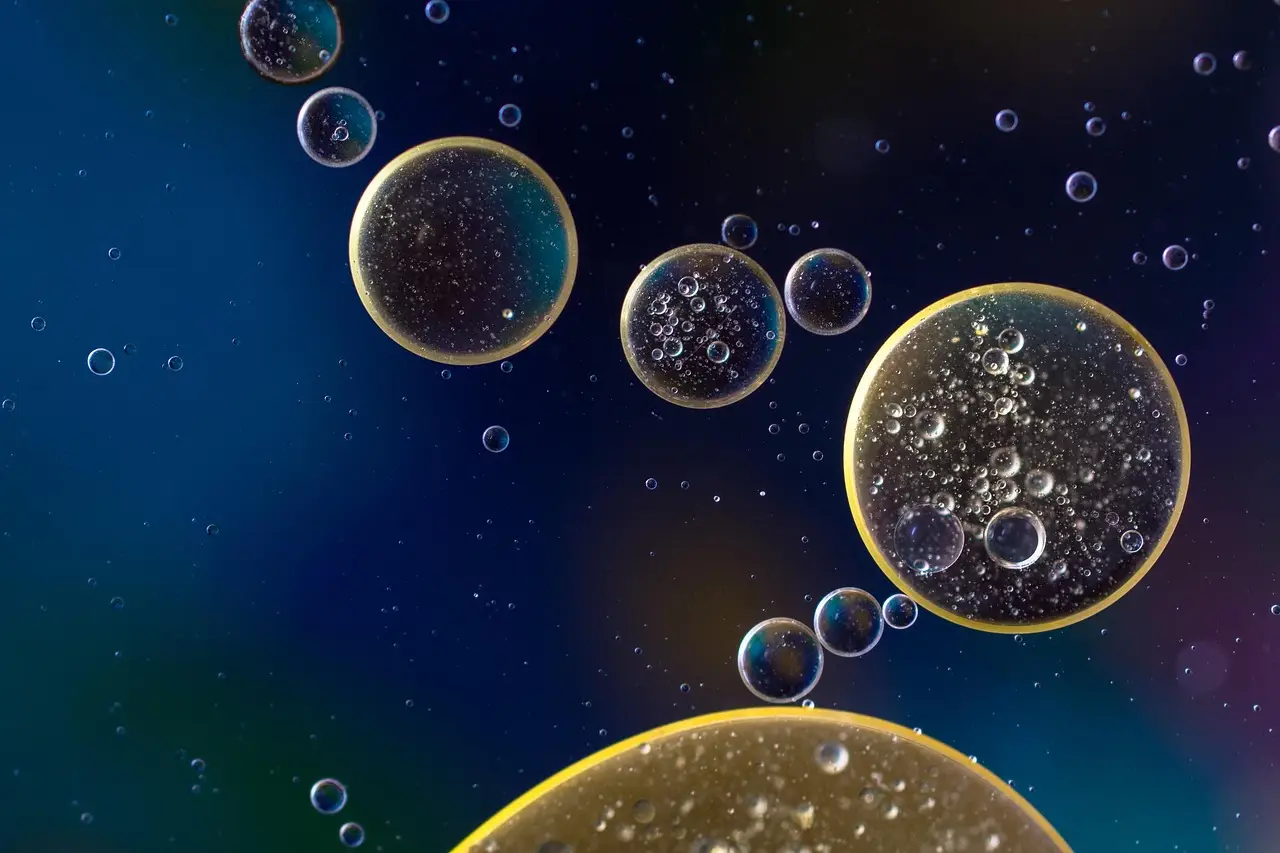
A biodegradable bubble roughly 200 times smaller than the width of a human hair can move away from lactic acid entirely on its own — no motor, no enzymes, no catalysts bolted to its surface. Chemist Daniela Wilson of Radboud University, working with colleagues at Durham University, published the finding in Nature Chemistry. It's a step toward artificial cells that behave like living ones, and possibly, far down the road, toward self-steering drug delivery particles.
How do living cells pull off the same trick?
The ability to "smell" chemicals and move toward food or away from toxins is called chemotaxis. Cells use elaborate machinery for it. "Receptors in their membrane detect the signal, after which an internal skeleton reshapes the cell to make it move," Wilson said. Researchers have spent years trying to copy this in artificial particles. Almost every attempt so far has needed extra parts — enzymes or catalysts attached to the surface acting like a small engine.
The new bubble doesn't. It's a hollow sphere made of PLA, polylactic acid — the same biodegradable polymer used in dissolvable stitches. When lactic acid is more concentrated on one side, the bubble moves away from it. The skin does both jobs at once: it senses the acid and it drives the escape.
What makes the bubble move?
The mechanism lives in the flexible skin. On the side facing the acid, lactic acid molecules stick to the polymer chains in the bubble's skin, Wilson explained. Those chains stretch out and become more exposed to the surrounding water. The two sides of the bubble then behave differently toward the water around them. That imbalance creates a tiny flow along the surface, which pushes the bubble away from the acid.
Rigid bubbles can't do it. The team tested vesicles made of polystyrene, a stiff material. "These rigid bubbles cannot change their skin and do not show the effect," Wilson said. The behavior is specific to the flexible PLA bubbles.
Why does this matter?
Two reasons, one near-term and one speculative.
First, the science. The result demonstrates a strikingly simple way to make artificial vesicles move by themselves. "This helps us understand how movement can arise from changes in molecular shape, which is also relevant for how cells move," Wilson said. "It brings us one step closer to artificial cells with lifelike behavior."
Second, the possible application — with heavy caveats. Lactic acid is a biologically meaningful signal. Tumors and inflamed tissues produce it in large quantities, so a particle that flees lactic acid — or, by extension, could be tuned to respond to such signals — might one day carry medicines precisely where they're needed.
Don't hold your breath. "However, this application is still a long way off," Wilson cautioned. "We have not yet tested anything in a biological or medical setting, but it opens up interesting possibilities."
What's the bottom line?
A simple polymer bubble, made from the stuff of dissolvable stitches, has achieved something that normally requires living cells' molecular machinery: sensing a chemical and swimming away from it. The work rests on lab experiments with synthetic vesicles, not tests in organisms, and any drug-delivery payoff lies well in the future. Still, it shows motion can emerge from nothing more than a soft skin changing shape.
Publication details: Danni Wang et al., "Conformationally driven negative chemotaxis in synthetic vesicles," Nature Chemistry (2026). DOI: 10.1038/s41557-026-02298-0.
via phys.org/rss-feed/ (Source)
More from Elena Vasquez
Show full bio
Correspondent covering money, funding and market shifts around general science news at SciBeat.
384 articles
Nearby plates
- T Cells Can Feel Tissue Stiffness, McGill Study Finds
- Scented Cleaners Can Flood Rooms With Trillions of Ultrafine Particles
- Why a Food Poisoning Bacterium Can Also Cause Severe Wound Infections
- MIT researchers build microfluidic tool to collect living cancer cells
- MIT Engineers Bacteria Into Living Transistors for Biological Circuits