Plate Nº 39 · recorded October 10, 2026
Health & Medicine ResearchReported finding
Scented Cleaners Can Flood Rooms With Trillions of Ultrafine Particles
Purdue researchers found that routine cleaning with scented products generates trillions of lung-penetrating nanoparticles within minutes, with inhaled doses comparable to or exceeding roadside traffic exposure.
By Nathan Brooks3 min read598 words
In brief
- Findings presented September 26, 2026 at the American Chemical Society fall meeting in Chicago.
- Routine cleaning with scented products can generate trillions of particles within minutes.
- Most particles measure 1–30 nanometers across, below the detection range of typical home air-quality monitors.
- Indoor terpene concentrations during cleaning reached 10–1,000 parts per billion, tens to hundreds of times forest levels.
- Inhaled nanoparticle dose matched or exceeded exposure from standing near heavy traffic.
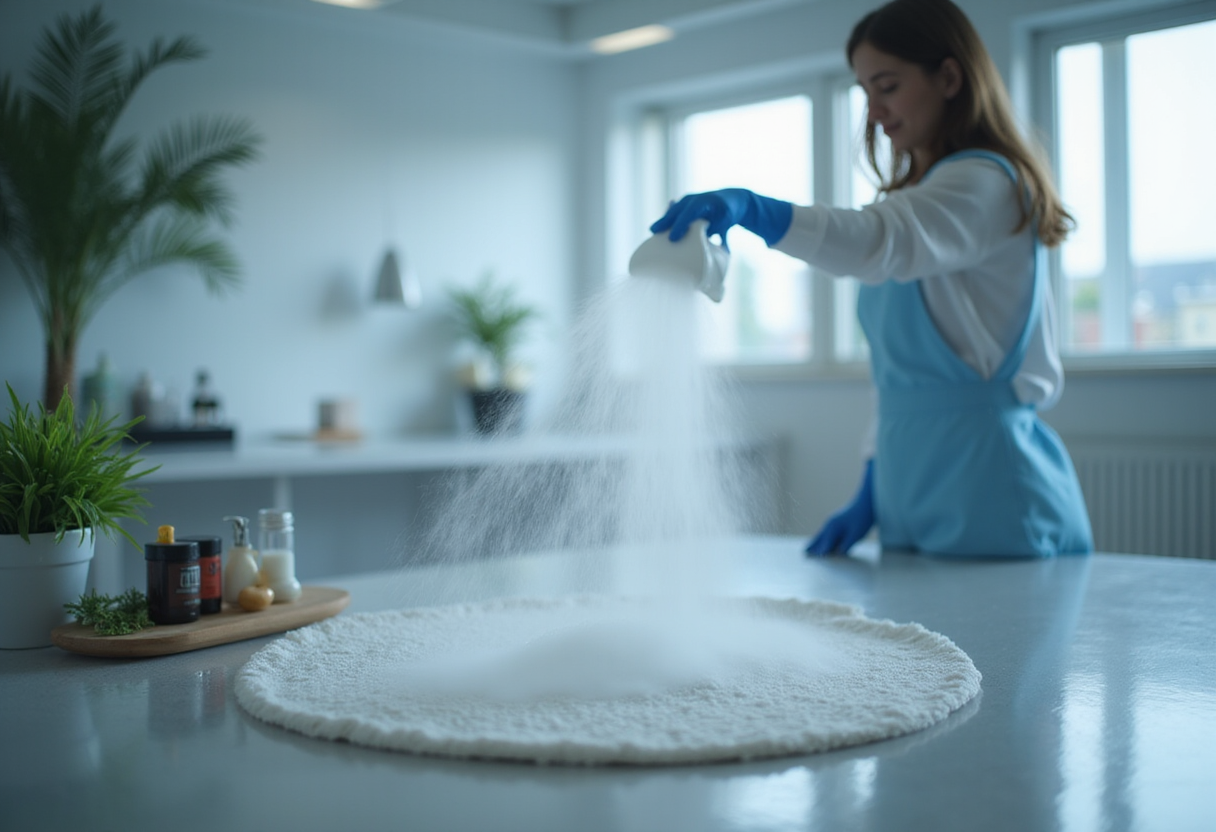
Scented cleaning products released during routine mopping or spraying can flood a room with trillions of ultrafine particles within minutes, researchers reported on September 26, 2026 at the fall meeting of the American Chemical Society (ACS) in Chicago.
The team, led by Brandon Boor of Purdue University, ran experiments inside a furnished model house on the Purdue campus featuring a functional kitchen, wood flooring, and a bathroom. Levels of particles 1–30 nanometers across climbed within minutes of cleaning, producing an inhaled dose comparable to—or greater than—standing near heavy traffic.
What makes these particles worth watching?
Nanoparticles are airborne specks smaller than 100 nanometers across, far below what the human eye can see. At 1–30 nanometers, they slip past most home air-quality monitors, which usually start measuring at larger sizes. Their tiny dimensions allow them to bypass the upper airways and lodge deep inside the lungs.
Once deposited, the particles can trigger irritation and inflammation. Some research suggests ultrafine particles can also cross into the bloodstream.
How do scented products generate them?
Cleaning liquids commonly contain terpenes such as pinene (pine), limonene (lemon), thymol (thyme), and linalool (lavender). These molecules evaporate quickly from sprayed droplets or wiped surfaces. Indoor terpene concentrations during cleaning hit 10 to 1,000 parts per billion—tens to hundreds of times the levels typical of a forest.
When terpenes meet ozone, they nucleate new particles at roughly 100,000 per cubic centimeter per second and grow them at up to 300 nanometers per hour. Total particle number peaked at 100,000 to 100,000,000 per cubic centimeter.
The same chemistry happens outdoors, but more slowly, because terpene levels in open air are far lower.
What does ozone add to the mix?
Boor and Ernest Blatchley, a Purdue professor of civil engineering, followed up by combining scented surface cleaners with germicidal far-UV (UV-C) lamps, which disinfect air by producing ozone. Inside the test house, ozone concentrations rose to 20–40 parts per billion while the lamps ran, somewhat below outdoor levels recorded during the experiments.
With extra ozone and high terpene levels combined, particle formation intensified further.
"By the time you finish cleaning up an indoor space, you've already formed a lot of nanoparticles and inhaled them," Boor said.
"Cleaning removes viruses and bacteria from surfaces, but it can also generate invisible air pollution," he added. "There's no visible dust or smoke in the air, but these particles are forming."
How can exposure be reduced?
The researchers stress that cleaning remains essential for virus and bacteria control. They recommend:
- Choosing fragrance-free or low-fragrance products.
- Avoiding several scented products in the same cleaning session.
- Running exhaust fans or opening windows to ventilate the space.
- Not running ozone-generating devices such as UV-C lamps at the same time as scented cleaners.
"We showed that indoor ozone reactions with fragrances from cleaning produce nanoparticles that carry a respiratory dose comparable to, or greater than, what you would experience from standing outside along a busy road," Boor said.
"Clean air should not smell like highly concentrated citrus fruit," he added. "It should not really smell of anything."
What's still uncertain?
The findings have not yet appeared in a peer-reviewed journal; they were presented as a conference abstract at the "Healthy Indoor Spaces: Bridging the Microbiome and Chemistry" symposium. Particle composition, long-term health effects, and how nanoparticle doses shift with different cleaning routines all require more study.
The research was funded by a National Science Foundation CAREER grant and the Alfred P. Sloan Foundation.
via ScienceDaily: Health & Medicine (Source)
More from Nathan Brooks
Nearby plates
- MIT Automates Lipid Nanoparticle Production for RNA Therapies
- Small Air Pollution Spikes Tied to Asthma Emergencies in Singapore
- Kimchi bacterium more than doubles nanoplastic excretion in mice
- 2,000 buried underwear pairs reveal how land use shapes Swiss soil
- Plasma Treatment Makes Plant-Based Packaging Nearly Waterproof