Plate Nº 60 · recorded November 14, 2026
Earth & ClimateReported finding
Mountain-building pulses may have helped make Earth habitable
A 2026 Science Advances study links two mountain-building pulses to nutrient-rich oceans, rising atmospheric oxygen and major shifts in the diversification of life.
By Priya Raman4 min read814 words
In brief
- Two mountain-growth pulses altered weathering and nutrient supply over the past 3 billion years.
- Before 3 billion years ago, phosphorus remained locked in the crust while oceans were nutrient-starved.
- At the first global oxidation event, 2.2 billion years ago, mountains had reached about half the height of today’s Himalayas.
- A second growth pulse coincided with a major oxidation event around 700 million years ago.
- The 2026 study reported maximum mountain-belt crustal thickness increasing from 30–60 km to nearly 90 km.
By Priya Raman
Earth’s crust beneath mountain belts thickened from 30 to 60 kilometres (19–37 miles) and then to nearly 90 kilometres (56 miles) in two growth pulses that coincided with major oxygen shifts and biological diversification, according to a 2026 Science Advances study.
The authors, tracing the past 3 billion years, propose that changes deep within Earth drove those pulses, raising mountains that exposed more rock and weathered additional nutrients into the oceans. The paper presents a correlation and a plausible mechanism, but not proof that mountains alone produced complex life.
“Changes that occurred deep in the Earth ultimately gave rise to much taller mountains over time, which may have made our planet habitable by providing the nutrients needed for life to form and flourish,” said Dr. Matthijs Smit of the University of British Columbia’s Department of Earth, Ocean and Atmospheric Sciences, the study’s lead author.
How could mountains feed a living planet?
Before 3 billion years ago, Earth’s crust held phosphorus, an element essential to life, while the oceans remained nutrient-poor. Smit said tall mountains changed that condition by exposing more rock to weathering—the breakdown of rock at Earth’s surface—and erosion—the removal and transport of weathered material.
Greater nutrient availability enabled photosynthesis—the process by which organisms use light to make food and, in some cases, release oxygen—to help raise atmospheric oxygen levels. The study links this biological response to periods of greatest mountain growth rather than treating nutrients as a complete explanation for diversification.
What did the rocks reveal?
To reconstruct the history, the team examined metamorphic rocks—rocks transformed by heat and pressure—driven deep beneath mountain belts by tectonic plates (the moving pieces of Earth’s crust) over the study’s 3-billion-year span.
The records showed that mountains developed where plates collided could gain substantial height over time. Their growth drastically altered weathering and erosion, delivering nutrients to the biosphere—the planet’s living world—and enabling photosynthesis to help increase atmospheric oxygen.
What changed when oxygen rose?
The first global oxidation event—a major episode of atmospheric oxygen accumulation—occurred 2.2 billion years ago. By then, mountains had risen from near sea level to roughly half the height of today’s Himalayas.
The second growth spurt coincided with the second major oxidation event around 700 million years ago. Co-author Dr. Douwe van Hinsbergen of Utrecht University in the Netherlands said: “The first growth spurt may have led to the emergence of land on a large scale for the first time, while the second growth spurt thrust mountain ranges to enormous heights.”
He argued that such profound effects may have given mountain building a far greater role in creating a habitable planet than previously assumed. The study connects geological timing with biological change, but it does not directly test every step between higher mountains and complex life.
Why did the ranges grow taller?
Another clue may lie in Earth’s cooling. Around the two growth spurts, the maximum thickness of crust in mountain belts rose first from 30 to 60 kilometres and later to almost 90 kilometres. Smit said the team suspects those increases are ultimately linked to planetary cooling.
In his account, cooling changed the process that builds mountains, allowing ranges to grow taller. The paper treats that link as a possible driver, not a settled cause.
How tall are mountains today?
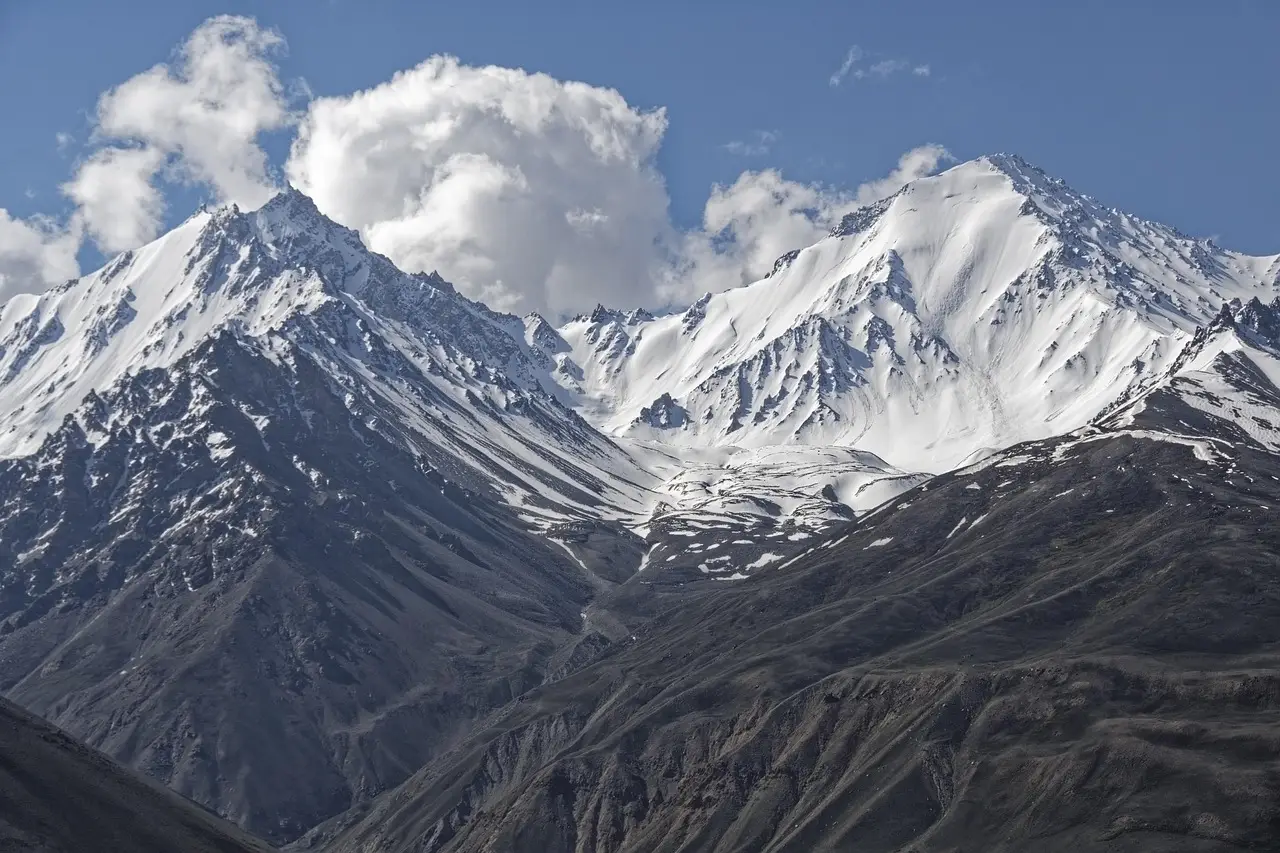
Mountains have come and gone throughout Earth’s history, but few ever reached the heights of the relatively young Great Himalaya. Mount Everest, K2 and Kangchenjunga, the three highest peaks on Earth, stand almost 9 kilometres (5.6 miles) above sea level on crust up to 80 kilometres (50 miles) thick.
That crust is about double the thickness of most other continents. The leaps in mountain stature likely produced massive and effectively irreversible increases in the amount of rock matter weathered into the oceans.
Did mountains drive diversification?
Co-author Dr. Ellen Kooijman of the Swedish Museum of Natural History in Stockholm said it is likely no coincidence that life developed and diversified around the same time as the two pulses.
She described the idea as exciting, noting that mountain belts once did not exist and that their development over 3 billion years may have driven the environmental and biological change that shaped the planet.
The study documents two major mountain-growth pulses and a plausible route through nutrients and oxygen. Its stronger claim—that the pulses helped create conditions for complex life—remains provisional because the timing shows that the events coincided, not that one caused the other.
The results appeared in “Raising mountains for a habitable Earth,” Science Advances (2026). The DOI is 10.1126/sciadv.aei2764.
Taller mountains, the authors suggest, may have helped turn a nutrient-poor young Earth into a world able to support complex life.
via phys.org/rss-feed/ (Source)
More from Priya Raman
Show full bio
Senior reporter covering people, launches and day-to-day practice in general science news at SciBeat.
384 articles
Nearby plates
- Ancient Ocean Chemistry Kept Earth Breathing, Study Finds
- Ancient Rocks Mark a Shift Toward Modern Plate Tectonics
- Mantle Motion Explains the Grand Canyon's Missing Billion Years
- Zircons Show Earth Absorbed Oxygen 3.4 Billion Years Ago
- Northern Baltic Sea's nutrient regime has shifted, 30-year study finds