Plate Nº 13 · recorded November 18, 2026
Space & AstronomyReported finding
NASA Asks Public to Flash Lights for Voyager 1's Light-Day Milestone
NASA invites the public to flash Voyager 1's call sign in Morse code after sunset on Nov. 17, ahead of the spacecraft reaching one light-day — 26 billion km — from Earth.
By Elena Vasquez3 min read599 words
In brief
- Voyager 1 reaches one light-day from Earth — about 16 billion miles (26 billion km) — on Nov. 18.
- The 'Shine Bright' event runs after sunset on Tuesday, Nov. 17; participants flash VGR in Morse code for about a minute.
- Voyager 1 launched Sept. 5, 1977, and is the most distant human-made object.
- Voyager 2 is expected to hit the same one-light-day milestone in November 2035.
- A NASA JPL discussion streams Thursday, Nov. 19, at 12 p.m. EST, with a 2027 Voyager documentary preview.
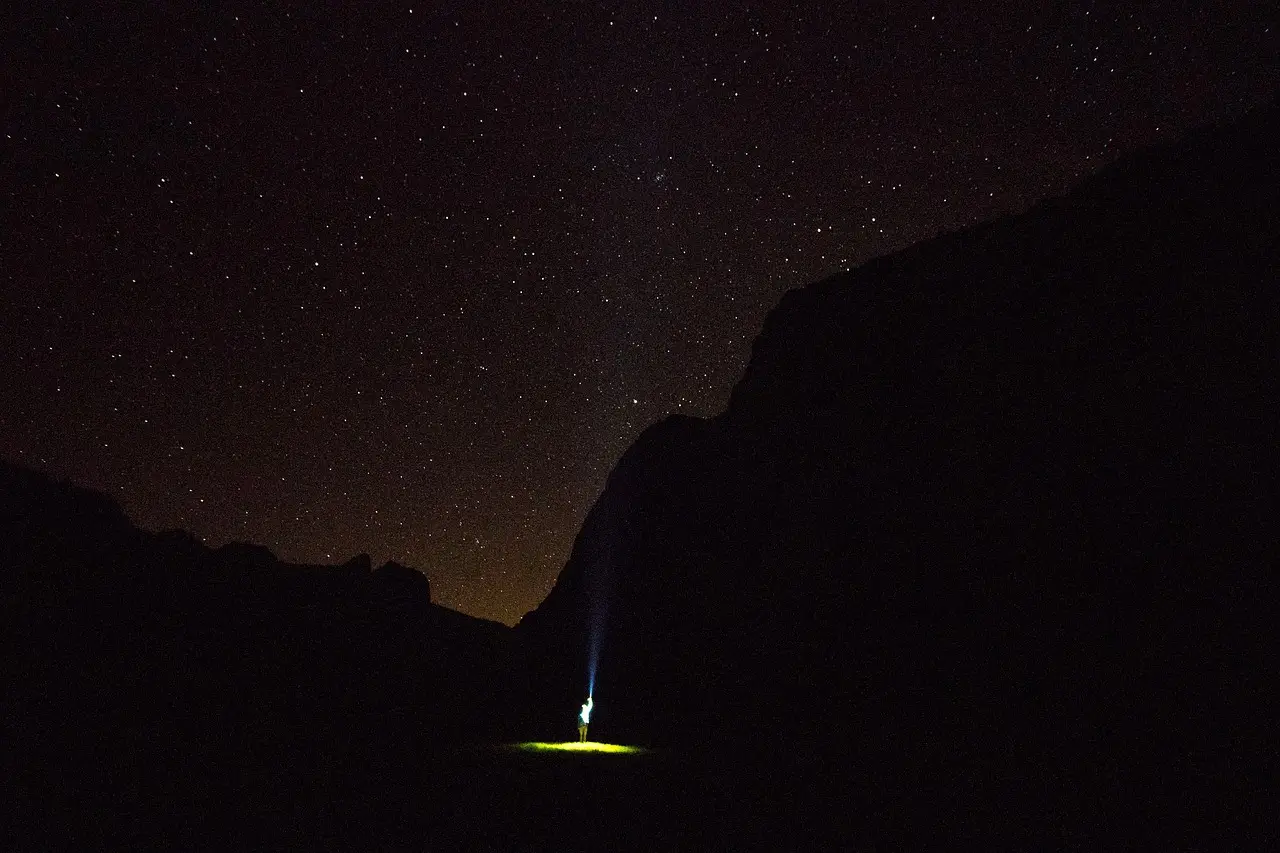
Voyager 1, the most distant object humanity has ever built, is about to sit one light-day from Earth — roughly 16 billion miles, or 26 billion kilometers. That's the distance light itself covers in 24 hours, and NASA wants the public to mark the moment with a global flashlight salute.
The event, called "Shine Bright for Voyager's Light-Day," takes place after sunset on Tuesday, Nov. 17 — the day before the spacecraft officially crosses the one-light-day threshold. Nearly 50 years after its Sept. 5, 1977 launch, Voyager 1 keeps adding firsts to its record.
How do you take part?
NASA asks participants to flash the mission's three-letter call sign, VGR, in Morse code using any portable light — a flashlight, phone light or bike light. The goal: a symbolic wave of golden light circling the planet.
The sequence breaks down like this, per NASA:
- V — three quick flashes, then one long flash
- G — two long flashes, then one quick flash
- R — one quick flash, one long flash, one quick flash
Repeat the pattern for about a minute. No Morse code knowledge required: NASA built an automated flasher that runs in a smartphone or tablet browser and displays the VGR sequence for you.
NASA also invites people to photograph or record their signals and post them on social media, tagging the agency's official account, @NASA.
Can your flashlight actually reach Voyager 1?
No — and NASA says that's not the point. The tribute is purely symbolic. At one light-day out, even radio signals traveling at the speed of light need about 24 hours to reach the spacecraft. A phone light doesn't stand a chance. Real communication runs through NASA's Deep Space Network, the system of giant radio dishes that talks to probes across the solar system.
The physics, though, is what makes the milestone striking. Voyager 1 will have traveled so far that light — the fastest thing in the universe — needs a full day just to catch up. In short: this is a measure of sheer distance, not speed.
Where are the Voyagers now?
Both Voyager probes are operating in interstellar space, the region beyond our sun's influence, and still return scientific data. Voyager 2, launched on a different route through the solar system, trails its twin. It is expected to reach its own one-light-day milestone in November 2035.
Keeping machines built in the 1970s alive this long is an engineering feat in itself, and NASA plans to talk about exactly that.
What's happening after the light event?
On Thursday, Nov. 19, at 12 p.m. EST (1700 GMT), NASA's Jet Propulsion Laboratory in Southern California will host a moderated discussion with Voyager mission team members and NASA leadership. The agenda covers the current status of both spacecraft, the unique observations they continue to collect in interstellar space, and the engineering challenges of keeping nearly 50-year-old probes running. A question-and-answer session with media and audience members follows.
NASA will also preview a Voyager documentary planned for release in 2027, timed to the mission's 50th anniversary.
For a mission that has carried humanity's message into interstellar space for close to half a century, the light-day salute gives people on Earth a way to appreciate just how far these pioneering machines have traveled. Step-by-step Morse code instructions and the automated VGR flasher are available online.
Grab a flashlight, step outside after sunset, and flash VGR skyward. Voyager 1 won't see it. But for one evening, the senders will.
via space.com (Source)
More from Elena Vasquez
Show full bio
Correspondent covering money, funding and market shifts around general science news at SciBeat.
503 articles
Nearby plates
- Voyager 1 Hits One Light-Day From Earth, and NASA Wants You to Blink Back
- Voyager 1 Nears One Light-Day From Earth, a First for Any Human Object
- Voyager 1 Hits One Light-Day From Earth — 49 Years After Launch
- Voyager 1 reaches 1 light-day from Earth on Nov. 18 after 49 years
- Voyager 1 to reach 1 light-day from Earth in November 2026