Plate Nº 65 · recorded November 17, 2026
Space & AstronomyReported finding
Voyager 1 Hits One Light-Day From Earth, and NASA Wants You to Blink Back
At 5:18 a.m. EST on November 18, Voyager 1 will be exactly one light-day from Earth. NASA wants you to blink Morse code "VGR" at the sky on November 17 to celebrate.
By Elena Vasquez3 min read583 words
In brief
- At 5:18 a.m. EST on November 18, Voyager 1 will be exactly one light-day from Earth.
- From that point, all communications with the spacecraft will take at least 24 hours round trip.
- Voyager 1 has been the farthest human-made object since 1998.
- NASA's 'Shine Bright' event runs after sunset on Tuesday, November 17, using the Morse signal V-G-R.
- NASA expects a few more years of life from the spacecraft thanks to recent equipment adjustments.
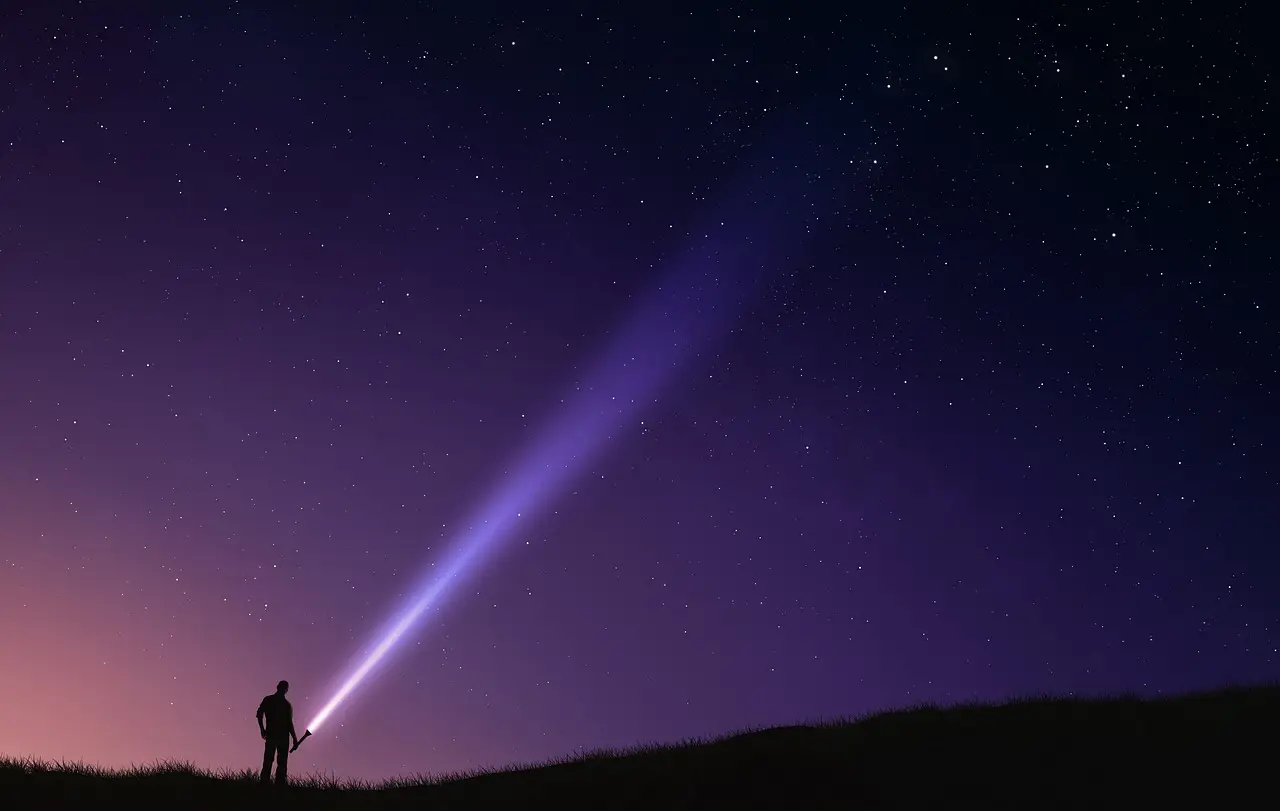
At 5:18 a.m. EST on November 18, NASA's Voyager 1 will sit exactly one light-day from Earth — the farthest any human-made object has ever traveled, and a distance that changes how we talk to it. From that moment on, every round-trip communication with the spacecraft will take at least a full 24 hours to send and receive.
A light-day is simply the distance light covers in 24 hours: about 25.9 billion kilometers. Voyager 1 crossed that threshold gradually, and the November 18 moment merely marks the exact instant. But the milestone is real. Signals travel at the speed of light, and nothing moves faster. So mission controllers face a built-in lag of a day or more every time they send a command and wait for a reply.
The spacecraft has held the record for the farthest human-made object since 1998. That means, technically, it has been breaking its own record continuously for the last 18 years, according to NASA's accounting. Every second it flies, it goes where nothing from Earth has gone before.
How can you join the celebration?
NASA announced a worldwide event called Shine Bright for Voyager's Light-Day. Anyone can participate. After sunset on Tuesday, November 17, aim a flashlight or smartphone at the night sky and blink out the Morse signal "V-G-R" — NASA's three-letter call sign for the spacecraft.
The code is short. Here's what to blink:
- V — dot-dot-dot-dash
- G — dash-dash-dot
- R — dot-dash-dot
Not fluent in Morse? NASA built a dedicated website that auto-flashes the "VGR" signal for you, if holding a phone aloft is easier than tapping it yourself.
The agency framed the event in plain terms. "A simple act. A shared moment. A celebration of humanity's farthest reach," NASA explained.
The event lands the evening before the record moment itself, so the timing lets participants around the globe take part after local sunset rather than at a single worldwide hour.
Why does one light-day matter?
It's a milestone of engineering endurance as much as distance. Voyager 1 launched as a piece of equipment originally intended to survive only a few years in deep space. Instead, it has kept transmitting for decades, pushing across the boundary of the solar system and into interstellar space.
The one-light-day mark is a convenient way to grasp an otherwise abstract distance. You can't see the spacecraft. You can barely picture the number. But a full day's travel for a light beam — the fastest thing in the universe — makes the gap visceral.
It also sets a practical limit. Future missions and communications will operate against that 24-hour round-trip delay. Every instruction, every health check, every bit of data comes with a day's wait built in.
Is this goodbye for Voyager 1?
No — not yet. Thanks to recent equipment adjustments, NASA expects to squeeze at least a few more years of life out of the spacecraft before it finally goes dark.
When that day comes, Voyager 1 won't vanish. It will keep drifting as an inert piece of technology, silent but still outbound. NASA describes its eventual fate as an interstellar monument to humanity's curiosity and creativity.
In short: on November 17, point a light at the sky, blink V-G-R, and salute the machine that just put a full light-day between itself and home.
via popsci.com (Source)
More from Elena Vasquez
Show full bio
Correspondent covering money, funding and market shifts around general science news at SciBeat.
503 articles
Nearby plates
- Voyager 1 Hits One Light-Day From Earth — 49 Years After Launch
- Voyager 1 Nears One Light-Day From Earth, a First for Any Human Object
- Voyager 1 to reach 1 light-day from Earth in November 2026
- Voyager 1 reaches 1 light-day from Earth on Nov. 18 after 49 years
- Voyager 1 reaches 1 light-day from Earth on Wednesday, Nov. 18