Plate Nº 88 · recorded October 10, 2026
Space & AstronomyReported finding
NASA's Moon Orbiter Spots 728-Foot Crater That Formed in 2024
NASA's Lunar Reconnaissance Orbiter confirmed a 728-foot crater formed on the Moon in 2024, the largest newly identified impact crater in the solar system. The collision chilled a 4-mile-wide zone around the site.
By Nathan Brooks4 min read721 words
In brief
- A 728-foot-wide crater named McGetchin formed on the Moon between April 11 and May 22, 2024.
- Researchers estimate impacts this large may hit the Moon only about once every century.
- LRO has operated around the Moon for more than 17 years and confirmed at least 1,000 new impact craters.
- A 4-mile-wide zone around the crater runs roughly 16°F colder than the nearby surface after sunset.
- Robert Wagner spotted the crater on October 24, 2025, during a routine global comparison of LROC images.
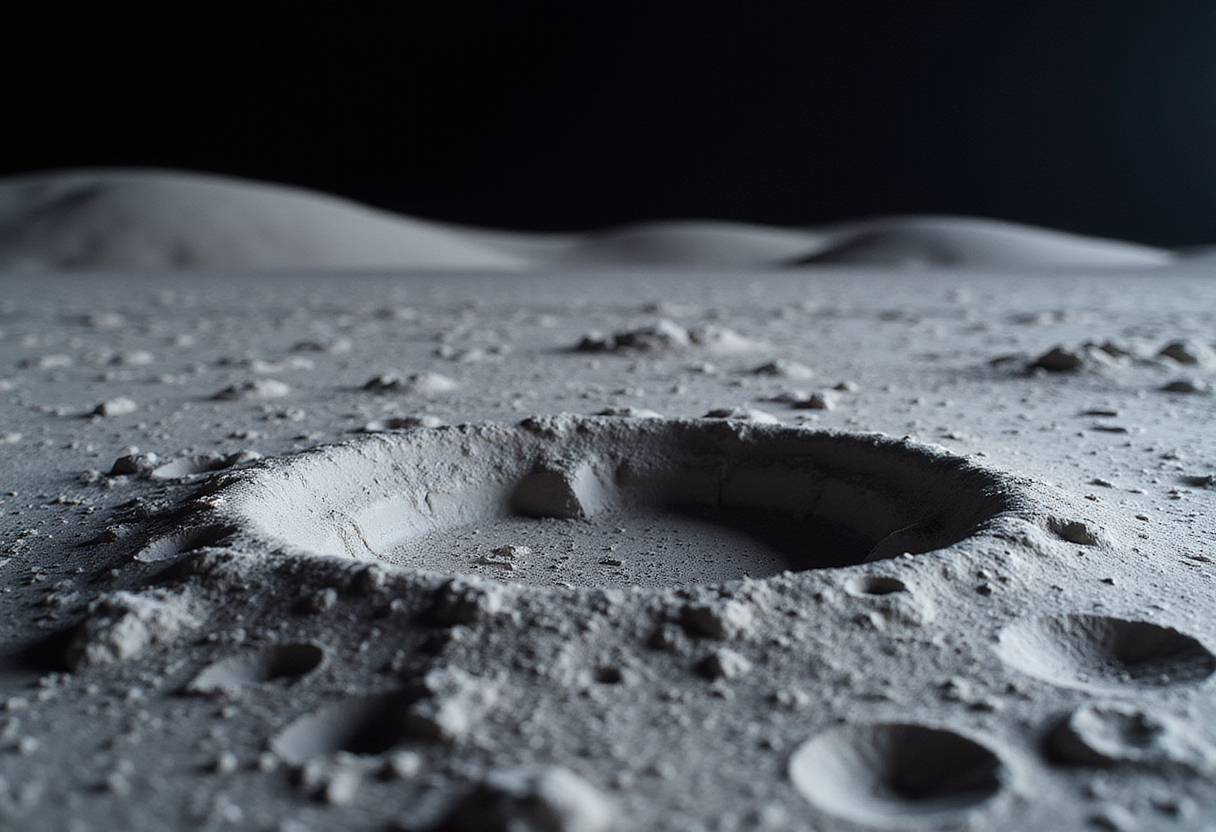
NASA's Lunar Reconnaissance Orbiter has identified a 728-foot-wide crater that formed on the Moon between April 11 and May 22, 2024, making it the largest newly formed impact crater ever confirmed in the solar system. Scientists reported the find on September 16 in Science Advances.
The crater, named McGetchin after pioneering lunar scientist Tom McGetchin, sits near the Moon's eastern edge. It measures 728 feet across and 141 feet deep. An asteroid or comet roughly the size of a three- to six-story building carved it out.
How big is the discovery?
The 728-foot width equals roughly two football fields placed end to end. The depth could hold three yellow school buses stacked vertically. Researchers estimate that an impact this large may strike the Moon only about once every century, or even less often.
How did scientists find it?
Robert Wagner, an image-processing specialist from Intuitive Machines working with NASA's Lunar Reconnaissance Orbiter Camera (LROC) system, spotted the crater on October 24, 2025. He was running a routine broad search for changes larger than 150 feet across, comparing global maps with earlier versions.
He stacked hundreds of before-and-after images from LROC's Wide-Angle Camera, which records broad areas of the lunar surface with pixels about the size of football fields. Software designed to reveal differences turned unchanged terrain gray and flagged any alteration as a bright or dark patch.
When McGetchin first appeared on his screen, Wagner recalled: "I just stopped, dropped everything, and started looking into what that spot was."
Most candidate signals are false alarms triggered by shifts in shadows or lighting. Wagner usually verifies real impacts by searching for fuzzy rings around single-pixel bright points, which mark sprays of freshly thrown regolith. McGetchin looked nothing like those small features. Its debris pattern stretched across hundreds of pixels.
"It was by far the most obvious impact debris pattern I've ever seen in one of these images," Wagner said.
Follow-up images from LROC's Narrow-Angle Camera, which captures details at roughly 3 feet per pixel, let researchers measure the crater and study how the surroundings had changed.
Why is the Moon so cratered?
The Moon has no atmosphere capable of slowing incoming space rocks or burning them up. On Earth, most meteoroids disintegrate before reaching the ground. On the Moon, they hit at full speed.
For more than 17 years, LRO has circled the Moon in a pole-to-pole orbit about 60 miles above the surface. Its seven instruments map the terrain, measure surface composition, track temperatures, and monitor radiation.
During that time, researchers have confirmed at least 1,000 new impact craters and recorded about 100,000 additional surface changes from impacts and debris thrown outward during collisions. Scientists estimate that impacts large enough to leave craters above the smallest detection threshold (about 30 feet across) create roughly 140 new craters across the Moon each year.
What does the surrounding cold zone reveal?
After McGetchin's discovery, scientists turned LRO's thermal instrument, Diviner, toward the site. They expected the new crater to differ from its surroundings. They did not expect the surrounding area to differ so dramatically.
An area roughly 4 miles wide around the crater runs about 16 degrees Fahrenheit colder at night than nearby terrain. A second paper published September 16 in Science Advances reports the cause: the impact churned and loosened the lunar regolith, the layer of dust and broken rock that covers the surface.
The disturbance left the material less dense and less able to hold onto heat after sunset. The cold spot extends well beyond the crater rim, showing that a single major impact can reshape the lunar surface far past the crater itself. These changes could also affect future missions, since differences in regolith texture and density can influence how rover wheels grip the ground.
What limitations remain?
McGetchin is the biggest newly formed crater on record, not the biggest ever. Older features, including the 1-mile-wide Linné crater and the South Pole–Aitken basin, span far wider.
More detailed results about the impactor's size and energy are expected in a future paper. Researchers also caution that automated difference-detection methods yield hundreds of false positives per pass, which is why human review remains essential.
via science.nasa.gov (Original)
More from Nathan Brooks
Nearby plates
- A Giant Crater May Reveal Whether Phobos Is a Captured Asteroid
- New Simulations: The Moon May Have Formed Intact in Five Hours
- Meter-Long Scorpion Stalked Britain 415 Million Years Ago
- Perseverance rover uncovers three water histories in Jezero Crater
- Perseverance Finds Early Mars Hosted Complex, Hot Water Systems