Plate Nº 86 · recorded October 10, 2026
Space & AstronomyReported finding
New Simulations: The Moon May Have Formed Intact in Five Hours
New simulations suggest the Moon may have emerged intact within about five hours of the giant impact, depending on how hot and strong early Earth and Theia were.
By Marcus Bennett4 min read788 words
In brief
- New simulations show an intact Moon can form within about five hours of the giant impact.
- The study models the collision thought to have occurred roughly 4.5 billion years ago between early Earth and the Mars-sized body Theia.
- The findings appear in The Astrophysical Journal Letters (2026, vol. 1008, L30).
- It is the first time Moon-formation simulations have included temperature-dependent material strength of both colliding worlds.
- The work builds on a foundational 2001 giant-impact study by Robin Canup and Erik Asphaug.
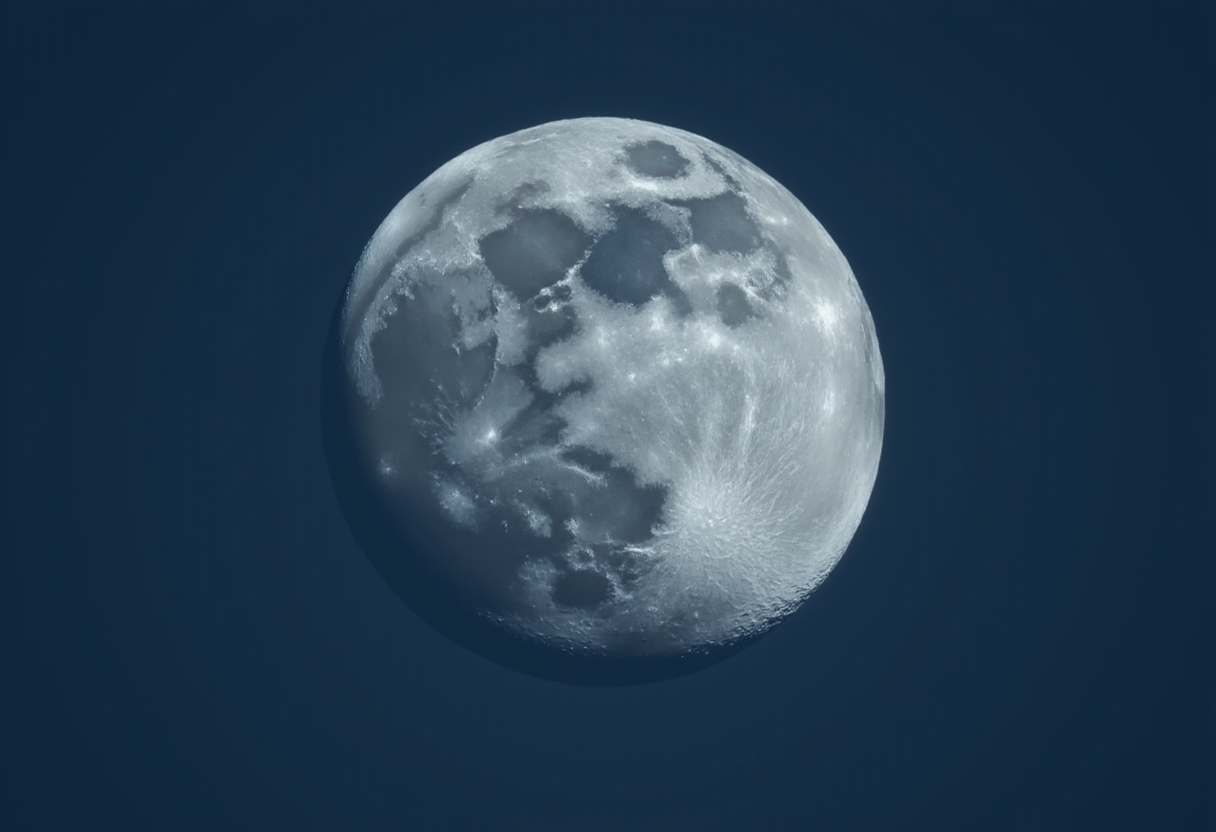
The Moon may have emerged fully intact within roughly five hours of the giant collision that rocked the early Earth, according to new simulations published in The Astrophysical Journal Letters. That is a dramatically faster birth than the textbook scenario, in which the Moon slowly assembled from a ring of debris over a much longer period.
The study, led by researchers at the Southwest Research Institute (SwRI) and the University of Arizona, ran advanced computer models of the impact thought to have occurred about 4.5 billion years ago between the young Earth and a Mars-sized body called Theia. It is the first time such simulations have accounted for the material strength — the ability of rock to resist deformation — of the two colliding worlds.
The result: whether the Moon forms intact or piecemeal depends heavily on how hot, and therefore how mechanically weak, Earth and Theia were before the crash.
What did the simulations actually show?
The researchers used an upgraded version of a technique called smoothed particle hydrodynamics (SPH), developed at the University of Arizona and the University of Bern in Switzerland. Unlike earlier models, this version treats planetary material as geologic substance — rock and metal that can resist being squeezed and stretched — rather than as pure fluid.
The outcomes split into two very different scenarios:
- Debris-disk case: Under many conditions, the impact destroys Theia and flings its remains into a broad disk of debris orbiting Earth. The Moon then gradually coalesces from that disk.
- Intact-capture case: When the team used the same parameters as the original impact modeling — including equal internal temperature structures in both bodies — an intact Moon emerged within about five hours.
Temperature proved especially important. Hotter planetary bodies are mechanically weaker, and that difference alone can dramatically change what happens after impact.
Why does material strength matter?
Scientists have modeled the Moon-forming impact for decades, starting with a foundational 2001 study led by Robin Canup of SwRI and Erik Asphaug of the University of Arizona's Lunar and Planetary Laboratory, a co-author of the new work. Those models, like most that followed, treated both worlds as fluids.
The reasoning was straightforward: the collision was so violent that it melted and vaporized large portions of Earth and Theia, so fluid behavior seemed a fair approximation.
"Based on our new results, however, we think that it is time to reconsider that," Asphaug said.
"We discovered that the preexisting geology of the Mars-sized proto-moon matters," said Adeene Denton, a former postdoctoral researcher at the Lunar and Planetary Laboratory now at SwRI. "When you simulate the Earth and the Moon as colliding bodies with geologic properties, it changes how the Moon forms out of that impact — that's something we considered unnecessary before."
Denton got the idea while working on a previous paper about the formation of Pluto and its moon Charon. Material strength is already known to matter in collisions between smaller bodies such as asteroids, dwarf planets and moons. Whether it mattered for Earth's Moon was an open question until now.
Could this tell us when the impact happened?
Because young protoplanets start hot and cool as they age, the thermal state of Earth and Theia at the moment of collision is tied to when it occurred. The findings hint that the Moon's present-day properties — perhaps including its volatile content, the easily vaporized elements and compounds locked inside rock — could encode clues about that thermal state.
"This in turn might help scientists better constrain when the moon-forming event occurred," said Canup, who was not involved in the new study.
What remains unexplained?
One long-standing puzzle survives intact. Earth and the Moon have remarkably similar compositions, something giant impact models have struggled to fully explain, and the new simulations do not solve it.
"Because Earth and Mars formed in the same neighborhood of the solar system, they are like siblings," Denton said. "The Moon and Earth are more like fraternal twins." One possibility is that Theia and the proto-Earth formed from the same reservoir of material, while Mars — chemically distinct from both — formed farther away.
The findings remain simulation-based and preliminary; they describe what physical models allow, not a confirmed history. Still, by showing that the internal condition of Earth and Theia strongly shapes the collision's aftermath, the study opens a new investigative tool.
"We now know that the geophysical state of Earth and Theia play a fundamental role in shaping the outcome of the collision," said co-author Namya Baijal, a doctoral student in Asphaug's group. "This gives us a new way to explore the conditions of the impact and what they might reveal about the Moon's origin."
via news.arizona.edu (Original)
More from Marcus Bennett
Nearby plates
- Webb Telescope Spots Mars-Sized Worlds Smashing Together
- Webb Telescope Witnesses Planet-Smashing Collisions Around Young Stars
- A Giant Crater May Reveal Whether Phobos Is a Captured Asteroid
- Earth and Mars Were Built From Different Cosmic Recipes
- Rocky Planets May Have Formed Just 100 Million Years After Big Bang