Plate Nº 84 · recorded October 13, 2026
Space & AstronomyReported finding
NASA's Roman Telescope Will Survey 200 Times More Sky Than Hubble
NASA's Nancy Grace Roman Space Telescope will survey patches of sky 200 times larger than Hubble, tracking supernovae, microlensing events, and an estimated 100,000 transiting planets.
By Priya Raman3 min read654 words
In brief
- Roman's field of view reaches up to 200 times that of the Hubble Space Telescope.
- The mirror matches Hubble's size and observes in visible and infrared light.
- Astronomers predict the Galactic Bulge survey will identify roughly 100,000 transiting planets.
- Roman will monitor small stars cooler than approximately 2,500°C (4,500°F).
- TESS has mapped nearly the entire sky across eight years of observation.
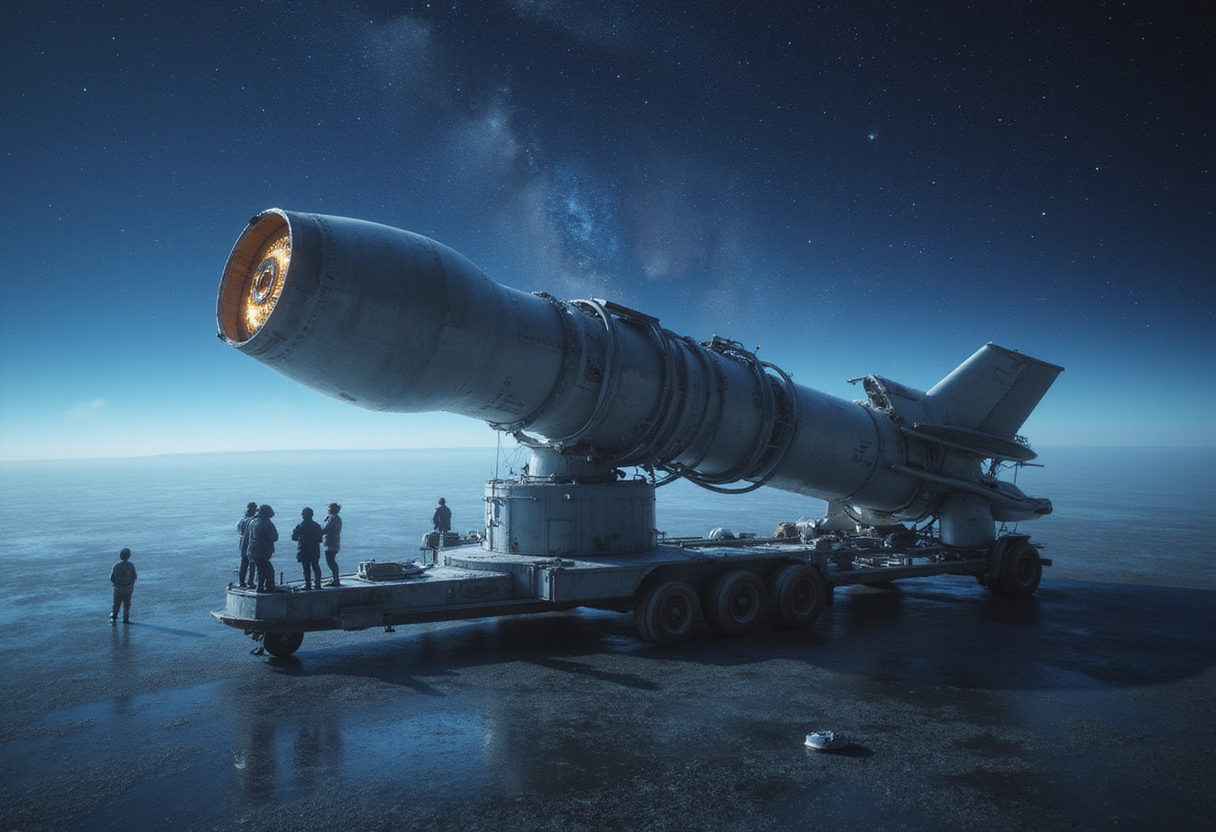
NASA's Nancy Grace Roman Space Telescope, designed to survey patches of sky up to 200 times larger than Hubble can capture in a single exposure, will soon begin tracking cosmic change.
Looking up from a quiet hillside, the night sky appears fixed. Stars seem locked in their constellations, and the Milky Way forms a smeared white band across the dark. In reality, every visible star rotates, ages, and eventually dies, often violently enough to seed the next generation of planets.
The observatory carries her name: Nancy Grace Roman, NASA's first chief of astronomy and the agency's first female executive. Three capabilities working together will define the mission: sharp images, an enormous field of view, and repeated visits to the same patches of sky.
How does Roman differ from Hubble?
Roman carries a mirror the same size as Hubble's and observes in visible and infrared light. The defining difference is field of view: Roman can frame a region of sky up to 200 times larger than Hubble in a single pointing.
Past missions that scanned wide fields, including Kepler and the Transiting Exoplanet Survey Satellite (TESS), sacrificed sharpness for coverage, and their lower spatial resolution caused nearby stars to blur together.
The James Webb Space Telescope reaches the opposite extreme, offering sharp imaging but a far narrower field impractical for monitoring millions of objects at once. Roman combines both qualities.
The third pillar is time. By revisiting the same regions repeatedly, Roman will register changes that a single image would miss, from hour-long stellar flares to year-long stellar evolution.
What will the two core surveys examine?
Roman's mission plan divides into core surveys, two of which focus on time-domain observations. The High-Latitude Time-Domain Survey will capture distant events, including supernovae, the explosive deaths of massive stars that seed new stellar systems.
The Galactic Bulge Time-Domain Survey will monitor the densely packed central region of the Milky Way.
In the galactic bulge, thousands of stars, along with intervening gas and dust, obscure the galaxy's core, and to human eyes merge into the familiar luminous band. Roman's near-infrared vision resolves individual stars there and uses them as a backdrop for two distinct investigations.
How will Roman find new planets?
The Galactic Bulge survey pursues both microlensing and the transit technique. In microlensing, the gravity of a foreground object warps and magnifies light from a more distant star behind it, briefly brightening the background star.
The foreground object may be a star, a planet roughly the size of Mars, or a black hole with hundreds of solar masses.
The transit method, in which a planet passing directly between its star and the observer dims the starlight in proportion to the planet's size, will also operate at scale in the bulge. The sheer density of stars there leads astronomers to predict the discovery of approximately 100,000 transiting planets during the survey.
What can the telescope reveal about small stars?
Cool dwarf stars, those below roughly 2,500°C (4,500°F), interest researchers for several reasons. Magnetic spots and surface clouds rotate into and out of view, allowing measurement of rotation periods.
Comparing those periods across a large sample can reveal patterns in stellar magnetic behavior over time. Such stars are faint and red, making them difficult targets for current visible-light surveys.
TESS has mapped nearly the entire sky across eight years and identified rotation periods for hundreds of these small stars, but its visible-light sensitivity and lower spatial resolution limit its reach. Roman's wide-field, high-resolution, near-infrared imaging should expand that sample substantially, allowing astronomers to study environments around small stars and the planets they host.
From distant supernova light to the smallest cool dwarfs in our galactic neighborhood, Roman will document a sky that observers once thought static but now know to be in constant transformation.
via Phys.org Space & Astronomy (Source)
More from Priya Raman
Show full bio
Senior reporter covering people, launches and day-to-day practice in general science news at SciBeat.
226 articles
Nearby plates
- NASA's Roman Telescope Will Image 100× More Sky Than Hubble
- Roman Space Telescope lifts off to survey the infrared sky
- NASA's Roman Telescope launches on mission 1,000 times faster than Hubble
- Roman telescope hits 1/100,000-degree stability in early tests
- NASA Powers Up Roman Telescope's 300-Megapixel Camera