Plate Nº 80 · recorded November 10, 2026
Chemistry & MaterialsReported finding
Neutrons Expose Ion Traffic Jams Inside Solid-State Battery Materials
Argonne-led researchers used neutron scattering at Oak Ridge to reveal ions helping and blocking each other in a solid salt, a key clue for designing solid-state batteries.
By Elena Vasquez3 min read600 words
In brief
- Argonne National Laboratory researchers published the technique in PRX Energy.
- Experiments ran at Oak Ridge National Laboratory's Spallation Neutron Source on a strontium chloride crystal.
- The salt conducts ions rapidly above about 1,200 degrees Fahrenheit.
- Rotating the crystal during measurement combined 3D motion data with energy transfer readings.
- The study tested a method on a salt; no working battery was built.
By Elena Vasquez
Researchers have used neutrons to catch ions moving together and getting in each other's way inside a solid — a first look at microscopic "traffic jams" that could decide whether solid-state batteries charge fast or crawl.
The team, led by Argonne National Laboratory, published its technique in the journal PRX Energy. They ran the experiments at Oak Ridge National Laboratory's Spallation Neutron Source, one of the most powerful neutron facilities in the world.
The findings matter because batteries live and die by ion movement. Every battery shuttles charged particles through an electrolyte while charging and discharging. Many today use liquid electrolytes. A solid one has to offer routes fast enough for ions to keep up, and until now, standard tools treated each ion as if it moved alone.
How do you watch a single ion hop?
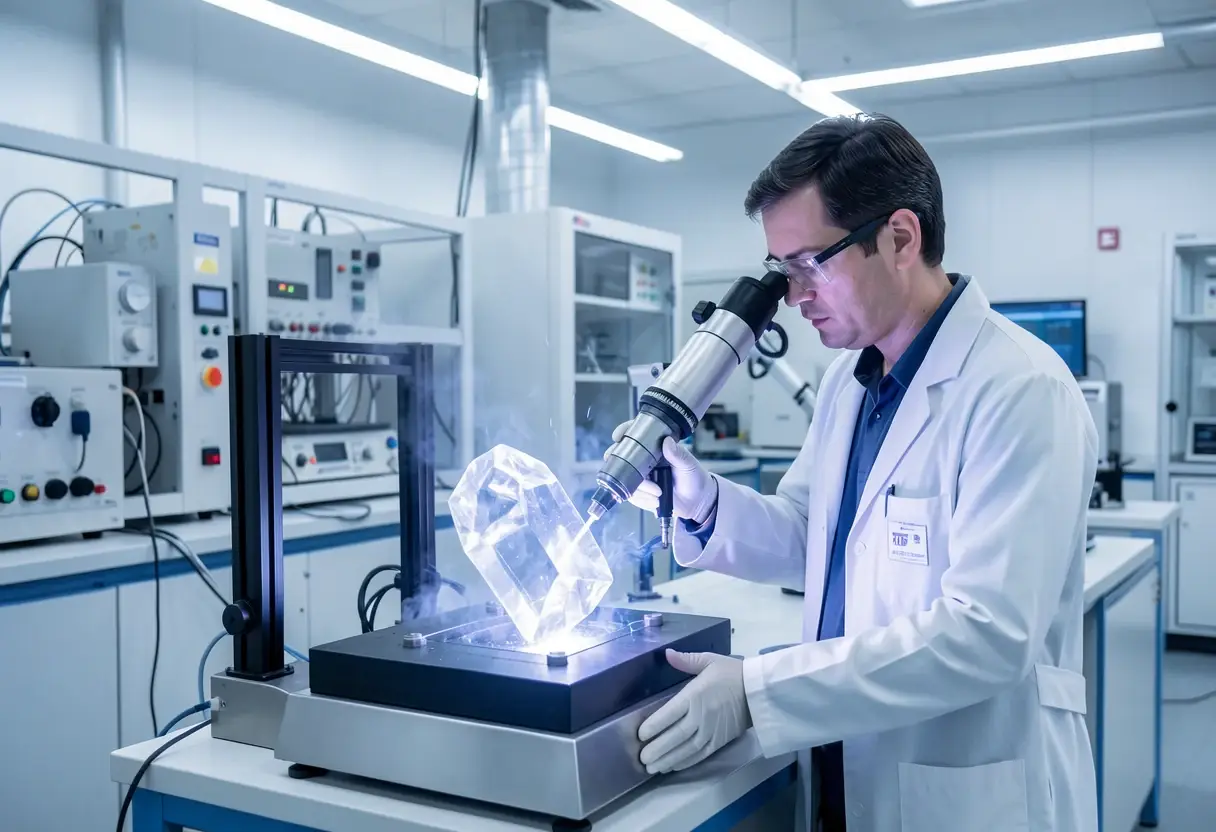
Neutrons, it turns out, are good eyeballs. The researchers aimed a beam at a crystal of strontium chloride, a salt scientists have studied for decades, and measured how the neutrons scattered. When a neutron bounces off the crystal, its change in direction and energy carries a record of how atoms and ions inside the sample are moving.
One twist made the difference. While collecting data, the team rotated the crystal. That filled in scattering from many directions and let them combine three dimensions of motion information with measurements of energy transfer — far more than a conventional scattering experiment captures.
The payoff is a way to see whether ions jump in patterns that an average measurement would hide.
Why strontium chloride?
The salt was a deliberate choice, not a battery candidate. Strontium chloride conducts ions quickly when heated above roughly 1,200 degrees Fahrenheit, and researchers already had a clear picture of how its ions hop between positions in the crystal lattice.
That made it a benchmark. The new measurements matched the earlier work on ion hopping, which told the team their method works. Then the data went further, revealing effects that appear only when ions interact rather than move in isolation.
What did the ion interactions reveal?
Here's the core mechanism. An ion's movement can determine whether a neighboring ion has room to move, or how easily it reaches its next spot. Depending on how the ions are arranged, those interactions can either speed charge through the solid or create jams.
That distinction could reshape how materials get designed. Two solids might offer nearly identical routes for a lone ion, yet conduct charge at very different rates once many ions move at once — because in one material they cooperate, and in the other they block each other.
In plain terms: the crowd matters as much as the road.
What are the limits?
Plenty, and the researchers are upfront about them. The study tested a method, not a battery. Nobody built a device, and strontium chloride itself isn't heading into your phone. The technique also produces vastly more data than a simple scattering measurement, so the team needed a powerful neutron source and serious computing resources to gather and analyze enough information to pick out the interactions.
The next step is applying the method to more practical solid electrolytes. If it works there, scientists can check whether their models of how those materials conduct charge are actually right — or whether the models are missing the crowd effects this technique now exposes.
The takeaway: neutron scattering with a rotating crystal gives researchers their clearest tool yet for seeing how ions behave in groups, and that group behavior may make or break the solid-state batteries of the future.
via knowridge.com (Source)
More from Elena Vasquez
Show full bio
Correspondent covering money, funding and market shifts around general science news at SciBeat.
384 articles