Plate Nº 13 · recorded November 10, 2026
Chemistry & MaterialsReported finding
Nanoindentation recrystallizes molybdenum at room temperature
A diamond nanoindenter can reform tiny regions of molybdenum at room temperature, potentially supporting local defect repair and future microchip interconnects without heating a whole sample.
By Elena Vasquez4 min read774 words
In brief
- Molybdenum was recrystallized at room temperature with a diamond nanoindenter, avoiding heating to about 1,000°C (1,832°F).
- The tip entered the metal by a few nanometers, and a controlled “pop-in” produced new crystal grains.
- Molybdenum melts above 2,600°C (4,712°F) and is used in nuclear reactors, jet-engine turbine blades and rocket nozzles.
- The study was published in the Proceedings of the National Academy of Sciences in 2026 under DOI 10.1073/pnas.2612140123.
- Semiconductor interconnects connect millions of chip components, and manufacturers are exploring molybdenum as a copper replacement.
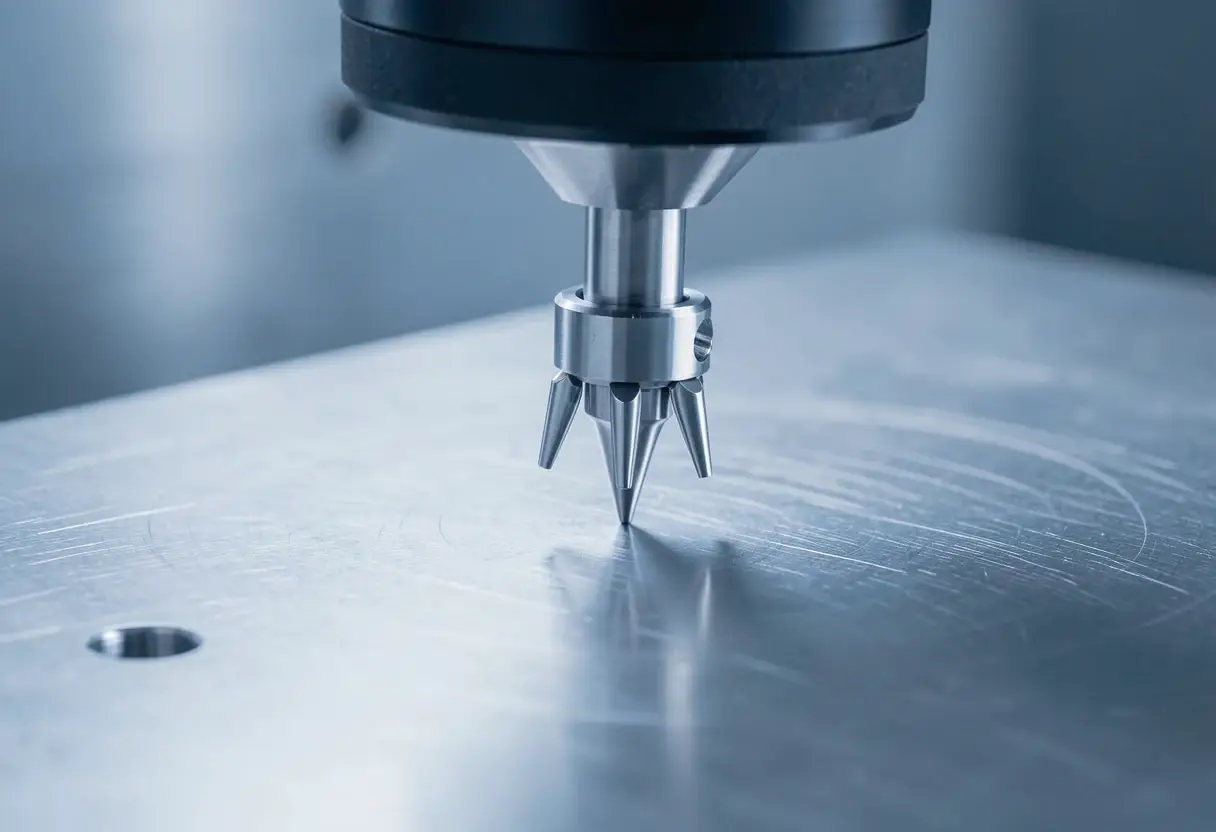
Room-temperature recrystallization can be triggered in molybdenum with a precisely controlled diamond nanoindenter, avoiding the heating to about 1,000°C (1,832°F) that the metal normally requires.
Researchers at the University of Rochester and the Technion–Israel Institute of Technology made the discovery by accident, then confirmed it through experiments and computer modeling and published the results in the Proceedings of the National Academy of Sciences.
The result could matter beyond the laboratory. Molybdenum reinforces nuclear reactors, jet-engine turbine blades and rocket nozzles because it does not melt until heated above 2,600°C (4,712°F); changing its internal structure at room temperature may create new uses, including next-generation semiconductors.
What does recrystallization change inside molybdenum?
Metals may look uniform, but their microstructures contain small regions called crystal grains. A grain’s shape, orientation and size influence how a material behaves, including its strength and how easily it bends or deforms without breaking. Recrystallization creates a new grain structure.
Before this work, researchers could not change molybdenum’s crystal grains at room temperature. They generally had to heat a sample to about 1,000°C (1,832°F) or above, requiring heat for the entire piece rather than a single small area.
Takeaway: The finding gives researchers a way to change molybdenum’s crystal structure without heating the whole sample.
How does the diamond tip trigger recrystallization?
The engineers used a calibrated tool called a nanoindenter, which pushes a fine diamond tip into a material to test its properties. Here, the tip penetrated molybdenum by only a few nanometers. The researchers initially expected extreme pressure to create a new solid phase, meaning a different atomic arrangement, but the metal responded through another route.
Associate professor Niaz Abdolrahim of Rochester’s Department of Mechanical Engineering said: “We had a hypothesis that applying extreme pressure to molybdenum would cause it to transform to a new solid phase. But then we found this interesting phenomenon of an entirely different stress-driven mechanism.”
A slight force from the nanoindenter creates extreme pressure and drives the diamond tip through the surface in a sudden, quick movement researchers call a “pop-in.” Entering this pop-in stage triggers recrystallization in the metal immediately around the indentation.
Pressure must be controlled. Once the tip moves beyond the pop-in event, the newly formed grains disappear. The researchers obtained recrystallization by manually stopping the test just after the pop-in, leaving a recrystallized patch around the small dent in the surface.
Researchers say the technique may help repair a defective region in a larger molybdenum sample, giving the damaged area new grains without affecting the rest of the sample.
Afnan Mostafa, a mechanical engineering Ph.D. student in Abdolrahim’s lab, said:
“Currently if you have a damaged sample, to fix it or form new grains, you have to heat the whole sample up to 1,000°C (1,832°F) or more. Here we show you don't need to heat up the whole sample. You just need to know where to poke, how much and when to stop.”
Takeaway: A brief pop-in creates new grains, while extra pressure removes them, making timing as important as force.
What could this mean for semiconductor chips?
The researchers say semiconductor manufacturers are exploring molybdenum for the tiny wires, called interconnects, that link millions of components on a microchip. They are considering it as a replacement for copper as chipmakers try to make smaller, more powerful devices to meet the computing demands of artificial intelligence systems.
At nanoscales, copper’s electrical resistance rises, reducing the flow of electricity, Mostafa said. Molybdenum does not share that resistance problem, which makes it appealing for the next generation of tiny interconnects.
Yet molybdenum, although extremely durable at high temperatures, can break suddenly at room temperature without warning. The team wants to determine whether controlled recrystallization can improve that behavior and unlock uses that currently require high temperatures.
Takeaway: Local grain control could support both targeted metal repair and the search for a better material for smaller chips.
What did the study establish?
The paper, “Mechanically driven grain refinement in Mo by nanoindentation pop-ins: A case of transient instability,” appeared in the Proceedings of the National Academy of Sciences in 2026. Its listed citation is Feitao Li et al., with DOI 10.1073/pnas.2612140123.
The reported result is local recrystallization at room temperature; the effects on fracture behavior, defect repair and semiconductor interconnects remain proposed applications rather than established commercial outcomes.
Takeaway: The paper documents a controlled laboratory method for changing metal grains; its larger engineering uses remain proposed.
via phys.org/rss-feed/ (Source)
More from Elena Vasquez
Show full bio
Correspondent covering money, funding and market shifts around general science news at SciBeat.
384 articles
Nearby plates
- Quantum Spins Push a 100-Milligram Diamond in Lab First
- Diamonds Can Generate Electricity, Hong Kong Scientists Discover
- Lasers Turn Ordinary Plastic Into Billions of Tiny Diamonds
- A New Recipe Makes 'Impossible' Metal Nitride Nanocrystals
- Two Alloys Refuse to Crack at −424°F — Here's What That Does and Doesn't Mean