Recorded November 20, 2026
Biology & EvolutionReported finding
New Snake Species Found in Ethiopia: The White-Throated Egg-Eater
Dasypeltis albigularis, a new egg-eating snake from Ethiopia's Harenna Forest, slices bird eggs open with its own vertebrae. Hatchlings weigh just 1.5 grams — and three more species may follow.
By Nathan Brooks3 min read669 words
In brief
- New snake species Dasypeltis albigularis described in Herpetozoa in 2026 from Ethiopia's Harenna Forest
- Hatchlings weigh 1.5 grams and are 20 cm long, eating only tiny bird eggs
- Crossbreeding with the montane egg-eater produced 1 hatchling from 21 eggs
- The species has a white throat patch spanning about 60 belly scales and blue-tinted skin between scales
- Researcher Arthur Tiutenko says three more new egg-eater species await description
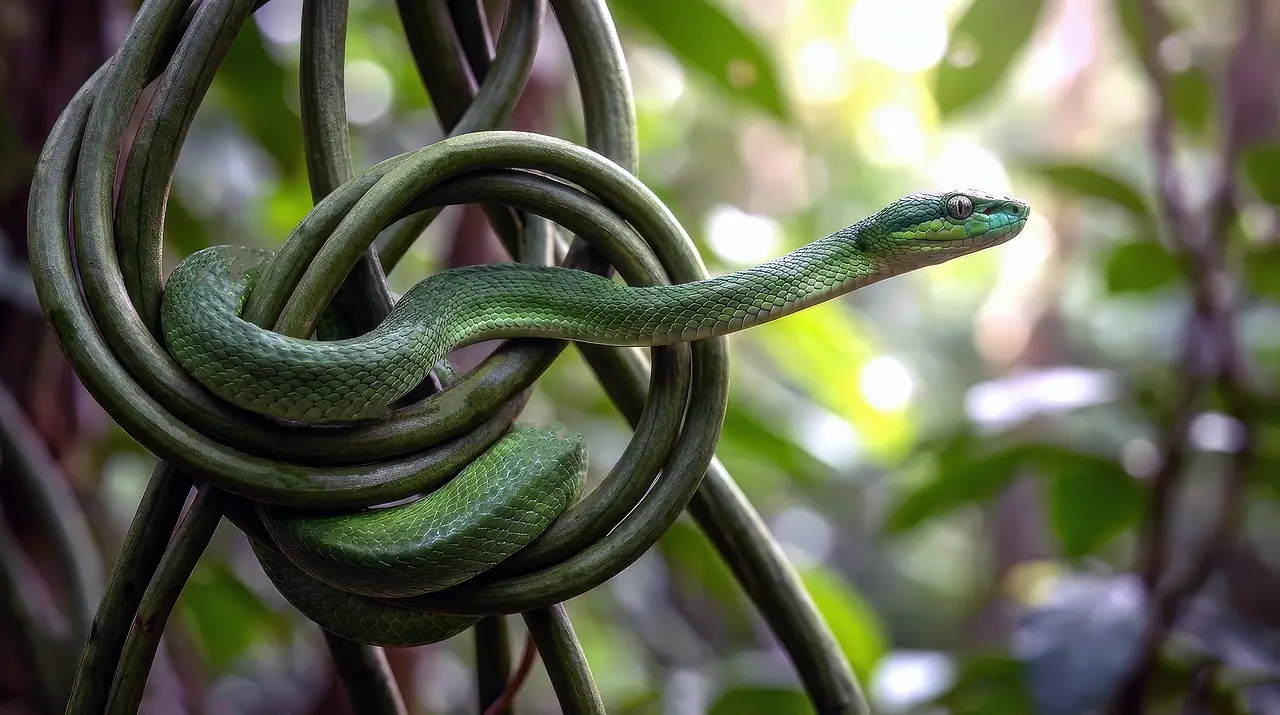
Zoologists have discovered a new snake species in Ethiopia's Harenna Forest, and it comes with a built-in egg peeler. The species, named Dasypeltis albigularis or the white-throated egg-eater, was formally described in the journal Herpetozoa in 2026 by Dr. Arthur Tiutenko of Friedrich–Alexander University Erlangen–Nürnberg (FAU) together with colleagues from LMU München and the South African National Museum in Bloemfontein.
The discovery started small. A local employee brought a young female snake to the research team working in the Harenna Forest, on the southern slopes of Ethiopia's Bale Mountains. Tiutenko initially assumed it was a Dasypeltis atra, the montane egg-eater — a species known from the eastern Congo Basin. Several egg-eating snakes in Ethiopia had previously been classified that way, though none had ever turned up in the Harenna Forest itself.
Where was the snake found?
The Harenna Forest covers a huge stretch of mountainous terrain in southern Ethiopia. It drops steeply from peaks of up to 4,000 meters (13,100 feet) down to dry savanna plains at roughly 1,000 meters (3,280 feet) — a nearly 3,000-meter descent within one forest. The forest is about the size of the Middle Franconian region of Germany, and it's the original home of a plant now grown in tropical highlands worldwide: arabica coffee.
Despite that botanical fame, the region remains what Tiutenko calls a blank spot on the scientific map — and his work is aimed at changing that.
How does an egg-eating snake work?
Egg-eating snakes eat nothing else. Other snakes might swallow an egg now and then, but for these animals eggs are the entire menu. Evolution gave them a striking adaptation: their vertebrae extend into the esophagus, and when an egg arrives, contracting muscles drag it across the bones, which slice the shell open like a miniature saw. Further contractions push the contents toward the stomach, and the snake spits out the peeled shell through its mouth.
Even freshly hatched white-throated egg-eaters manage this. The hatchlings weigh just 1.5 grams (0.05 ounces), measure 20 centimeters (7.9 inches), and have a body roughly the thickness of a knitting needle. Their only viable food is the tiny eggs of small bird species — and Africa hosts an unusually wide variety of those birds.
"That may also be the reason why egg-eating snakes only live in Africa, and in particular in a small area in the southwest corner of the Arabian Peninsula," Tiutenko hypothesizes. His idea remains a hypothesis, not a settled conclusion.
What gave the species away?
The researchers spotted differences early. Unlike the fully black montane egg-eater, the Harenna Forest snake carries a white patch over its throat and across roughly the first 60 scales of its belly, and the skin showing between its scales shimmers blue.
Behavior differed too. Other egg-eating snakes rub their scales together to produce a loud warning sound. The white-throated female makes the same rubbing motion — but silently.
The decisive evidence came from mating experiments. When the female was paired with a male montane egg-eater, only a single female hatchling emerged from a total of 21 eggs — a strikingly low hatching rate. The male then lost interest in her entirely, showing attraction only to females of his own species or to his own daughter, a hybrid that was at least partly the same species as him.
Genetic analysis finally confirmed the FAU researcher's suspicion: the black snake with the white throat from the Harenna Forest is a separate, previously undiscovered species.
What comes next?
More discoveries may be close. "Three other new species in this genus are still waiting in line," Tiutenko said. He is currently researching three different egg-eating snakes from the Horn of Africa — one black, one red and one patterned. The formal description of D. albigularis, co-authored with colleagues at LMU München and the museum in Bloemfontein, appears in Herpetozoa (DOI: 10.3897/herpetozoa.39.e205043).
via phys.org/rss-feed/ (Source)
More from Nathan Brooks
Show full bio
Market editor covering companies, deals and strategy in general science news at SciBeat.
563 articles
Nearby plates
- Raptors banded in Europe are dying in West Africa, study finds
- Why Snake Embryos Twist Into Right-Handed Spirals: A Gut Explains It
- Taung Child Dated to 3 Million Years Ago Still Reshapes Human Origins
- Bone marks suggest eagles prey on human-sized baboons in the Sahara
- Prehistoric Snake Vasuki Indicus May Have Rivaled Titanoboa