Recorded November 23, 2026
Biology & EvolutionReported finding
One Supergene Decides If a Moss Ant Queen Grows Wings
A 6.5-million-base supergene on chromosome 1 makes moss ant queens wingless with a single copy, a Harvard–Georgia team reports in Science Advances.
By Marcus Bennett3 min read598 words
In brief
- A supergene of ~6.5 million DNA base pairs on chromosome 1, named ergatoid, determines winglessness in moss ant queens.
- Researchers collected 173 colonies from 18 sites across Canada and the US for the study, published in Science Advances on November 23, 2026.
- 80 genetic variants found in all 28 wingless queens tested were absent from all 25 winged queens.
- One copy of the dominant variant is sufficient for a queen to develop without wings.
- The supergene alters larvae already destined to become queens rather than converting worker larvae.
By Marcus Bennett
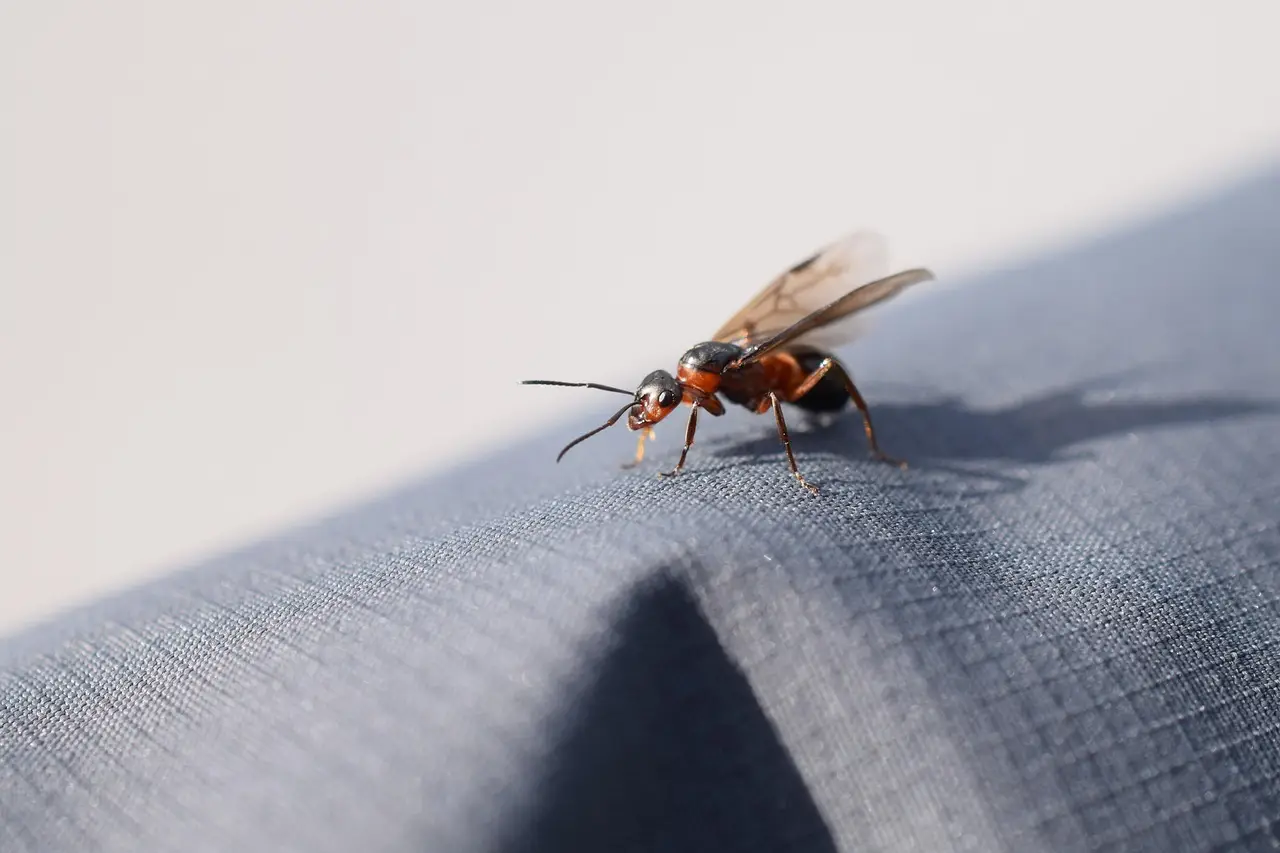
A single block of DNA containing roughly 6.5 million base pairs decides whether a moss ant queen emerges with wings or without them, researchers at Harvard University and the University of Georgia reported on November 23, 2026, in the journal Science Advances.
The block is a supergene — a large stretch of DNA carrying multiple genes that are inherited together as one unit. It sits on chromosome 1, and the team named it ergatoid, borrowing the scientific term for wingless queens. Just one copy of the variant is enough: a queen larva carrying it develops into a wingless adult.
For entomologists and evolutionary biologists, that is the headline finding. It means a whole new body plan — an entirely distinct caste — can appear without evolution building a new developmental pathway from scratch.
How the team found it
The researchers started in the field, collecting 173 colonies of moss ants from 18 locations across Canada and the United States. Back in the lab, they measured hundreds of individuals — workers, winged queens and wingless queens — recording body size, head size and eye size.
The measurements showed that wingless queens are not simply small queens. They mix worker-like and queen-like traits. Their middle body sections resemble those of workers in relative height, while their relative eye length matches that of winged queens. In plain terms: wingless queens are a mosaic, not a scaled-down version of either caste.
To find the genetic cause, the scientists compared the DNA of 25 winged queens against 28 wingless queens. They found 80 genetic variations that appeared in every wingless queen and in none of the winged ones — and all 80 clustered in the same region of a single chromosome. That region was the ergatoid supergene.
The team then ran a confirmation round on a separate sample: 83 winged queens and 61 wingless queens. The variant held up as dominant, meaning one inherited copy reliably produces the wingless form.
What the supergene actually does
The study settled one hypothesis and left another open.
It ruled out the idea that the supergene converts ordinary worker larvae into queens. Instead, it acts on larvae already destined to become queens, altering their development so wings never form.
Exactly how that happens remains unclear. The authors could not establish the precise mechanism. They did, however, detect changes in gene activity that point toward hormones — the chemical signals that regulate development and growth — as likely players.
That gap matters for anyone planning follow-up work: the supergene is identified, its dominance is confirmed, and its developmental target is known, but the molecular chain from gene to missing wing is still unmapped.
Why it matters beyond ants
The authors argue their results explain how new castes can evolve without an entirely new developmental program. As they write in the paper: "Our results show that a novel morphological caste can arise through modification of an existing caste developmental program without requiring the evolution of an entirely new larval population."
They also draw a parallel to cell biology. "As in the evolution of novel cell types, new castes can arise through modification of preexisting subunits rather than de novo innovation," the team notes.
For practitioners, the takeaway is straightforward: a 6.5-million-base supergene called ergatoid, on chromosome 1, dominates winglessness in moss ant queens — and it works by reprogramming an existing caste pathway, not by inventing a new one.
The paper is Samuel V. Arsenault et al., "A supergene converts queen-destined larvae into a novel caste in ants," Science Advances (2026), DOI: 10.1126/sciadv.aei5142.
via phys.org/rss-feed/ (Source)
More from Marcus Bennett
Show full bio
News editor covering regulation, policy and their impact on general science news at SciBeat.
597 articles
Nearby plates
- Dinosaur-Killing Asteroid May Have Triggered Ants' Rise, Study Finds
- Wasps Are Hijacking 10-Million-Year-Old Ant Homes in Borneo's Trees
- Chameleon Embryos Share a Developmental Trick Once Thought Unique to Mammals
- Honey Bee Colonies Are Superorganisms, New Study Argues
- Paper Wasps Recognize Faces With Brain Cells Like Ours