Plate Nº 65 · recorded November 16, 2026
Space & AstronomyReported finding
Physicist Solves Why Aging Stars Briefly Get Dimmer
A 2026 study offers the first quantitative explanation for the luminosity bump: an entropy threshold crossed deep inside aging red giant stars triggers the brief dip.
By Nathan Brooks4 min read733 words
In brief
- The study by Saskia Hekker appeared in The Astrophysical Journal Letters in 2026 (DOI: 10.3847/2041-8213/ae9ff0).
- It is the first quantitative description of what triggers the red giant branch luminosity bump.
- Models currently place the bump at higher luminosities than observations show, meaning it appears late in simulations.
- The trigger is a critical drop in specific entropy at the base of a star's convective zone.
- Arcturus, Aldebaran and Pollux are bright, naked-eye examples of RGB stars.
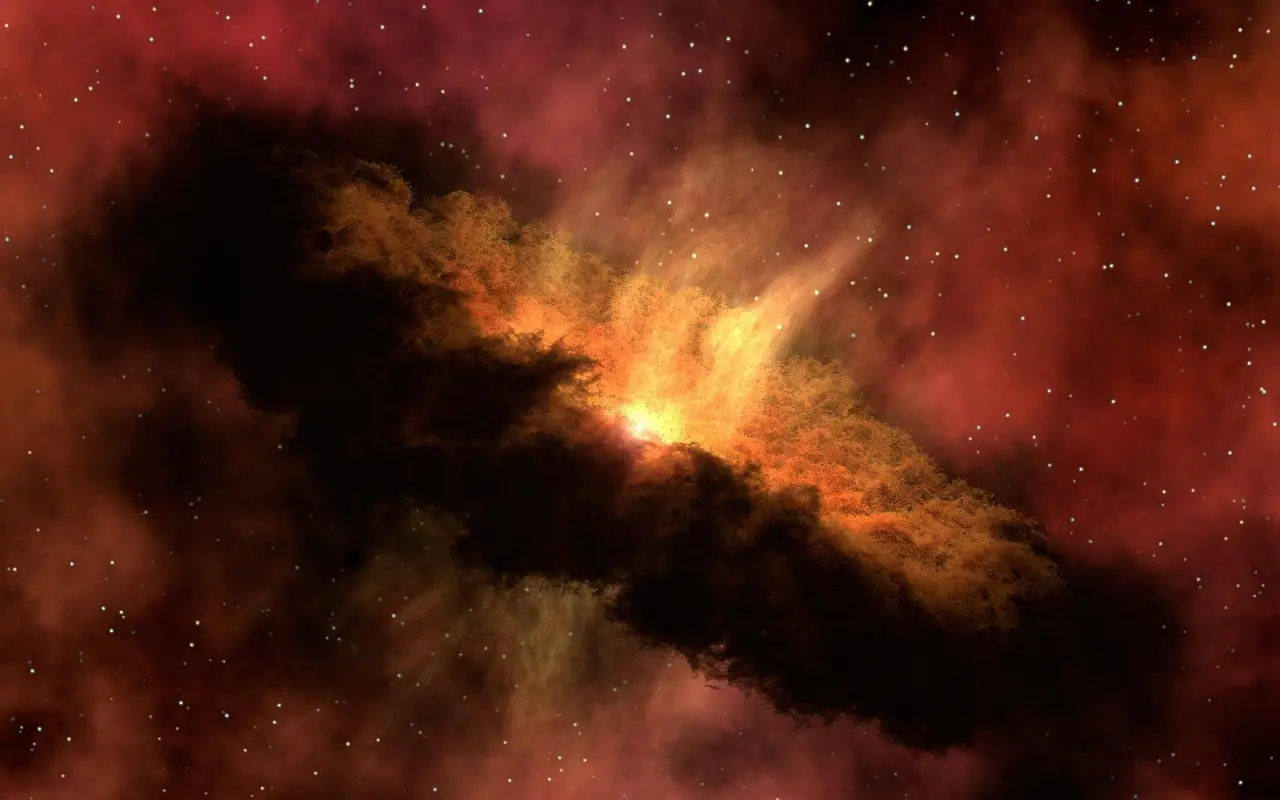
A single-author study published in The Astrophysical Journal Letters in 2026 proposes the first quantitative explanation for a decades-old puzzle: why aging stars briefly get dimmer before continuing to brighten. The answer, according to Saskia Hekker of the Heidelberg Institute for Theoretical Studies, comes down to a thermodynamic property called specific entropy crossing a critical threshold deep inside the star.
What is the luminosity bump?
Low-mass stars like our sun shine steadily for billions of years. When they exhaust the hydrogen in their cores, they swell into red giant branch (RGB) stars — bright, numerous, and easy to observe. Arcturus, Aldebaran and Pollux are all naked-eye RGB stars. As these stars age and cool, they grow larger and more luminous in a fairly steady progression.
But there's a glitch. RGB stars experience a brief, abrupt dip in brightness known as the luminosity bump, named for how it appears in the color–magnitude diagrams of stellar clusters. Astrophysicists have long understood how the bump ends, but what starts it has remained unexplained.
"The luminosity bump is a temporary decrease in luminosity against this otherwise increasing trend," Hekker explains. Low-mass stars that have burned through their core hydrogen climb the red giant branch in the direction of increasing brightness and falling surface temperature — until the bump interrupts that climb.
What's the problem with current models?
The bump is confirmed by observation and understood in theory, but the two don't quite agree. In models, the bump appears at higher luminosities than astronomers actually measure — in plain terms, the simulated version arrives late. "To understand why the bump appears later in the models than in observations, the physics of the bump needs to be unraveled," Hekker writes.
How does the new explanation work?
RGB stars are layered. Their cores, made of inert helium after hydrogen fusion ended there, exert no outward pressure and contract inward. Most of the remaining hydrogen sits in the outer layers, with fusion happening in a thin shell. Above that sits a churning, convective envelope — the region that mixes stellar material like a boiling pot.
As the core contracts and the surface expands, the deepest layer of the convective envelope moves inward. "This causes the deepest layer of the convective envelope to move inwards, reaching layers that have changed their chemical composition due to (burning) processes earlier in the evolution of the star," Hekker explains. That mixing event is called dredge-up, and it alters the envelope's composition.
The shifting boundary between the convective zone and the layers below it — the base of the convective zone, or BCZ — is organized around specific entropy, a measure of how disordered the gas is at that boundary. As the BCZ moves deeper, the entropy difference across the boundary shrinks. Once it drops past a critical value, the luminosity bump kicks in.
How is this different from older ideas?
Previous explanations were mechanical: the thin hydrogen-burning shell was thought to reach some boundary inside the star, triggering a change. Hekker's account is thermodynamic — the bump begins when an entropy threshold is crossed, not simply when layers meet.
"This succinct explanation of the onset of the bump is the first quantitative description proposed so far," Hekker said.
Why does it matter?
Nobody can see inside a star. Astrophysicists test their physics against the only part they can observe — the outside — and refine theory until it matches. This work will feed into that cycle and, Hekker argues, into stellar modeling more broadly.
"This viable description of the mechanism behind the onset of the bump provides crucial and new insights for the exploitation of the bump as an anchor point in stellar evolution theory," she writes. The new knowledge could guide changes to the physics in stellar models that go beyond simply calibrating the overshoot — the goal being to place the bump at the correct luminosity while keeping models consistent with measured surface abundances.
The findings are preliminary in the sense that all single-study theoretical results are: they'll need to hold up as modelers apply them. But for now, an entropy threshold looks like the best answer yet to a question that has sat unresolved in stellar physics.
The paper, "The Role of Specific Entropy in the Onset of the Luminosity Bump" by S. Hekker, appears in The Astrophysical Journal Letters (2026), DOI: 10.3847/2041-8213/ae9ff0.
via phys.org/rss-feed/ (Source)
More from Nathan Brooks
Show full bio
Market editor covering companies, deals and strategy in general science news at SciBeat.
388 articles