Plate Nº 91 · recorded November 11, 2026
Space & AstronomyReported finding
Ripples in Space-Time Could Expose a Hidden Population of Exoplanets
Two NASA-led studies show the future LISA space observatory could detect exoplanets around binary white dwarfs by reading ripples in space-time, a population never seen before.
By Priya Raman4 min read781 words
In brief
- LISA, launching in the mid-2030s, could reveal exoplanets around double white dwarfs via gravitational waves
- The Milky Way holds an estimated 10 million double white dwarf systems with orbital periods under an hour
- Webb could confirm planets by infrared excess out to at least 500 light-years; LISA may detect sub-Jupiter masses
- Gravitational waves were predicted by Einstein in 1916 and first detected in 2015
- Two papers appear in The Astrophysical Journal (2026) led by Casey McGrath of NASA Goddard
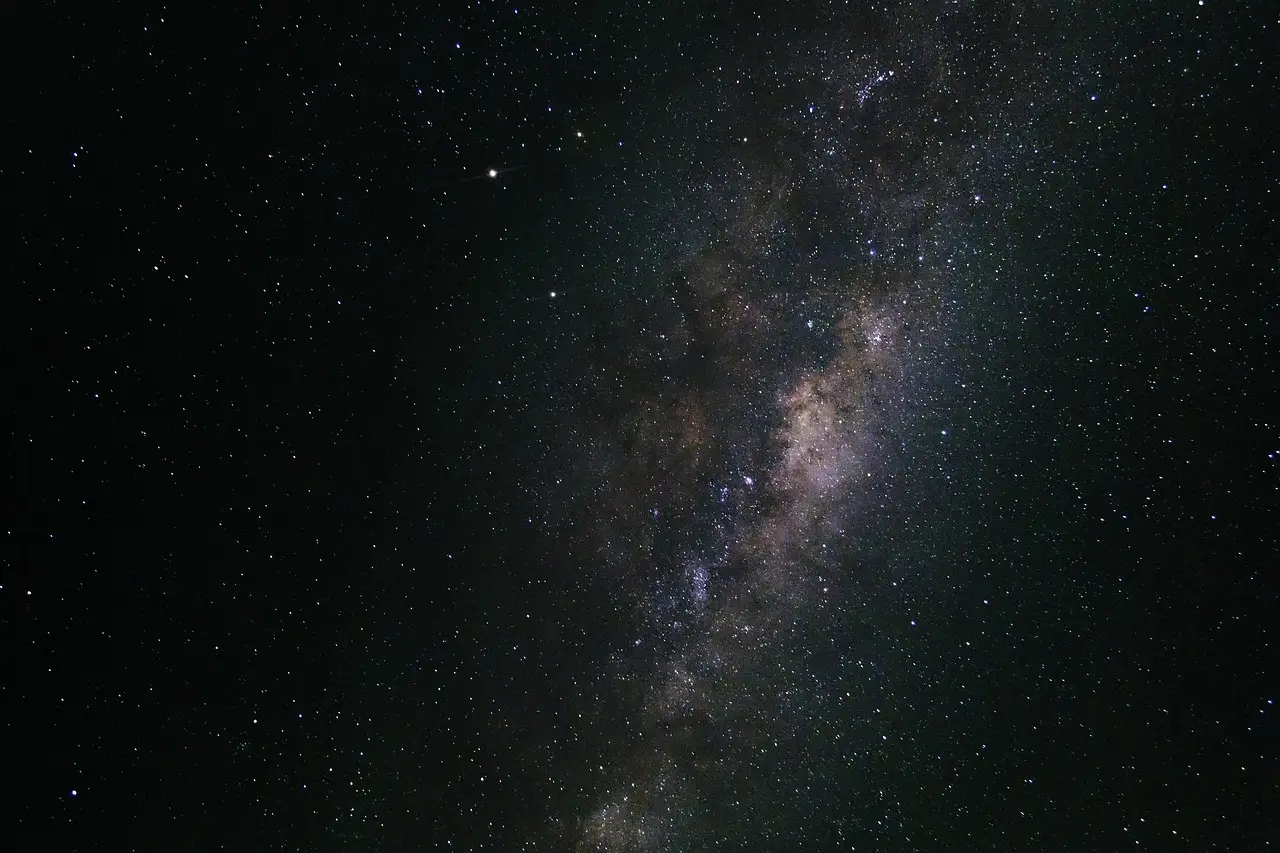
A space observatory slated for launch in the mid-2030s could reveal an entirely new population of planets beyond our solar system—not by gathering light, but by reading ripples in space-time itself. Two NASA-led studies published in The Astrophysical Journal show in new detail how the LISA mission (Laser Interferometer Space Antenna) can detect exoplanets, worlds orbiting stars other than the sun, throughout the Milky Way.
The most abundant signals for LISA will come not from planets directly, but from their hosts: double white dwarf systems, binary pairs of Earth-sized stellar remnants in tight orbits. Astronomers estimate the Milky Way contains 10 million such systems with orbital periods under an hour, and they expect LISA to resolve about 10,000 of them individually, along with roughly 100 mixed binaries pairing white dwarfs with neutron stars or black holes.
"The most common source for LISA is expected to be double white dwarf systems, which are binaries composed of white dwarfs in tight orbits," said Casey McGrath, a postdoctoral researcher at the University of Maryland, Baltimore County, and NASA's Goddard Space Flight Center in Greenbelt, Maryland. "If an exoplanet also orbits within one of these systems, its presence becomes imprinted on the gravitational wave signal in a way we'll be able to uncover."
How does a planet leave a fingerprint in space-time?
The method mirrors a long-standing technique called radial velocity, which uses starlight. As a planet orbits, its gravity tugs the host star into a small reflex wobble. That wobble shifts the star's spectral lines between redder and bluer wavelengths through the Doppler effect, the same phenomenon that changes the pitch of a passing siren.
"Something similar occurs with gravitational waves," said Scott Noble, a theoretical astrophysicist at NASA Goddard and co-author of the confirmation paper. "By themselves, double white dwarfs will emit gravitational waves at a nearly continuous frequency. Add a sufficiently massive planet to the system, and its presence causes the binary to experience reflex motion, adding a Doppler modulation to the gravitational signal."
For LISA, this modulation appears as sidebands: secondary signals at frequencies just above and below the main one. McGrath likens the process to modern radio, where a carrier frequency carries voices or music in sidebands at adjacent frequencies. In gravitational waves, the sidebands carry the message of a planet.
Why would these planets be a first?
Astronomers have found exoplanets around a few isolated white dwarfs, but never around a binary white dwarf pair. Any LISA detection would therefore open a distinct, previously unseen exoplanet population. The idea was first proposed by Japanese astronomer Naoki Seto in 2008; the two new papers, one solely by McGrath and one with co-authors, now map the planet masses and orbital periods where the technique works best.
How could the Webb telescope confirm the finds?
Detection alone is not enough. "Once LISA captures its first exoplanet detections, it will be critical for us to validate some of them," said Mary Anne Limbach, an assistant research scientist at the University of Michigan and a co-author of the confirmation paper. "These joint detections will allow us to establish that the gravitational signals correspond to genuine planets rather than false positives."
The team's confirmation method exploits NASA's James Webb Space Telescope and its infrared sensitivity. A planet in a double white dwarf system emits more infrared light than the stars alone, and Webb can detect this excess out to at least 500 light-years. In a test case at that distance, Webb could confirm a planet about five times Jupiter's mass, while LISA could detect a sub-Jupiter planet under ideal circumstances.
What hardware makes this possible?
The European Space Agency leads the LISA mission, with NASA contributing telescopes, the laser system, charge-management devices for the proof masses, and data analysis. Three spacecraft will trail Earth around the sun, forming a triangle 1.6 million miles (2.5 million kilometers) on each side. Infrared laser beams will link adjacent spacecraft, measuring relative distance changes smaller than the width of a helium atom—the passing signatures of gravitational waves.
Einstein predicted such waves in his 1916 general theory of relativity; ground-based observatories first detected them in 2015. They travel at the speed of light and pass undisturbed through whatever they meet, which makes them a uniquely clean probe of the cosmos.
The papers appear as McGrath (2026), DOI: 10.3847/1538-4357/aea216, and McGrath et al. (2026), DOI: 10.3847/1538-4357/aea07d. The findings remain projections until LISA flies—but the galaxy's dead-star pairs now look like a map waiting to be read.
via phys.org/rss-feed/ (Source)
More from Priya Raman
Show full bio
Senior reporter covering people, launches and day-to-day practice in general science news at SciBeat.
342 articles
Nearby plates
- LISA's Gravity Ripples Could Spot Planets Around Dead Stars
- A Mysterious Radio Signal Pointed at a Super-Earth. Was It Aliens?
- Stellar activity, not a giant planet, explains nearby wobble
- Star Caught Slowly Snacking on a Brown Dwarf 300 Light-Years Away
- Astronomers Find Youngest White Dwarf Paired With a Millisecond Pulsar