Plate Nº 27 · recorded November 10, 2026
Space & AstronomyReported finding
Astronomers Find Youngest White Dwarf Paired With a Millisecond Pulsar
A pulsar spinning 10,000 times a minute has the youngest white dwarf companion ever recorded — a proto-white dwarf still wrapped in leftover debris from mass transfer 600 million years ago.
By Elena Vasquez5 min read1,088 words
In brief
- NGC 362D spins once every 5.83 milliseconds — over 10,000 rotations per minute.
- Its companion, COM-NGC 362D, finished mass transfer roughly 0.6 billion years ago, making it the youngest white dwarf companion to a millisecond pulsar ever found.
- The system lies about 29,300 light-years away in globular cluster NGC 362 and was discovered in December 2022.
- The companion is a very low-mass (~0.18 solar mass) helium white dwarf still in its pre-cooling phase.
- The study combined radio data with 10 years of Hubble ultraviolet and near-infrared observations.
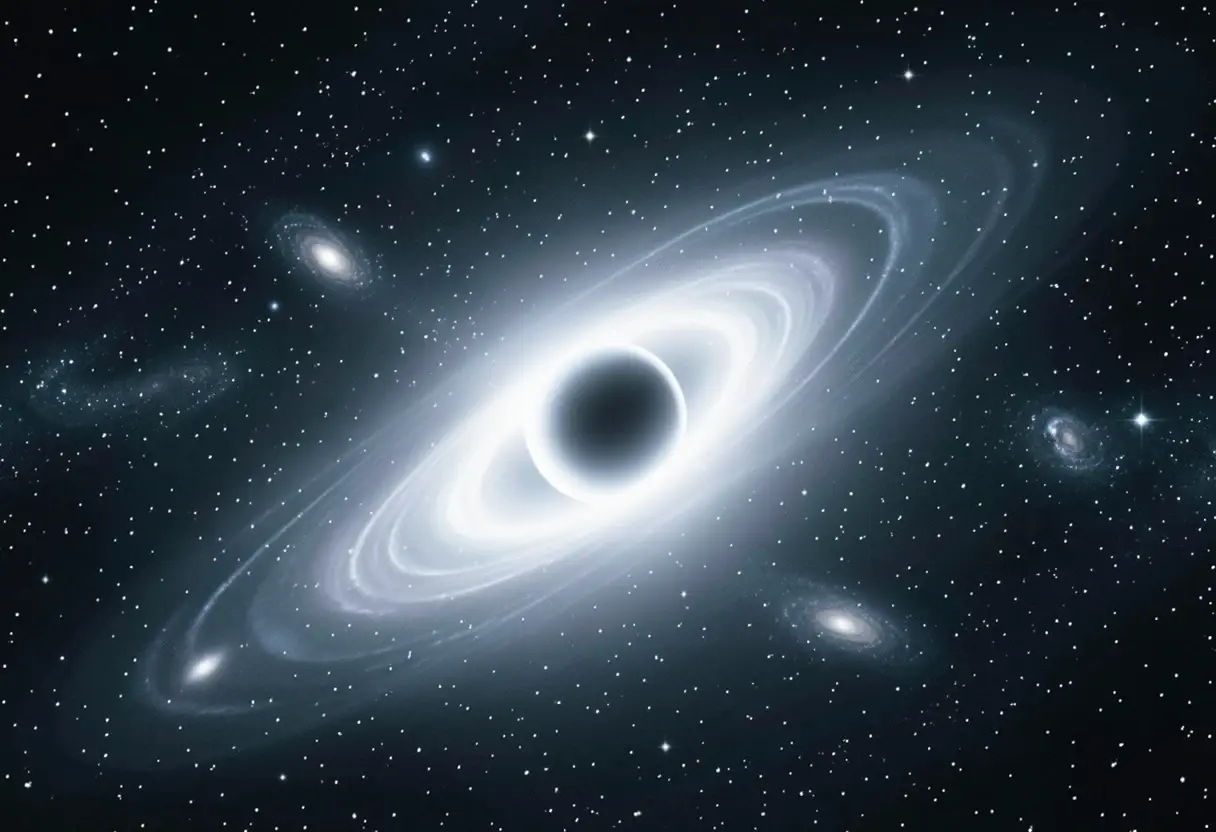
Astronomers have identified the youngest white dwarf companion ever found orbiting a millisecond pulsar, a rare catch that opens a window onto what happens right after one of the strangest processes in stellar evolution. The system, NGC 362D, sits about 29,300 light-years away in the globular cluster NGC 362. Researchers from Italy and Germany published the finding in Astronomy and Astrophysics.
The pulsar's companion, named COM-NGC 362D, is a proto-white dwarf — a dense stellar core that has only just begun its transition into a white dwarf. The team's models show it finished transferring mass to its partner roughly 0.6 billion years ago, making it the youngest such companion on record.
"Our analysis robustly shows that this object is a very low-mass (∼0.18 M⊙) He white dwarf still in the pre-cooling phase," the authors write. That mass is less than a fifth of our sun's, packed into an object still settling into its final compact form.
What is a millisecond pulsar?
Some background helps here. Most Milky Way stars are ordinary "main sequence" stars like the sun, shining by fusing hydrogen into helium. When stars exhaust that fuel, they evolve into strange end states. About 97% of the galaxy's stars will eventually become white dwarfs — objects roughly Earth-sized but with the sun's mass, glowing only with leftover heat.
Rarer and denser still are neutron stars, which form when massive stars explode as core-collapse supernovae. One of these can hold two solar masses within a diameter of just 12 km, or 7.5 miles. The old line: a teaspoon of neutron star would "weigh" a billion tons.
Neutron stars are small, dark and hard to spot. But some announce themselves as pulsars — rapidly rotating neutron stars that sweep beams of light from their poles like cosmic lighthouses. If a beam points our way, astronomers see it blink.
Millisecond pulsars (MSPs) spin even faster, completing a rotation in 10 milliseconds or less. They only form with help from a companion star. As the companion swells late in its life, matter spills over and spirals onto the neutron star, transferring angular momentum — in plain terms, rotational energy that spins it up. Astronomers call this the recycling process.
"Millisecond pulsars (MSPs) form in binary systems containing a slowly rotating neutron star that is eventually spun up to millisecond periods by heavy-mass and angular-momentum transfer from an evolving companion," the authors explain. The mass transfer typically begins when the donor star is a main sequence, subgiant or red giant star.
NGC 362D itself spins with a period of just 5.83 milliseconds. That's more than 10,000 rotations per minute. Radio astronomers first discovered it in December 2022, inside the globular cluster NGC 362. Globular clusters are prime hunting grounds for these systems, because stars there are packed tightly enough that neutron stars readily find companions.
How did the team pin down the companion's age?
The researchers cross-referenced radio data from the pulsar with ten years of Hubble Space Telescope observations in ultraviolet and near-infrared light. Comparing that data against stellar evolution models let them determine the companion's age, mass and other properties.
The models also turned up a surprise. The system showed less ultraviolet radiation than expected for a white dwarf of this type. Something was dimming the UV signal.
"Remarkably, the photometric properties of NGC 362D show, for the first time in this class of objects, significant wavelength-dependent variations that are consistent with the presence of residual circumstellar material," the authors write. That material, in their preferred scenario, was likely expelled during the mass-transfer phase — more evidence of just how young the white dwarf is.
Lead author Greta Ettorre, a Ph.D. student at the Alma Mater Studiorum University of Bologna, put it plainly: "What makes this system particularly interesting is the possibility of observing it at a very early stage of its evolution. Moreover, the attenuation of the signal that we observed in the ultraviolet could indicate the presence of material still surrounding the white dwarf."
What does this tell us about stellar recycling?
The finding matters because the pulsar's pull drastically reshapes its companion's fate. By stripping away the companion's outer layers, the recycling process forces it to become a white dwarf far sooner than it would on its own. Catching a pair right after that stripping ends — with a residual cloud of expelled material possibly still orbiting the exposed core — is exceptionally rare.
"NGC 362D currently offers us a unique opportunity to study what happens in the immediate aftermath of the millisecond pulsar recycling process," said co-author Emanuele Dalessandro of INAF, Italy's National Institute for Astrophysics. "The possible presence of material around the white dwarf is particularly interesting. It could produce signatures at radio wavelengths in addition to the optical, similar to those observed in systems with non-degenerate companions, and could therefore help us correctly interpret the properties of other young systems."
The researchers hedge where they should. They acknowledge it's unclear whether circumstellar material could survive this long, though it remains their favored explanation. They also raise an alternative: the material may have been expelled during a previous hydrogen-shell flash — a brief thermonuclear event in the star's outer layers — rather than during mass transfer.
"Our proposed scenario envisages that COM-NGC 362D is an extremely young WD that only recently ended the mass-transfer phase and is surrounded by a residual cloud of material producing self-extinction," the authors write.
If the young-core interpretation holds, finding this object could make it easier to identify other newborn white dwarfs around pulsars. That's a real payoff for pulsar science at large, because millisecond pulsars serve as natural clocks. Their pulses arrive with extraordinary regularity.
"Measuring the arrival times of their pulses with extreme precision allows us, among other things, to study gravity under extreme conditions and to carry out increasingly precise tests of general relativity," Ettorre said. "Understanding their surroundings and reconstructing their evolutionary history is therefore essential to fully exploit what these remarkable cosmic laboratories can tell us."
The paper is Greta Ettorre et al., "The youngest white dwarf companion to a millisecond pulsar: Insights from NGC 362D," Astronomy & Astrophysics (2026), DOI: 10.1051/0004-6361/202662038. The take-home: a freshly stripped stellar core, still wrapped in its own debris, gives astronomers their clearest look yet at how nature builds a millisecond pulsar.
via phys.org/rss-feed/ (Source)
More from Elena Vasquez
Show full bio
Correspondent covering money, funding and market shifts around general science news at SciBeat.
384 articles
Nearby plates
- Strong magnetic fields can push white dwarfs past the Chandrasekhar limit
- Star Caught Slowly Snacking on a Brown Dwarf 300 Light-Years Away
- Dead Star With Two Debris Rings May Preview Our Solar System's End
- MIT Team Finds a Star Slowly Eating Its Companion for Billions of Years
- Chandra Catches Hidden Black Hole Fueling 'Supernova Impostor'