Plate Nº 62 · recorded November 17, 2026
Earth & ClimateReported finding
Sand Grain Size Works as a Wind Speedometer, Stanford Finds
Stanford researchers show a dune's median grain size reveals the speed of the winds that built it, on Earth and Mars alike — a wind speedometer written in sand.
By James Calloway4 min read734 words
In brief
- Study published Nov. 16 in Proceedings of the National Academy of Sciences by Stanford researchers.
- Analysis drew on 30 years of wind data from 24 dune fields worldwide, plus one dune field on Mars.
- Dune-forming winds just modestly exceed the sand-moving threshold, so grain size reveals wind speed.
- Method applies to modern dunes and sandstones dating back 3 billion years, the authors say.
- The hypothesis builds on an untested 2010 idea from University of Pennsylvania researchers.
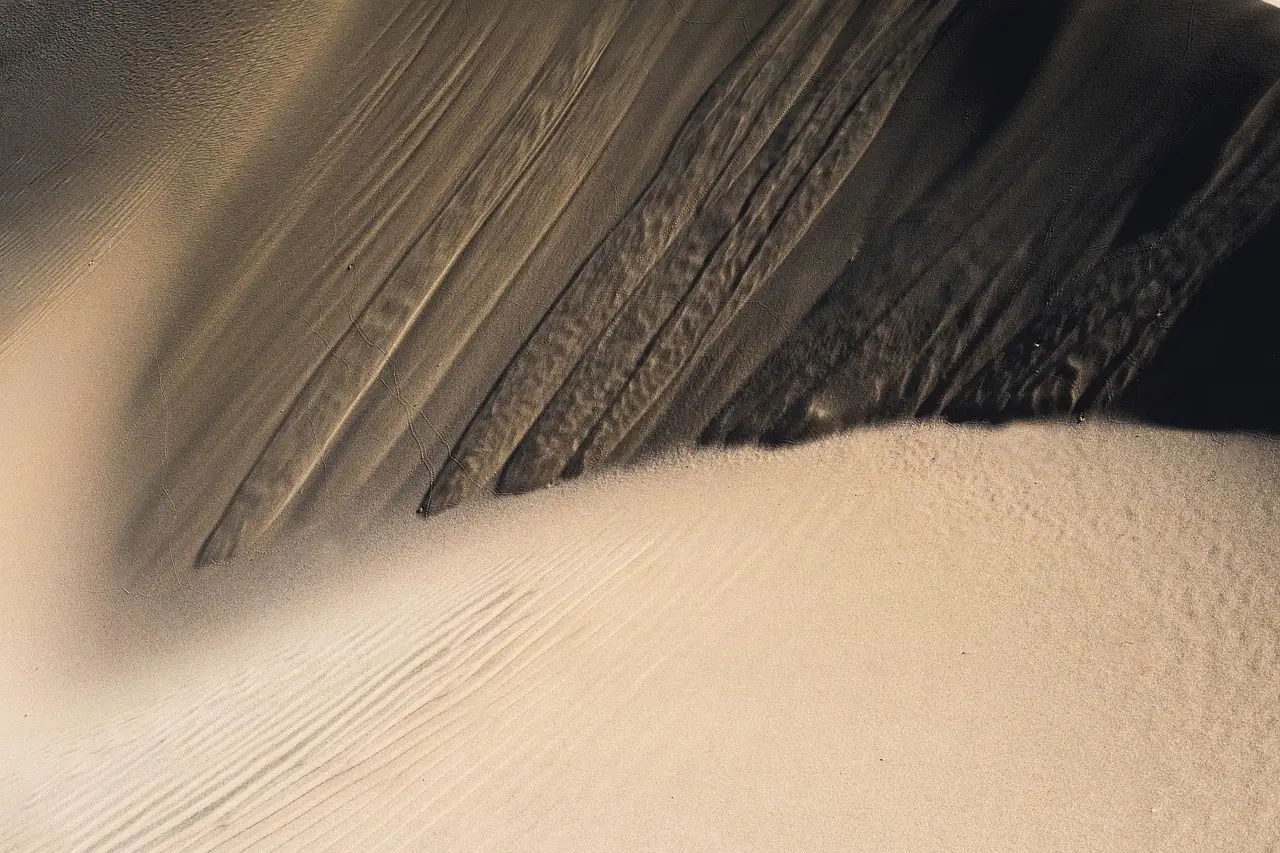
A single number hidden in a sand dune — its median grain size — can now tell scientists how fast the winds were that built it, on Earth or on Mars, according to Stanford University research published Nov. 16 in Proceedings of the National Academy of Sciences.
That is a bigger deal than it sounds. For decades, planetary scientists could read a dune's shape and say which way the wind blew, and how persistently. Speed was the missing variable. Now it isn't.
What did the researchers actually show?
The Stanford team demonstrated something almost anticlimactic in its simplicity: dunes on both Earth and Mars are built by winds that are just barely fast enough to move sand along the ground. Not gales. Not storms. Winds that modestly exceed the threshold where grains start hopping.
That threshold depends largely on grain size, so measure the grains, and you can work backward to the wind. The researchers call it using sand as a wind speedometer.
Lead author Colin Marvin, who worked on the study as a Ph.D. student, put it this way: dunes are a "great recorder of what happens on a planet's surface, and particularly the interactions between what's happening in the atmosphere of a planet and what's happening on the surface." His supervisor and senior author, Mathieu Lapôtre, is an associate professor of earth and planetary sciences at the Stanford Doerr School of Sustainability.
Where did the idea come from?
Here's the curious part. The underlying hypothesis isn't new. In 2010, University of Pennsylvania researchers proposed that windblown dunes form under winds just slightly above the sand-moving threshold. Then, apparently, everyone moved on.
"Since then, nobody's really looked at this idea," Marvin said, "even though it's really powerful because it tells you something about the environmental conditions that formed the dune fields that we see on not just Earth and Mars, but on a variety of other planetary bodies."
Fourteen years is a long gap for an idea this testable. The Stanford group finally closed it.
How did they test it?
The team pulled together 30 years of wind data and grain-size measurements from 24 dune fields around the world — different shapes, different sizes, different settings. For each field, they calculated which wind speed moved the most sand over time.
The result: those peak sand-moving winds tracked closely with grain size, and only modestly exceeded the transport threshold. The pattern held everywhere they looked, from Coral Pink Sand Dunes State Park in Utah to the dunes of Earth's oldest desert in Namibia.
Then came the harder test. The researchers ran the same analysis on data from a dune field on Mars. Consider what differs between the two planets: atmospheric pressure, gravity, sediment density. The correlation survived anyway.
That suggests windblown dunes form in essentially the same way on any body with plenty of loose sediment and winds that become rarer as they get stronger. It also implies dunes formed similarly in Earth's deep past, even as the atmosphere changed over billions of years.
What does this change for climate science?
Plenty, if the method holds up. Lapôtre said the finding will let scientists "better reconstruct winds and climates through time, on Earth and beyond." And it doesn't just apply to live dunes: "It works for modern dunes and for sandstones dating back 3 billion years."
Those reconstructions could help researchers test models of ancient atmospheric circulation on Earth and Mars. Marvin is already on it, according to Lapôtre: "Colin is actively working on that, actually. He's already pushing on to the next steps."
The caveats
Worth remembering what this study is not. It covers Earth and one dune field on Mars. Dunes and ripples have also been spotted on Venus, Saturn's moon Titan, and even a comet orbiting the sun — and the paper's own logic says the pattern should generalize only where loose sediment is ample and strong winds are rare. Conditions elsewhere may not cooperate.
The grain-size method also inherits the usual uncertainties of reading ancient rock: sandstones record median grain size imperfectly after billions of years of burial and cementation.
Still, a portable wind speedometer made of sand, validated on two planets, is a genuinely useful tool. The wind it measures may have stopped blowing eons ago. The record, it turns out, stayed put.
via phys.org/rss-feed/ (Source)
More from James Calloway
Show full bio
Staff writer covering regulation, policy and their impact on general science news at SciBeat.
474 articles