Plate Nº 67 · recorded September 30, 2026
Biology & EvolutionReported finding
Scientists Capture Hidden Molecular Machine Parasites Can't Live Without
Researchers have imaged, at near-atomic resolution, the unusual RNA-processing machinery that trypanosomatid parasites depend on — a step toward new drugs.
By Priya Raman5 min read970 words
In brief
- Researchers visualized two key stages of RNA processing in trypanosomatid parasites at near-atomic resolution.
- The parasites cause sleeping sickness, Chagas' disease, and leishmaniasis, and have relied on this unusual RNA-processing system for nearly 40 known years.
- The images show how the machinery's components assemble, potentially opening a path toward new parasite-specific drugs.
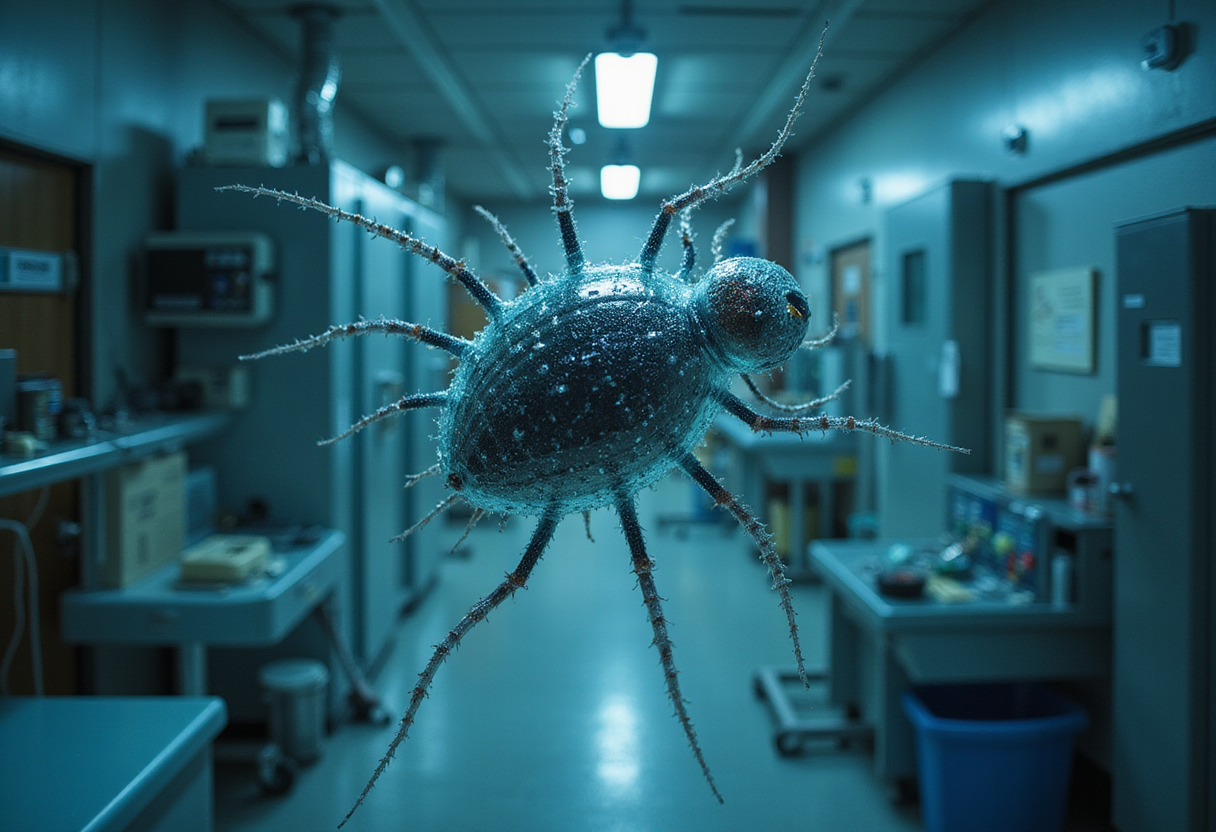
Parasites responsible for sleeping sickness, Chagas' disease, and leishmaniasis rely on an unusual molecular system to process their RNA — and for the first time, researchers have photographed that machinery at near-atomic resolution.
The new images show two key stages of the process, revealing how the machine's components come together inside the parasites. The findings, which concern a group of single-celled organisms called trypanosomatids, mark the clearest look yet at a biological system that scientists have known about for nearly 40 years but never seen in such detail.
Why these parasites matter
Trypanosomatids cause some of the world's most debilitating tropical diseases. Trypanosoma brucei causes African trypanosomiasis, better known as sleeping sickness, a fatal illness if left untreated. Trypanosoma cruzi triggers Chagas' disease, which damages the heart over years. Leishmania species cause leishmaniasis, a family of diseases ranging from disfiguring skin ulcers to life-threatening infections of the liver and spleen.
Together, these parasites infect millions of people across Latin America, Africa, and Asia, and they disproportionately affect populations with limited access to healthcare.
An odd way to read genes
To understand what the researchers saw, it helps to know what RNA processing means. When a cell reads a gene, it first produces a rough copy of that gene in the form of RNA, a molecular cousin of DNA. That rough copy must then be edited, trimmed, and spliced — cut into pieces and reassembled — before it can serve as a blueprint for making proteins, the workhorse molecules of life.
Human cells and most other organisms splice their RNA using a standard molecular machine called the spliceosome. Trypanosomatids, however, do things differently. For almost four decades, scientists have known that these parasites depend on an unusual variant of this system, one so distinct that it has long been considered a potential weak point — a feature the parasite needs but the human host does not.
Because of that difference, the parasite's version of RNA processing has attracted interest as a possible drug target. If a medicine could disable this machinery, it might kill the parasite while leaving human cells untouched. The catch has been that no one had seen the machinery clearly enough to understand how it works, let alone how to disrupt it.
Seeing the machine at work
That is what the new study changes. The research team visualized the parasite's RNA-processing machinery — often referred to as a trans-spliceosome — at near-atomic resolution. In plain terms, they produced images detailed enough to distinguish the individual molecular components and how they fit together, much like examining the gears and bearings of an engine rather than just its outer casing.
Crucially, the researchers did not capture a single frozen snapshot. They visualized two distinct stages of RNA processing, showing how the machine assembles and operates step by step as it works on RNA. Seeing the machinery in two functional states gives scientists a moving picture of the process, not just a portrait.
The images reveal how the machine's components assemble into a working whole — information that fills a gap left open since the unusual system was first discovered nearly 40 years ago.
What near-atomic resolution really means
"Near-atomic resolution" may sound like jargon, so here is what it means. Molecules like those inside the spliceosome are far too small for ordinary microscopes. To see them, researchers use a technique called cryo-electron microscopy, which fires electrons at samples frozen in a thin layer of ice and reconstructs three-dimensional structures from the resulting images.
At near-atomic resolution, scientists can trace the backbone of large molecular machines and identify where individual building blocks sit. That level of detail is what turns a black box into a diagram — and diagrams are what chemists need when they design molecules that bind to a specific spot and block a machine's function.
The promise, with caveats
The results are exciting for parasitology, but they are also early. Structural images are a starting point, not a cure. Knowing what the machine looks like does not automatically produce a drug; researchers still need to identify compounds that interfere with it, test those compounds in the laboratory, and then run clinical trials — a process that typically takes many years.
Still, the work gives scientists something they have never had: a precise map of a molecular system that trypanosomatids cannot survive without. Every future effort to design drugs against sleeping sickness, Chagas' disease, or leishmaniasis can now build on this structural foundation.
A 40-year question moves closer to an answer
Scientists first recognized that trypanosomatids process RNA in an unconventional way in the mid-1980s. Since then, the field has inferred much about the system indirectly — through biochemical experiments and genetic studies — but direct structural evidence of how the machinery assembles had remained out of reach.
By capturing two stages of the process at near-atomic detail, the new research closes a long-standing gap. It shows, for the first time at this resolution, how the components of the parasite's RNA-processing machine organize themselves to do their job.
For the millions of people at risk from trypanosomatid diseases, that knowledge is a step — a careful, preliminary, but meaningful step — toward treatments aimed at a target the parasites genuinely cannot replace.
Current treatments for these diseases are often old, toxic, or difficult to administer. A new target, understood at the level of individual atoms and molecular gears, offers a direction that previous generations of researchers could only speculate about.
The next phase of the work will likely focus on testing how the machine behaves when candidate molecules bind to it, and on confirming which parts of the assembly are most vulnerable to interference. Those questions remain open. But the camera, at last, is pointed at the right engine.
via google.com (Original)
More from Priya Raman
Show full bio
Senior reporter covering industry trends and analytics at SciBeat.
57 articles
Nearby plates
- Scientists Find a Way to Kill a Drug-Resistant Deadly Fungus
- Why a Food Poisoning Bacterium Can Also Cause Severe Wound Infections
- COVID-19 immunity may shield against other bat coronaviruses
- Scientists Map Three Weak Points in Antibiotic-Resistant Bacteria
- Florida's Dengue Outbreak Is the Largest in the Continental US in Decades