Plate Nº 94 · recorded September 30, 2026
Space & AstronomyReported finding
Simulations Trace First Stars to Chemical Clues in Today's Universe
The MEGATRON project uses detailed simulations to trace how the first stars lit the dark cosmos and spread the elements that still shape galaxies today.
By James Calloway3 min read572 words
In brief
- The MEGATRON project simulates how the first stars and galaxies formed in the early universe.
- The collaboration includes the University of Bath, the University of Chicago, and the Institut d'Astrophysique de Paris.
- The simulations link the first stars to chemical and structural fingerprints still observable in galaxies today.
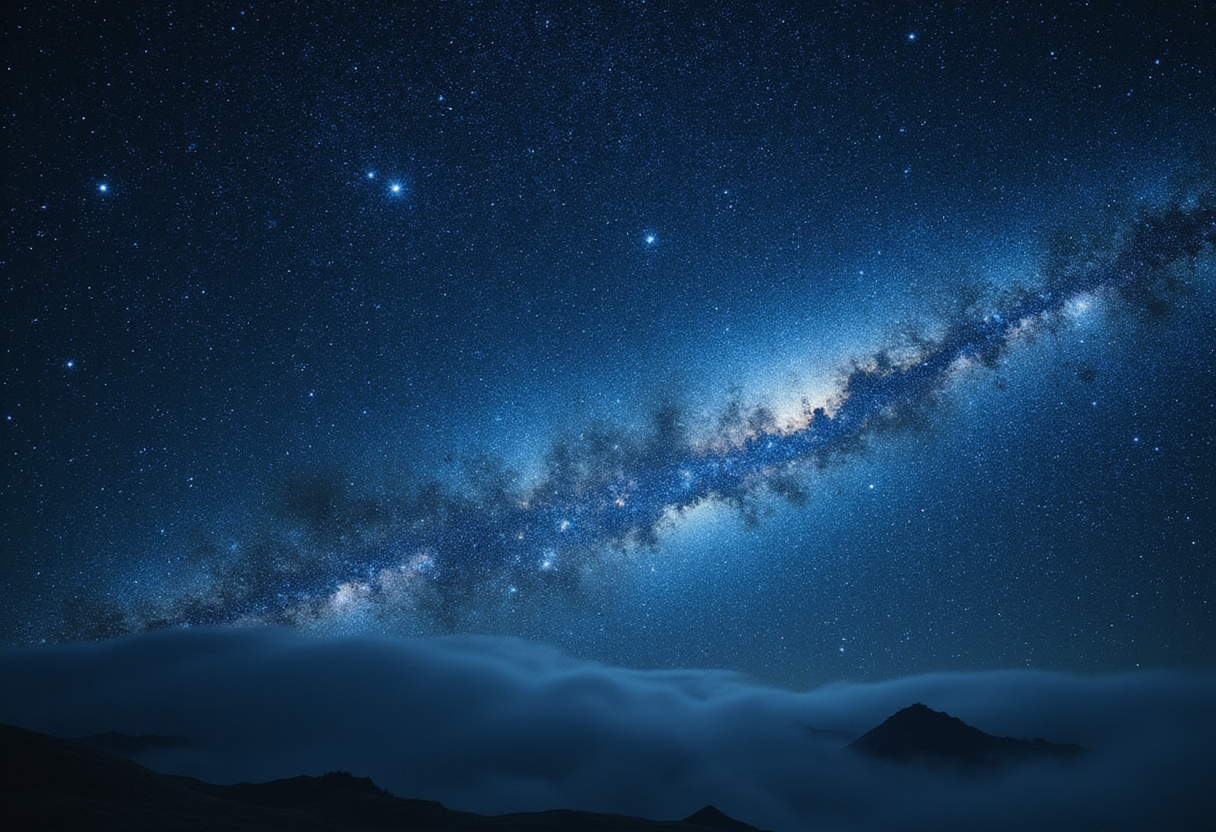
A team of astrophysicists has carried out some of the most detailed simulations yet of the early universe, aiming to explain how the first stars and galaxies formed — and how they left traces that astronomers can still detect today.
The project, known as MEGATRON, is led by researchers at the University of Bath in the United Kingdom, working with collaborators at the University of Chicago in the United States and the Institut d'Astrophysique de Paris in France. Their goal is to reconstruct a chapter of cosmic history that no telescope can observe directly: the moment when the universe first lit up.
A dark universe waiting for its first lights
For roughly the first few hundred million years after the Big Bang, the cosmos contained no stars and no galaxies. It was filled almost entirely with hydrogen and helium gas, and it stayed dark. The first stars changed that. They ignited, flooded their surroundings with light, and began producing heavier chemical elements through nuclear fusion — the same elements that would eventually form planets, and everything on them.
The problem for astronomers is that these first stars are long gone. Because they lived so far back in time, researchers cannot study them directly. Instead, they rely on supercomputer simulations: mathematical models of how gas, gravity, radiation, and chemistry interact over billions of years. By running such models, scientists can compare them against observations of the present-day universe and test whether their picture of the early cosmos holds up.
What the MEGATRON simulations do
MEGATRON takes this approach further than most previous efforts. The simulations track how the first stars formed from primordial gas, how they grouped into the first galaxies, and how the energy and chemical elements they produced spread through surrounding space — a process astronomers call "enrichment," in which heavier elements created inside stars are scattered outward and incorporated into later generations of stars and planets.
The findings, the researchers say, connect those earliest stellar generations to observable "fingerprints": chemical and structural signatures in galaxies that astronomers can measure today. In other words, the simulations offer a bridge between events no one can see directly and evidence that sits within reach of current telescopes.
Why the details matter
The jump in detail matters because early-universe physics is sensitive to small effects. How the first stars heated and ionized the gas around them, and how quickly their processed chemical elements mixed into their cosmic neighborhood, shapes everything that comes afterward — including the properties of the galaxies we now observe.
By modeling these processes at high resolution, the team can test competing scenarios against real data. If the simulations reproduce the chemical patterns seen in ancient stars and distant galaxies, that supports the underlying model. If they do not, researchers know something in their assumptions needs revising.
Caveats and next steps
As with all simulation-based work, the results depend on the assumptions built into the models — for example, how the first stars behaved and died, and how their material mixed with surrounding gas. The findings should be read as a framework for interpreting observations rather than a final description of the early universe. Still, by linking the first stars to signatures measurable today, the MEGATRON project gives astronomers a concrete way to probe an otherwise invisible era of cosmic history.
The project is a collaboration between the University of Bath, the University of Chicago, and the Institut d'Astrophysique de Paris.
via Phys.org Space & Astronomy (Source)
More from James Calloway
Nearby plates
- Simulations Reconstruct How the First Stars Forged the Universe
- Webb Telescope Witnesses Planet-Smashing Collisions Around Young Stars
- Faint Young Stars Suggest Messier 74 Is Nearly Twice as Large as Thought
- Astronomers Find the Lightest Double Neutron Star System Ever Measured
- Astronomers Find First Stellar Stream Beyond the Milky Way