Plate Nº 71 · recorded November 18, 2026
Space & AstronomyReported finding
SN 2026ahvu brings astronomers an early Type Ia opportunity
Discovered on Nov. 2 in NGC 1433, about 50 million light-years away, SN 2026ahvu brightened quickly and will receive close follow-up with DECam and Gemini South.
By Priya Raman4 min read807 words
In brief
- SN 2026ahvu was the 41,855th transient discovered in 2026.
- ATLAS discovered the supernova in NGC 1433 on Nov. 2.
- The host galaxy, NGC 1433, lies about 50 million light-years away.
- Its apparent magnitude fell from 17 to 13.5 within days.
- The Chandrasekhar limit in the standard Type Ia mechanism is about 1.44 solar masses.
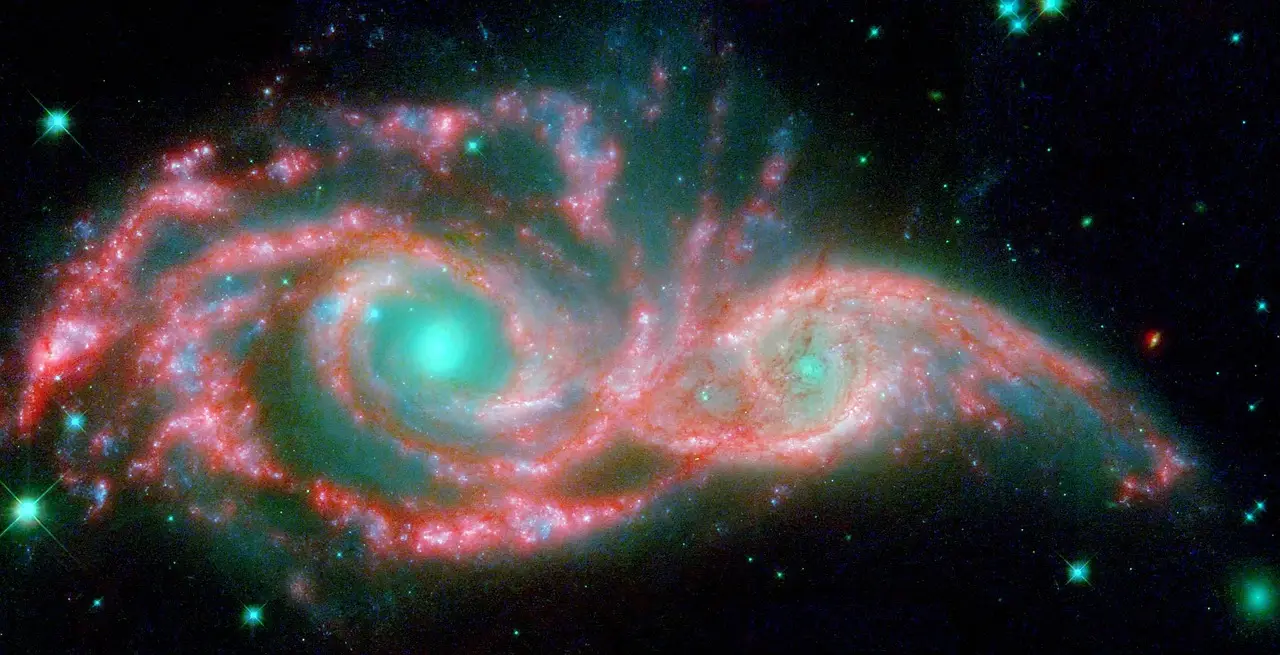
SN 2026ahvu, the 41,855th transient discovered in 2026, lies about 50 million light-years away in the spiral galaxy NGC 1433. Within days, its apparent magnitude fell from 17 to 13.5. Lower apparent magnitude means greater brightness, so the rapid rise gave astronomers an early view of the explosion.
Discovery came on Nov. 2 from ATLAS, the Asteroid Terrestrial-impact Last Alert System. The survey was designed and optimized to spot incoming near-Earth objects shortly before they reach Earth, but it also detects other transient sources. That dual role placed SN 2026ahvu before observers while it was still rising.
Why does this discovery merit close attention?
Although thousands of transients and supernovae have been found in 2026, two features set this one apart: relative proximity and early detection. The suffix “ahvu” serves as a chronological identifier. The early light curve, a record of brightness over time, offered astronomers a chance to observe the explosion from an earlier point in its evolution.
The International Astronomical Union sanctions the Transient Name Server (TNS), which records new transients and hosts AstroNotes, where short discovery reports appear. The ATLAS team wrote: “We report a new transient source, most likely a supernova in the galaxy NGC 1433.”
Its discovery note applies to sources within 100 megaparsecs, an astronomical distance unit, or to events with other notable features. Those include bright transients in galactic nuclei, slowly rising objects and rapidly fading ones.
The same entry described the observing network: “ATLAS operates with 4 x 0.5m telescopes in Hawaii (Haleakala and Mauna Loa), Chile (El Sauce) and South Africa (Sutherland), and a fifth unit in Tenerife, Canary Islands.”
The system surveys the whole sky robotically, with a one-day cadence between −50 and +50 declination and a two-day cadence in the polar regions, weather permitting. Declination is the sky coordinate that measures position north or south of the celestial equator. While pursuing near-Earth objects, ATLAS searches for stationary transients—sources that do not move between observations—and reports them publicly to the registry.
What kind of explosion produced the light?
SN 2026ahvu is not a core-collapse supernova, in which a massive star exhausts its fuel, collapses and explodes. It is a Type Ia supernova, generally produced in a binary star system. Here, a white dwarf called the accretor star draws material from a companion called the donor star.
Matter accumulates on the white dwarf’s surface until it breaches the Chandrasekhar limit, about 1.44 solar masses, where a solar mass denotes the mass of the Sun. The white dwarf then explodes, and the explosion obliterates it.
Type Ia explosions can also arise when two white dwarfs in a double white-dwarf binary merge and explode, so the observed event does not by itself identify the precise binary configuration.
How will astronomers study its changing light?
SN 2026ahvu’s detection triggered alerts, and follow-up telescopes began observing it. The Dark Energy Camera, or DECam, and the Gemini South telescope have produced new images. Type Ia supernovae typically remain bright for about six months, although the peak itself lasts only several days. Their light inevitably fades after the peak.
That peak is powered by radioactive decay of nickel-56 (⁵⁶Ni), an unstable form of nickel. After nickel-56 decays, cobalt-56 (⁵⁶Co) converts to iron-56 (⁵⁶Fe) and creates a weaker tail of light.
About two or three months after the initial explosion, the ejecta—meaning expelled stellar material—will have thinned and expanded enough to form a nebula, an expanding gas cloud. Spectra, the patterns of light that reveal chemical composition, can then show the composition of the whole exploded star rather than only its core.
This progression is fairly well understood, but additional observations can refine the picture of the explosion. The teams plan more images and detailed measurements of how the light changes over time. SN 2026ahvu also lies within reach of astrophotographers, who may deliver additional images as the supernova evolves.
How does it help measure cosmic distances?
Type Ia supernovae serve as standard candles. Astronomers use their characteristic intrinsic brightness, meaning their light output before distance dims it, to infer how far away they lie.
They anchor the cosmic distance ladder, the sequence of measurements that extends distance estimates to objects too distant for direct measurements such as parallax, the apparent shift produced by viewing an object from different positions. Each stage calibrates the next, so every additional well-observed Type Ia supernova can improve the ladder’s accuracy.
Beyond their role in distance work, supernova remnants rank among the most visually striking objects in astronomy. SN 2026ahvu is still brightening, leaving astronomers time to record the rise, peak and fade of a nearby Type Ia supernova and to refine its role as one of the cosmic distance ladder’s standard candles.
via phys.org/rss-feed/ (Source)
More from Priya Raman
Show full bio
Senior reporter covering people, launches and day-to-day practice in general science news at SciBeat.
476 articles
Nearby plates
- Supernova SN 2026ahvu Flares Up Just 50 Million Light-Years Away
- Supernova SN 2026ahvu Brightens Near NGC 1433: Why Astronomers Are Racing
- Asteroid 1995 BJ4 Grew a Tail — and It May Be the Largest Main-Belt Comet
- Gamma-ray burst's engine fired for 27 days, shattering the record
- Webb Pins Down the Farthest Fast Radio Burst Ever Seen — and Its Odd Home